When I travel, I enjoy exploring the history and folklore of the towns and villages I am privileged to visit. While St. Andrews is primarily know for its golf courses and its world class university, St. Andrews is also rich in legend and story. Here is a compilation of fact and trivia about this historic area in Scotland:
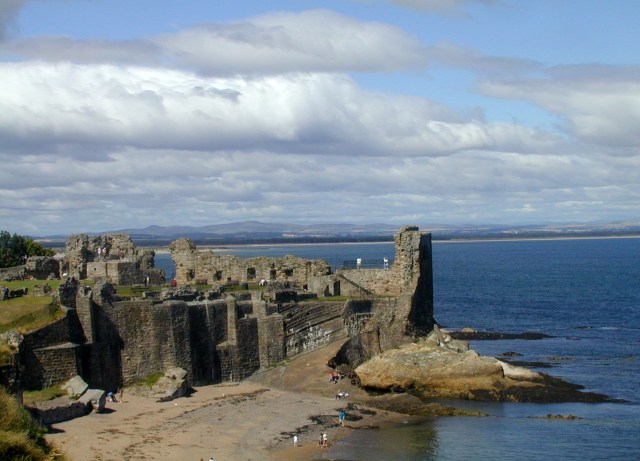
The town of St Andrews was originally the town of Kilrimont. In 736 AD, a monk named St Rule brought relics (bones) of St Andrew (Brother of St Peter, the first Pope) from Greece to a monestary in Kilrimont . By 1000 the town has become headquarters of the Scottish church and is called St Andrews.. It becomes a pilgrimage for most of Britain and becomes a wealthy city. The cathedral was founded in 1160. The cardinal of the UK lived in St Andrews.
Golf is first played there in about the fourteenth century. St Andrews University founded in 1413. James II bans golf in 1457 for a period of time because it interfered with practicing archery.
Martin Luther’s complaints against Rome were posted in 1517. Protestant martyrs were burned in St Andrews in1528, 1533, 1546, 1558. An obelisk above the Old Course is called the Martyrs Monument and it has their names inscribed. In 1560 parliament ends Catholicism as the church of Scotland. Mary Queen of Scots was the first woman known to play golf—1568.
James Wilson was a Scot who moved to South Carolina and was a signer of our Declaration of Independence. He was educated at St Andrews Univ. He and other Scots had shipped clubs and balls from St Andrews to Charleston, SC in 1743.
In the early days of golf a feathery ball took a day’s work to make one. They cost one-half Crown (a gold piece), so only the wealthy could afford to play golf. (Plus, golf professionals, who also caddied and made clubs and balls.)
The Scottish Flag is a sideways cross signifying the way that St Andrew was crucified in Greece—with arms and legs spread. The flag is called the Saltire.
The Royal and Ancient Golf Club was formed in 1754 by 22 gentlemen as the Society of St Andrews Golfers. In 1834 King William IV gave the club its R&A title and the club began to make the Rules of the game for the world. When the USGA was formed in 1894, they first followed the R&A and then soon began interpreting the Rules themselves. All of the world except the USA and Mexico follows the R&A’s rules decisions.
In the 1840’s, the town was nearly bankrupt. The land for the golf courses was used to raise rabbits for a number of years.
The first 12 British Opens (called The Open) were held at Prestwick starting in 1860.
Old Tom Morris was Prestwick’s keeper of the greens until he replaced Alan Robertson at St Andrews. The first Open at St Andrews was in 1873 and was the first year of the “claret jug” trophy.
The townspeople bleached their linen on the course in the early days. Early Rules mentioned linen that interfered with play.
The golf course originally was played as eleven holes out, and the same eleven holes were played back in—22 holes played for a round. In 1764, the course became 9 holes out and the same 9 holes in. In 1832, the course became 18 separate holes.
Holes 1, 9, 17 and 18 have greens that aren’t shared by any other hole. Old Tom changed the first hole by widening it and he moved the 18th green to opposite his golf shop, making it 60 yards longer. The new green was built over an old graveyard. All of the holes for the shared greens add up to 18 (2 and 16, 3 and 15, 4 and 14, etc.)
Par out is 444 454 434 (36)
Par in is 434 454 444 (36).
Eventually, because the R&A made the Rules of Golf, all golf courses adopted 18 holes as a round of golf.
Bobby Jones had to win the British Amateur championship on the Old Course as one of the legs of his famous Grand Slam of 1930. In his first match with the unfortunate Sid Roper, Bobby buried him early, starting 3, 4, 3, 2, 4 reaching 5 under par after 5 holes.
Old Tom Morris was born in St Andrews 16 June 1821. He died in St Andrews on 24 May 1908, just three weeks shy of his 87th birthday. He had won the British Open four times (1860’s). He designed many great golf courses in Scotland. He followed Allan Robertson as keeper of the greens and head professional at St Andrews. He had worked for Allan in the early days making clubs and balls. Tom built a thriving club and ball business in St Andrews when he returned from Prestwick in 1865. His shop still stands in the same place today.
A remarkable story is how Old Tom Morris died. He had been sitting at the window of his golf club (The New Club) having a pint of beer or two on a Sunday (No golf on the Old Course on Sundays, even to this day). He had to go to the bathroom which was a down staircase in the back of the club house. He got disoriented and fell into the coal bin—an eight foot fall. He died shortly afterwards.
His son, Young Tom had the record of 77 on the Old Course from 1869 to 1887 when his brother Jamie equaled it. Hugh Kirkaldy shot 74 in 1888. There have been 62’s in modern times.
An amazing fact is that golf on the Old Course was free for all comers until 1913. Locals played for free until 1946. Today, locals pay a fee of about $200 for the entire year. Guests pay about $218. per round. Guests account for 40% of play.
Bunkers originated in St Andrews. According to the stories, bunkers on the Old Course at St Andrews occurred naturally and Tom Morris decided to leave them there when designing some of the holes. If you are wondering how they came about, the answer is sheep!
In the early days, the course also doubled up as a place for grazing sheep. Unfortunately the sheep didn’t like the strong winds that the Old Course is famous for. In order to protect themselves, they joined forces and burrowed into the ground, creating holes to hide in until the wind died down. These holes ended up being many of the pot bunkers you see on television when watching golf at the Old Course. Sure they’re a pain to play out of but they certainly make the game a whole lot more interesting!
The world’s first female golfer played at St Andrews. Mary Queen of Scots was a member of the local golf club and many regard her as being the world’s first female golfer. She started playing golf at St Andrews soon after her husband Darnley was murdered.
Legendary golfer, Tiger Woods will only stay in room 269 at The Old Course Hotel when he stays in St Andrews. The reason being that 269 was the number of strokes it took him to win his first Open Championship in St Andrews back in 2000.
A lot of golf is played in St Andrews. More then 230,000 rounds of golf are played on the seven courses in St Andrews each year. 45,000 of these are played on the Old Course alone. The Old Course has also played host to the Open Championship more than any other venue, at twenty eight times.
 Cove Creek Reflections