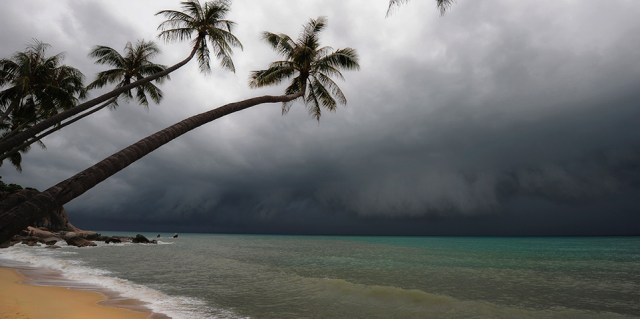
Today has been a sad and anxiety-riddled day on the Panhandle of Florida. One of the most powerful storms in history sprinted across the Gulf of Mexico and then blitzed ashore between Panama City Beach and Port Saint Joe, wreaking havoc from Navarre Beach to the Big Bend.
Photos and videos on tv and social media are all too familiar. Signs down, roofs blown away, beaches eroded, and homes under water.
Although I grew up in Alabama’s tornado alley, I escaped exposure to catastrophic storms until 1994. I was serving as pastor at the First Baptist Church of Williams near Jacksonville, Alabama when a tornado touched down on Palm Sunday near Ragland, Alabama and cut a trail to Rome, Georgia, demolishing hundreds of homes, destroying five church campuses, and taking 29 lives before leaving that area.
Later, in 2005, when I began serving at FBC Pensacola, we dealt with a series of destructive storms including Hurricanes Ivan, Cindy, Dennis, and Katrina. To date, during our 13 years in Pensacola, we have weathered 16 named storms that have affected the Panhandle.
As a category 4 storm, Hurricane Michael will likely be remembered as the strongest hurricane to hit the gulf coast, and one of the most powerful to hit United States in our lifetime.
Once a storm passes, residents are faced with a haunting reality. Life will never be the same. For many, friends have been injured, businesses have been damaged, homes have been destroyed, and irreplaceable family heirlooms lost. A sense of despair prevails. But for most, at least, life will continue. In fact, today’s storm bulldozed on shore with winds near 155 mph, and yet at this point, there no reported fatalities and only minimal injuries.
Following previous tornadoes and hurricanes, the communities I served learned a lot about patience and perseverance. We learned a lot about the grace and hope that emerges in the middle of chaos. We learned the importance of looking forward and not backward. We learned to focus on our dreams for the future rather than the nightmare of the storm. We learned a lot of valuable lessons at the congested intersection of life and faith, lessons that have helped us to heal and move forward, slowly and progressively.
In the days ahead, as we help others put life back together, let us employ the lessons learned from storms past as we help our neighbors rebuild after the storm:
1. Life goes on after the storm. Once the initial shock of the devastation has been absorbed, it’s time to channel all of your energy to re-building and moving forward. Despite the grief over things lost, there is a unique kind of joy that arises when you begin dreaming of the new things you can build…together. And interestingly, the challenge of re-building has a healing effect and can be a healthy way to process the grief of storm-associated losses.
2. When a storm hits, no one is exempt. Storms result from a chaotic weather pattern and they tend to strike indiscriminately. Regardless of what you hear from those with quirky religious superstitions, storms are not typically God’s way of punishing the “worst of sinners.” Storms affect everyone in their path, whether you are rich or poor, young or old, faithful or faithless. As Grady Nutt used to remind us, “It rains on the just and the unjust, and not always just on the ‘just’.”
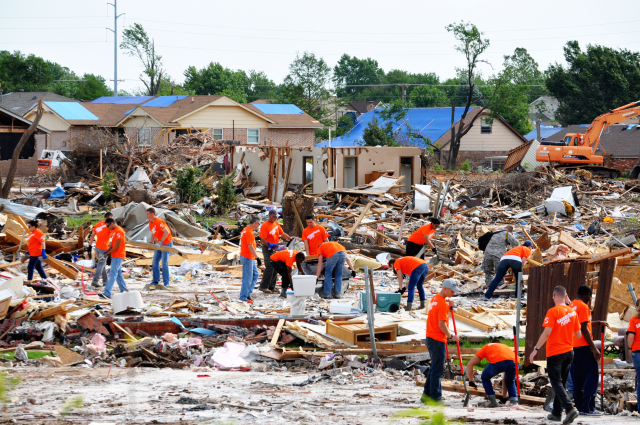
3. When the going gets tough, people of good will mobilize and work together cooperatively. After each of the aforementioned storms, a variety of church groups, missional agencies, and community organizations rolled up their sleeves, and went to work. To assist in the cleanup and the re-building process, many volunteers will be needed. After previous storms, I have been privileged to work alongside faith-based groups, work release inmates, utility cooperatives, Campers on Mission, student groups, biking clubs, medical groups, and other community volunteers.
4. All kinds of talents and skill levels are needed for clean-up and re-building. We were fortunate to have a huge corps of skilled personnel who managed chain saws, dozers, cranes, and front-end loaders. However, we also needed folks to cook food, drive trucks, pick up debris, run errands, care for children, visit the elderly, sweep the floor, manage communications, and do household cleaning. In disaster relief, every job is important and every volunteer has something to offer. Never underestimate the importance of doing all the good you can, where you can, when you can.
If you want to volunteer, always connect with an organization such as your church or denominational mission agency, Volunteers of America, the Salvation Army, the Red Cross, or BRACE. Don’t just strike out on your own. Each of these organizations will be engaged in relief work following Hurricane Michael.
5. Relief work fosters a unique sense of community. We learned that remarkable bonding occurs in the field. The sense of community born among those who work together following a storm forges a spiritual kinship that lasts for a lifetime… or longer.
6. Refuse to live in fear of the next storm. Those affected by storms may be inclined to experience storm phobia, a fear of storms. Many begin to live in such a heightened state of anxiety, that every cloud invokes a near panic attack. One alternative to living in fear is to be better prepared for the next storm. Perhaps that means creating a storm preparation checklist. Or possibly that means better implementation of a storm safety plan. Time and energy spent worrying about something as unpredictable as a future storm is wasted energy. It is best to find creative ways to transform that energy into constructive preparation.
7. A storm experience can deepen your spiritual faith. For some of us, simply having a “close call” invokes a profound sense of one’s mortality. Others may emerge from a storm with a “new lease on life” that translates into a commitment to live in a deeper and more meaningful sort of way. For still others, during the rebuilding process they discover a community of friends who inspire them toward a more authentic and honest understanding of faith, a faith they want and often claim for themselves.
Today many of us are praying for those in the path of a storm that has wreaked havoc in local neighborhoods. Many of these affected residents are feeling shock, anger, and a nearly overwhelming sense of despair.
The people of Florida, Alabama, and Georgia are resilient. And the residents of the Panhandle where I live deeply love the Emerald Coast. In the next few days, relief agencies and churches will mobilize labor pools and resource centers. And residents will be drying their tears, rolling up their sleeves, and getting ready to repair and rebuild, because there are some things deep inside that the strongest storm cannot destroy.
(Barry Howard is a retired minister who lives on the beautiful Emerald Coast of Florida.)

 Cove Creek Reflections