
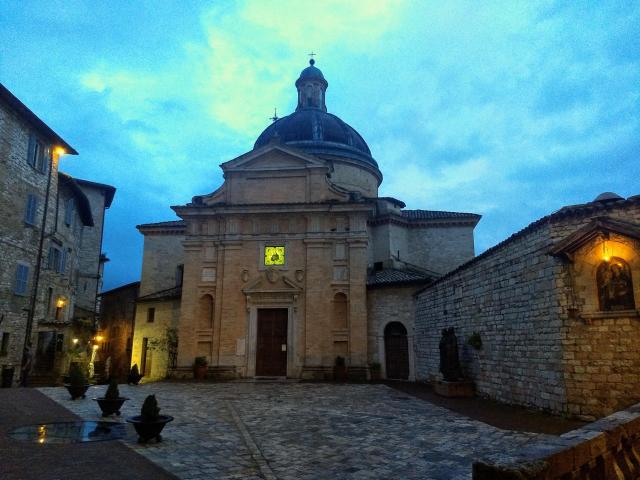
As our train from Venice approached the Santa Maria degli Angeli station we could see the old town of Assisi sitting on the slope of an Umbrian butte with prominent castles and cathedrals visible from miles away. We headed to our hotel immediately after disembarking, and along the way we saw a few friars walking so routinely that few seemed to notice their presence. There was definitely a spiritual aura here, affirmed by a sense of peace and serenity not present in the larger cities we visited.
Assisi is known world-wide as the home of St. Francis, who was canonized by Pope Gregory IX on July 16, 1228. When I was in college, I took a few semesters of voice lessons, even though I was not a music major. My instructor chose the music I was to learn and since he knew that I was serving as a minister at a local church, one semester he chose “Lord, Make Me an Instrument of Thy Peace,” the prayer of St. Francis of Assisi, as one of the pieces I was to memorize.
The prayer was likely written long after the death of St. Francis in his honor. Later, the prayer was set to music by Sebastian Temple and published in 1967. This selection was also one of the pieces our church choir sang on their 2010 Tour in Italy. I still remember the words and occasionally sing them when no one else is around:
Lord, make me an instrument of your peace;
where there is hatred, let me sow love;
where there is injury, pardon:
where there is doubt, faith ;
where there is despair, hope
where there is darkness, light
where there is sadness, joy
O divine Master,
grant that I may not so much seek to be consoled as to console;
to be understood, as to understand;
to be loved, as to love;
for it is in giving that we receive,
it is in pardoning that we are pardoned,
and it is in dying that we are born to Eternal Life.
Amen
This experience in college marked my introduction to the prayer and my first acquaintance with St. Francis. Since that time I have read accounts of the life and ministry of St. Francis and I have often quoted him in sermons and columns. Little did I know that I would have the privilege of visiting his hometown not just once, but twice.
Once again this year many of the faithful from around the world are making a summer pilgrimage to this historic place. For some Catholics, making the journey to Assisi is as important, if not more so, than traveling to Rome. Assisi is also a popular destination for seekers and mystics who are exploring and probing their doubts and presuppositions. In other words, some travel to Assisi to re-enforce their spiritual beliefs while others travel to Assisi to discover a higher purpose or a more spiritual meaning to existence.
Last night we visited the central piazza for dinner. Today we will visit the Cathedral of San Rufino where St. Frances was baptized, the Patriarchal Basilica in Santa Maria delgi Agneli where St. Francis died, and the Basilica of St. Francis where St. Francis was buried. Now I can better see how the life and message St. Francis still inspires spiritual pilgrims today.
Volumes have been written about the life of St. Francis, but three emphases from his ministry stand out as particularly relevant to the challenge facing the Christian church, especially Baptists, in the 21st century:
St. Francis emphasized simplicity of lifestyle. In 1206, the young Giovanni Francesco di Bernardone, who would later be known as St. Francis, had a vision of Jesus Christ that transformed his life. A couple of years later he heard a sermon on Matthew 10:9-10, in which Christ tells his followers they should go forth and proclaim the kingdom of heaven, and “do not take along any gold or silver or copper in your belts. Take no bag for the journey, or extra tunic, or sandals, or a staff, for the worker is worth his keep.”
Francis took this literally and it inspired him to devote himself to a life of poverty and to begin preaching a message of repentance and hope. The message of Francis captured the hearts of young men from all over Italy who in turn wandered about preaching the Gospel to rich and poor alike. His message of non-materialism emphasized a love for God, a love of nature, and equality of humankind.
Desiring to share the good news with everyone, St. Francis ventured outside the walls of the church and took his message to the streets, preaching in the common language of the people, not in the traditional Latin of the church, so that all could understand. While some protested this new practice of St. Francis and the methods he employed, eventually the pope gave his blessing in 1223, and the Franciscan Order was included in the larger Catholic community.
Clare who at age 18 was captivated by the message of St. Francis. On the evening of Palm Sunday in 1212, she departed her father’s mansion without his permission, and headed to the valley below. Once there, friars escorted her to St. Francis who cut her hair, gave her a simple brown tunic, and commissioned her to a life of poverty. She spent the next forty years in the convent of San Damiano and was gradually joined by other women who heard the call to serve God. They became known as the Order of the Poor Clares.
One legendary story is told of Clare attempting to visit St. Francis when he was on his death bed. Since women were usually not permitted, when told by a friar that Clare had arrived to visit, St. Francis is said to have responded, “Then welcome Brother Clare.”
Much about St. Francis’ approach to ministry seems extraordinarily relevant for our time. To counter the materialistic impulses of our day, perhaps we need to re-emphasize the value of service, the beauty in nature, and the worth of each human being. Instead of waiting on people to “come to church,” perhaps we should also take the message to the streets, preaching through lifestyles and language a message of hope that the common people can understand. And perhaps we must find ways to affirm both the men and women that God calls to serve, recognizing that the spiritual passion and giftedness God places within a man or a woman supersedes the rules or traditions of the church or the culture.
In some ways, following the path of St. Francis in our time could be considered as radical as it was almost 800 years ago. But it is a path worth following to revitalize the church and advance the Good News.
 Cove Creek Reflections