
Press On!


press-on1Remarkably, I have been sleeping pretty good during the pandemic. But most mornings when I wake up, I must clarify my focus, adjust my attitude, and dig deep to retrieve my motivation.

At 4:15 this past Monday morning, I awoke like an alarm clock had gone off in my head, and a song was playing involuntarily. The tune and the lyrics by Johnson Oatman, Jr. were both familiar and encouraging:

I’m pressing on the upward way,
New heights I’m gaining every day;
Still praying as I’m onward bound,
“Lord, plant my feet on higher ground.”

I wish that all mornings began with such a sense of peace. On some mornings during these days I have awakened with a sense of dread and anxiety, not because my faith is weak, but because I am human. Because there is a cloud of uncertainty hovering over our lives due the current pandemic, our cognitive and emotive systems are on high alert. And when we remain on high alert for prolonged periods it tends to deplete our energy and to elevate our anxiety.

So, most mornings, I must pray and sing and think my way into an attitude adjustment in order to counter these feelings of angst, or else my emotional rumblings turn into verbal grumblings. Like the song says, in all kinds of circumstances we must “press on” toward higher ground.

Life is often unfair, mostly unpredictable, and frequently uphill. The adventure requires courage, faith, and determination. During seasons of frustration, disappointment, and uncertainty, we must “press on” toward the upward call of God in Christ Jesus (Philippians 3:14):

  • When life throws you a curve ball and the unexpected happens, press on.
  • When cabin fever sets in and you long to return to the old normal, press on.
  • When you are tempted to give up or give in, press on.
  • When you have a bad case of the blues or you are suffering deep down depression, press on.
  • When you get angry at the incompetence of a colleague or supervisor who just doesn’t get it, press on.
  • When you are at the beginning of the treatment regimen, one that suppresses your appetite and oppresses your spirit, press on.
  • When you are at the foot of the mountain about to begin the uphill journey of recovery, press on.
  • When tension rises within your family because you are spending so much time together, press on.
  • When you are tempted to settle for mediocrity as you work from home, press on.
  • When death or disease takes away someone you love, in the power of the Spirit, press on.
  • When you are grateful for virtual church, but you can’t wait to get back to actual church, press on.

The old normal is gone. The current normal is temporary. A new normal is coming. Putting the past behind us and the future before us, let us press on!

In the wee hours Monday morning, the second verse of that great hymn became my prayer:

My heart has no desire to stay
Where doubts arise and fears dismay;
Though some may dwell where those abound,
My prayer, my aim, is higher ground.

May the Lord plant our feet, our faith, our attitude, and our motivation on higher ground!

(Barry Howard serves as the pastor at the Wieuca Road Baptist Church in Atlanta. He also serves as a leadership coach and columnist with the Center for Healthy Churches.)
These Are Puzzling Times

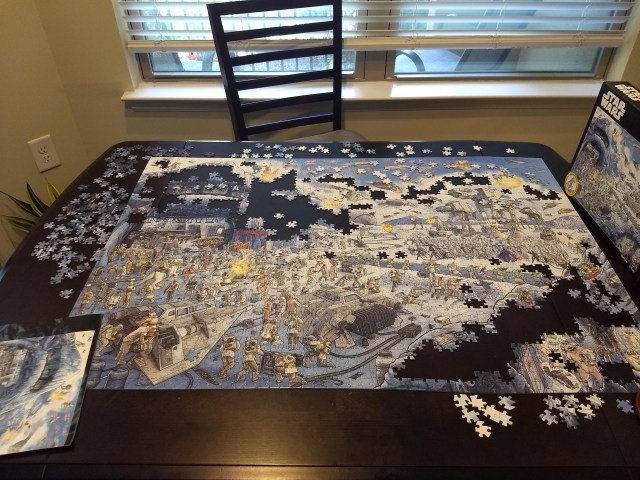
star wars puzzle 2

A lot of folks must be working on jigsaw puzzles during the pandemic because a few days ago, I bought the last puzzle on the shelf.

In addition to my pastoral work, during these days of being “safer at home,” Amanda and I have been spending a little more time reading, watching Andy Griffith reruns, and putting together jigsaw puzzles.

Last month we pieced together a 1000-piece puzzle of a Thomas Kinkade painting. A couple of days ago we passed the halfway mark toward completing our first 2000-piece puzzle which will eventually look like a collage of Star Wars characters.

I’m still not sure whether my affinity for puzzles parallels my work as a pastor, but I have discovered that bringing order to the chaos of this fragmentation is both relaxing and reflective.

Erno Rubik, who invented the Rubik’s Cube, suggests that, “The problems of puzzles are very near the problems of life.”

As we navigate the days ahead, including the emergence of a new normal, I have been thinking about the lessons we can learn from a jigsaw puzzle. Here are a few takeaways from my reflections:

  • Every little piece counts and contributes to the big picture.
  • Don’t expect to see the big picture with clarity right away. Watch for it to gradually emerge.
  • Attempting to force-fit pieces is futile. Some pieces that don’t look like they go together, do. Some pieces that look like they go together, don’t.
  • To maintain focus and avoid disillusionment, it helps to keep the picture on the box in front of you.
  • Start with the edges. It helps to know the boundaries, parameters, and perimeters.
  • Looking at the puzzle from different vantage points provides a clearer perspective on the big picture.
  • Working as a team is important. It helps to have one or more partners who can see things that you don’t readily see.
  • Take a break! Walk away! Give it a rest! And you will find more matching pieces with fresh eyes.
  • You will be tempted at some point to quit or give up. Don’t!
  • Putting together little puzzles within the big puzzle may help to complete the big picture more efficiently.

Life is a puzzle, and so is figuring out how life is going to change as we emerge from the pandemic. It is wise to navigate these days with prayer, patience, and perseverance.

In Isaiah 43:19 (ESV) the Lord declares, “Behold, I am doing a new thing; now it springs forth, do you not perceive it? I will make a way in the wilderness and rivers in the desert.”

During these puzzling times, if we truly believe that God will “make a way in the wilderness” and that God is preparing to do “a new thing” in our life, in the church, and in our world, we will be inspired to work together in this emerging reality even though we cannot yet see how all the pieces will fit together.

(Barry Howard serves as the pastor at the Wieuca Road Baptist Church in Atlanta. He also serves as a leadership coach and columnist with the Center for Healthy Churches.)

7 Things Churches Are Learning During the Pandemic

church interior 2Church looks and feels very different right now.
For the past six to seven weeks, as a proactive expression of love for our people and our communities, most of our churches have been gathering online for worship, Bible study, and committee meetings rather than assembling in person.

Pastors are learning to preach to cameras. Staff members and volunteers are learning new technology skills. Churches have been quickly setting up or upgrading their online giving platforms. Small groups and individuals have been responding to ministry needs with creative ministry actions.

Certainly, churches were not the only ones affected by the “shelter in place” orders. Restaurants scrambled to revise their delivery system to take out or curb side only. Banks limited access to their lobbies to “appointments only,” channeling most transactions to the drive thru window.

However, churches stereotypically are perceived as the most resistant to change.

As I have collaborated with other pastors and church leaders in recent weeks, it seems we are all learning a few things about ourselves that may be helpful in shaping the next chapter of ministry:

  • Online is the next best thing to being there. While online services are not likely to replace in-person gatherings, we are realizing that livestream worship is a good option for those who, for one reason or the other, cannot attend services on campus. We are also discovering that for some of our members, the increase in online options is a blessing. After the current health guidelines are lifted, online options should be perceived, not as a replacement, but as an enhancement to a church’s ministries.
  • Each of us has a priestly responsibility. The priesthood of the believer is multifaceted. Our priestly privilege includes having direct access to God, being accountable to God, and having an assignment from God. We have the privilege of “priesting” one another as we encourage each other, care for neighbors, build up the body of Christ, and share the teachings of Jesus through our words and our actions.
  • Every home is a satellite campus of the local church. Although we have known this for ages, we are becoming more adept at organizing our life at home as an outpost of faith formation, a house of worship, a chapel for prayer, and a launch point for ministry action.
  • A campus is a valuable resource of the church, but it’s not a church. A brick and mortar campus can be an important tool for a congregation, but it is just one of many tools in a congregation’s toolbox. A campus should always be perceived as a resource for the nurturing of our faith, not a source of our faith.
  • We need the human touch and social engagement of spiritual community. During these days of social and physical distancing, we have experienced withdrawal pangs from missing the handshake at the door, the passing of the peace, the hug from our favorite elder saint, and blending our voices in song while in the same room with others from our family of faith. While we are grateful for online connections, we will emerge from this crisis with a greater appreciation for the privilege of in-person meetings.
  • Our members are more resourceful and creative than we realized. Many members have jumped into action to sew masks for healthcare workers and first responders. Others have been proxy shoppers, delivering groceries and pharmaceuticals to those most at risk. A few members have written songs or poems to encourage or entertain others, and then posted, published, or performed their artistry on social media platforms.  In the future, we can enlist their skills to advance the ministry and the liturgy of the church.
  • We can function in a healthy way with fewer meetings. Some committees are continuing to meet by video or conference call. Some are sharing monthly or quarterly reports via email.  And others have postponed monthly meetings until after the “shelter in place” guidelines are lifted. All in all, committees are meeting as necessary, but less frequently than before the crisis. I expect that some monthly committee meetings may easily transition to quarterly meetings as we emerge from this pandemic.

Every major world event, including war, terrorist attack, health pandemic or ground-breaking discovery, has altered or revised the normative patterns and protocols of life on this planet. It is yet to be seen what the new norms will look like after COVID-19.

For many reasons, both spiritual and economic, it is doubtful that churches will have the option of returning to a pre-virus status quo. However, churches that build on the lessons learned during the pandemic, will be better prepared to serve their communities in the next chapter of ministry.

(Barry Howard serves as pastor of the Wieuca Road Baptist Church in Atlanta. He also serves as a leadership coach and columnist for the Center for Healthy Churches.)

Navigating Holy Week

Holy-Week

This year the entirety of Holy Week will look and feel a little different as we gather online for our worship services. However, if we navigate our journey through Holy Week with a compass of honest inquiry and prayerful reflection, this year’s trek may strengthen and equip us to live with faith and hope in all seasons.

This Sunday is Palm Sunday which marks the beginning of Holy Week, a week that is to be different from a normal week.  For Christians, Holy Week is a season for soul-searching and contemplating the depth of God’s love.  During this week, Christians, all around the globe will be reflecting on the events that led to the death, burial and resurrection of Christ.

Let’s review the important mileposts of Holy Week:

The traditional observance of Holy Week seems to have originated in the Christian East, emerging out of the practice of pilgrimages to Jerusalem.  Each day of Holy Week is important but at least four days call for specific reflection.

Palm Sunday is a day to revisit the royal welcome extended to Jesus by the curious crowd as he entered Jerusalem.

On Maundy Thursday believers recall the occasion when Jesus washed the feet of the disciples as he gave them a new mandate to love and serve.  Then, many Christians receive communion in commemoration of the Last Supper Jesus shared with his disciples.

Good Friday is a day to deeply reflect on the suffering of Christ on the cross and to contemplate the final words from the cross.

Finally, Resurrection Sunday, or Easter, is a festive day to affirm the ultimate victory of life over death as we proclaim that “Christ is risen; He is risen indeed.”

As we navigate our way through each episode of Holy Week, John 12-20 may serve as a helpful travel guide.

Along the way, take time to listen to the voices of the crowd.  Hear again the teachings of Jesus and think about his days in Jerusalem.  Contemplate the cruel injustice of the cross. Experience the passion of Christ’s suffering. Then listen to the sounds of silence as we await Easter morning.

At the end of this slow and deliberate journey through Holy Week, we will be better prepared to celebrate the resurrection and to renew our commitment to follow in the footsteps of Jesus as we navigate life.

Considering the challenges of our current state of emergency, I am praying that the message of Easter will infuse us with faith, hope, and courage.  N.T. Wright offers us a timely reminder that, “The resurrection gives you a sense of what God wants to do for the whole world.”

Let’s rise above the obstacles and inconveniences posed by the current health pandemic, and let’s navigate a meaningful and memorable journey through Holy Week.

(Barry Howard currently serves as pastor of the Wieuca Road Baptist Church in Atlanta and as a leadership coach with the Center for Healthy Churches.)