

Let’s Be Frank!

On his 100th birthday he played a tennis match. When he turned 101, after suffering a light stroke, he switched from tennis to pickle ball. And he is the first person over 100 years old to invite me and my wife to join he and his girlfriend for a double date. Today Frank Stovall turns 102.

Over the years I’ve been privileged to serve as the pastor to more than two dozen men and women who have lived 100 years or more. The oldest lived to be 108. Each one of them were remarkable in their own way. Frank is by far the most active, perhaps because he has good health, great eyesight, a sharp mind, and a positive attitude.

Frank was born on February 25, 1921. Earlier this week when I asked Frank if he was having a big celebration, he said, “I don’t have a birthday. My family has turned it into a birthday season, with multiple events over several days.”

Since Frank is Wieuca’s most senior member and one of Wieuca’s two remaining charter members, I interviewed Frank about some of the most significant memories and highlights from his life. Here are a few of the questions I posed:

  • What are some of the biggest changes you’ve seen in your 102 years? Oh my! I really haven’t thought about that. There have been so many gradual changes. The city limits of Atlanta and other major cities have expanded. People have not changed all that dramatically…There are still some good people and some bad people. However, when I was younger there was so much trust. As time has gone on, we don’t have the trust in other people we once had. Of course, I’ve experienced the Great Depression and a couple of major wars. There have been overwhelming changes in technology, especially with computers and smartphones. Now you can ask your phone a question and it answers immediately. We used to look up those questions in the encyclopedia, which took a lot of time.

  • When did you start playing tennis and what was one major highlight of your tennis career? My brother played tennis, so of course I wanted to play. I started playing around the age of 10. I became pretty competitive, but there was one fellow who beat me regularly. I would be ahead in the match, and he would come from behind and win. One of my biggest moments was when I finally beat him. After that, he never beat me again.

  • When did you make your commitment to become a Christian? I think I was 8 years old when I made my commitment to Christ at the West End Baptist Church. M.A. Cooper was our pastor, and during the invitation hymn I walked the aisle and made my public profession of faith. I was baptized a short time later. Then I joined Wieuca as a charter member on July 7, 1954.

  • What are one or two fond memories from the early years of Wieuca? I remember our first meetings in the schoolhouse at R. L. Hope. Those were exciting days. Later, my wife and I started the young adult department and led that department for 25 years. It started as a young married department but expanded to include all young adults, married and single. Eddie and Dryna Rains and many other wonderful people were in our department back then.
  • Who are some of the influential people you remember in your life and in the church? In high school, a retired military gentlemen named Mr. Sutherland, was an excellent English teacher. He influenced many of us by his example and his teaching. In the intermediate department at Wieuca, Dr. Bill Galloway, was an outstanding Sunday School teacher, and respected leader. He was also a good tennis player and a great badminton player. I usually won when we played tennis and he usually won when we played badminton. He was highly regarded.
  • What is your hope for Wieuca in the future? I am very impressed with Wieuca and the faithfulness of those who have stayed. Our community has changed significantly since those early days. I hope Wieuca will always stand by the principles of Baptist theology. I hope Wieuca will continue to do the things that made Wieuca great. Hospitality, generosity, and creativity have been a few of Wieuca’s greatest strengths. I hope Wieuca will flourish in missions and ministry in the next chapter as it has in the past, which I suspect will look much different. But it will be good!

Until now, Frank has continued to drive himself to church on Sundays where he attends more than 90% of the time. However, he told me last Sunday that he plans to give up driving, not because he is no longer a good driver, but because his insurance company considers it too much of a liability for a 102 year old to drive. Then Frank added, “I guess I will start Ubering to church.”

Frank Stovall’s exemplary faithfulness is encouraging and, I hope, contagious.

James Garfield wrote, “If wrinkles must be written on our brows, let them not be written upon the heart. The spirit should never grow old.” Let’s all be Frank now, and not wait until we are 102.

(Barry Howard serves as the pastor at the Church at Wieuca in North Atlanta. He also serves as a leadership coach and columnist with the Center for Healthy Churches. He and his wife, Amanda, reside in Brookhaven, Georgia.)

Lent: A Season for Spiritual Renewal

If you have a longing for spiritual renewal, the observance of Lent presents a great opportunity to re-examine your life and recalibrate your soul.

Wednesday, February 22, is the first day of Lent. What is Lent? In the Christian tradition, Lent is a period of penitential preparation for Easter, which begins on Ash Wednesday in Western churches. Lent is observed for 40 days, like the fast of Jesus in the wilderness, and it traditionally focused on “fasting, prayer, and almsgiving.”

Respected British scholar, N. T. Wright, proposes that “Lent is a time for discipline, for confession, for honesty, not because God is mean or fault-finding or finger-pointing but because he wants us to know the joy of being cleaned out, ready for all the good things he now has in store.”

Lent is a time for repentance and a season for spiritual renewal. Perhaps over the past year you have neglected some of the important spiritual practices such as prayer, devotional reading, confession, thanksgiving, and worship participation. Maybe you have made poor ethical or moral decisions. Or possibly you have grown inactive or dormant in our spiritual walk.

Lent is a great time to reconnect, recommit, and reengage. To maximize the opportunity to deepen your spiritual walk, consider refreshing your devotional life (including prayer and Bible reading). In addition to the hard print devotional books, there are many online devotional options available for your Lenten reading. Here are a few examples:

Lent is also a time to prioritize our participation in worship. Worship is not only a time to gather with others to offer prayer, praise, and thanksgiving. Worship is a time encourage others along their journey and to allow others to encourage you. Consistent involvement in worship leads to a reshaping of our perspective and a realignment of our priorities.

Walter Brueggemann contends that Lent leads us exit an anxious way of life and to embrace a more simple way of life: “I imagine Lent for you and for me as a great departure from the greedy, anxious anti-neighborliness of our economy, a great departure from our exclusionary politics that fears the other, a great departure from self-indulgent consumerism that devours creation. And then an arrival in a new neighborhood, because it is a gift to be simple, it is a gift to be free; it is a gift to come down where we ought to be.”

So, where do we begin? Perhaps we begin by praying the words of Psalm 139:23-24: Search me, God, and know my heart; test me and know my anxious thoughts. See if there is any offensive way in me, and lead me in the way everlasting.”

(Barry Howard serves as the pastor at the Church at Wieuca in Atlanta, Georgia. He also serves as a leadership coach and columnist for the Center for Healthy Churches. He and his wife Amanda currently reside in Brookhaven, Georgia.)

Love, Faith, and Simplicity: Remembering Our 2012 Visit with President and Mrs. Carter

What is it like to visit the home and the church of a former president?

In the spring of 2012, my wife and I were blessed to spend a week in Plains, Georgia where I had been invited to lead in revival services at the Maranatha Baptist Church. Their most famous members, Jimmy and Rosalynn Carter, were present in every service.

I first met Governor Jimmy Carter in 1975 when I was a sophomore in high school and he was the featured speaker for the Alabama State FFA Convention in Montgomery. Interestingly the delegates at those conventions were seated in alphabetical order according to the school they represented, and since I served as a delegate from Alexandria High School, I had a front row seat.

Then in 2004, Amanda and I made the pilgrimage to Maranatha to attend President Carter’s Sunday School class and stand in line with the other worshippers to have a photo taken with the 39th president. On that particular Sunday, Mrs. Carter was traveling internationally with an initiative related to the Carter Center.

Never would I have guessed in 1975 that I would become a pastor and someday preach in President Carter’s home church. After the first service in 2012, the worshippers formed a line to greet the guest preacher and his wife and welcome them to Maranatha. The Carters stood in line like every other member, and when they greeted us, Mrs. Carter welcomed us and commended the sermon, while President Carter shook my hand and kissed my wife on the cheek. She was so in awe of President Carter she quipped, “I may never wash my face again.”

The tradition at Maranatha is for the guest preacher to have lunch with the Carter’s during the revival week. We met the Carter’s at Dylan’s Diner on Wednesday, and then accompanied them to their home for dessert and conversation.

Before departing the restaurant, President Carter took me to every table in the restaurant, asked the patrons where they were from, introduced me as the guest evangelist for their revival, and invited every person in the diner to attend the final service that night. Then he added to his invitation, “If you come, you can sit with me and Rosalynn.” That night the attendance peaked, and the Carters were surrounded by the guests he invited from the restaurant.

The Carter’s home is modest and welcoming. President Carter built most of the furniture. We talked about his upbringing in Plains, his career in the Navy, his visits with world leaders, his work with Habitat for Humanity, his love for the Gulf Coast, and the well-being of several of our mutual friends. It was remarkable to hear stories of his recent conversations with Fidel Castro, and I was particularly interested in his recollections of Israeli Prime Minister Menachem Begin and Egyptian President Anwar Sadat.

Mrs. Carter, who insisted that we call her Rosalynn, had prepared sugar-free banana pudding for our dessert. She served it in a Corningware dish much like my grandmother’s. When I went to the kitchen to assist her with the coffee, I noted that she used a white older model Mr. Coffee coffeemaker, just like the one we use at home. Our visit was rich in simplicity and authenticity.

After we finished dessert, President Carter gave us a tour of his study, where he gave us an overview of some of his newest commentaries, followed by a tour of his workshop, where he showed us a few of his paintings and samples of his woodworks.

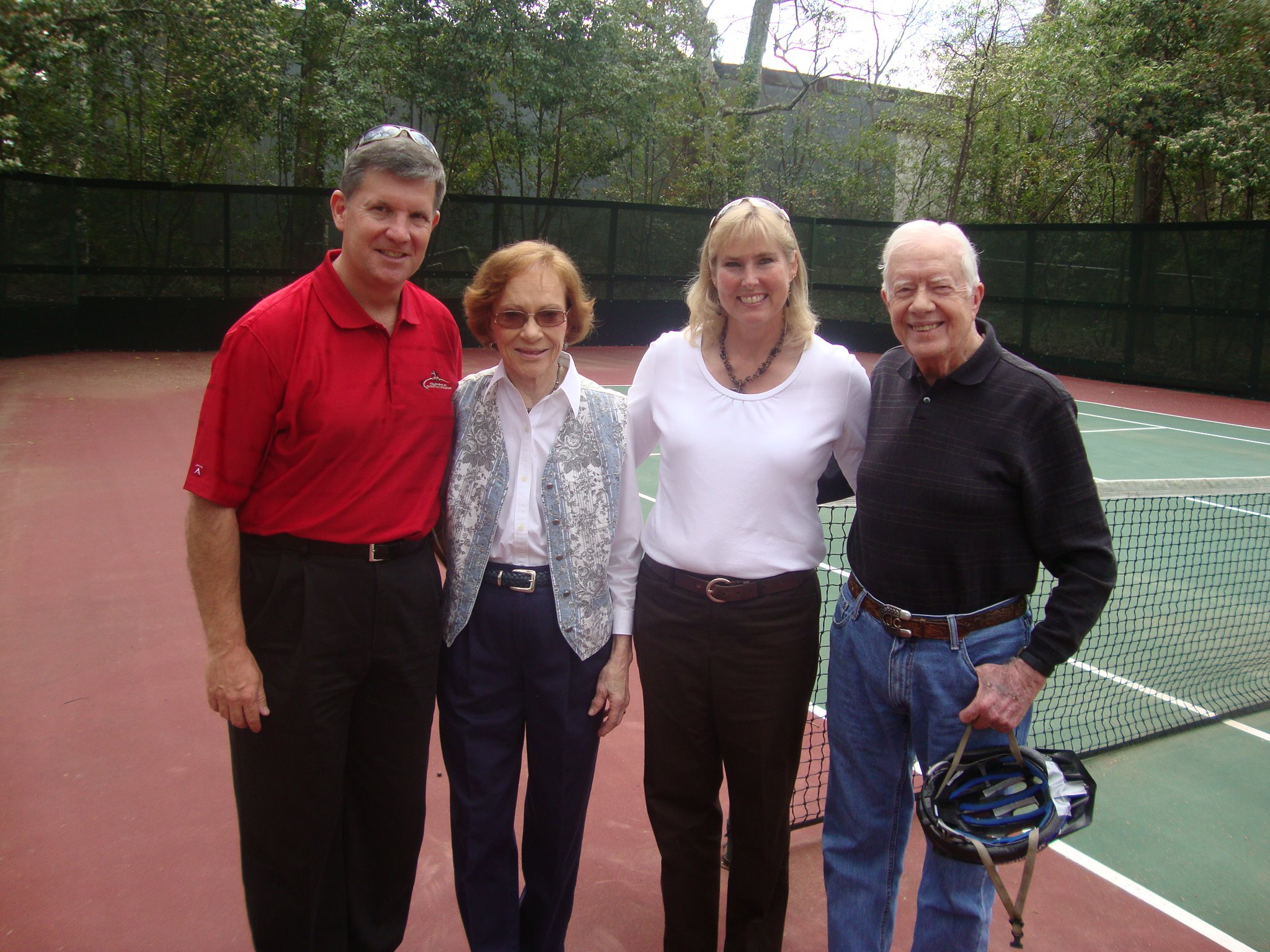
Then he said to Amanda, an avid tennis player, “Would you like to see our tennis court?” After he shared a few tennis stories, he said, “We normally take a photo of the guest minister on the front porch, but since Amanda loves tennis, we can take a photo of the four of us here on the tennis court.” Then he requested that one of the Secret Service Agents take the picture, a photo that we will continue to treasure for the remainder of our days.

After the photoshoot, we returned to the house to retrieve a few books he had signed for us, and then they walked us to our car, so we could return to the Plains Inn to freshen up before the evening service.

On the casual walk to our vehicle, as the two of them held hands, they shared with us that their home had been given to the National Park Service so that visitors could continue to visit Plains for years to come. Then Mrs. Carter pointed to a gardenesque area in the front yard and said, “And this is where we will be buried.” And President Carter squeezed her hand and said, “But not yet, Rosie. Not yet.”

In his book, A Full Life, President Carter confessed, “Earlier in my life I thought the things that mattered were the things that you could see, like your car, your house, your wealth, your property, your office. But as I’ve grown older I’ve become convinced that the things that matter most are the things that you can’t see — the love you share with others, your inner purpose, your comfort with who you are.”

Before our visit, we knew the Carters were faithful servants and influential advocates for the poor, the persecuted, and the underserved. During our visit, we learned they were gracious, down to earth, and comfortable in their own skin.

On Saturday, the world learned that President Carter is beginning hospice care at home, rather than continuing to go back and forth to the local hospital. Hopefully, this proactive decision will enable him to maximize his time on earth with peace and comfort.

As they complete their final chapter, I can almost imagine him saying, “Not yet, Rosie. But soon!”

(Barry Howard serves as the pastor of the Church at Wieuca in North Atlanta. He also serves as a leadership coach and columnist with the Center for Healthy Churches. He and his wife, Amanda, currently reside in Brookhaven, Georgia.)