
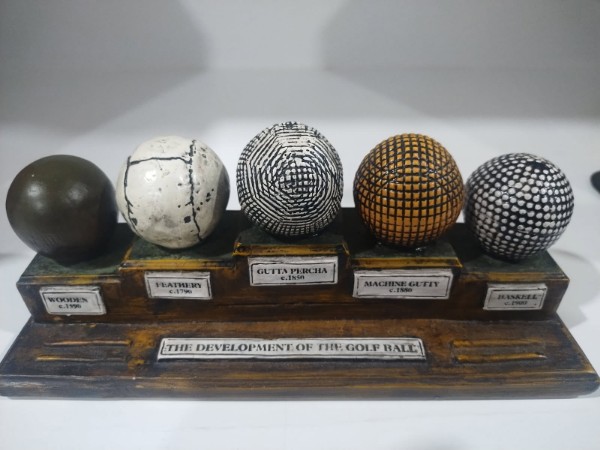
Long before I started playing golf, I collected golf balls as a hobby. Some were gifts from friends and church members. Others I picked up while walking near the local golf course. I kept the ones with interesting logos and gave the others to high school students or local golfers.
Once I started learning to play golf, the gifts of golf balls increased, as did other golf décor such as artwork, divot repair tools, and ball markers. One of my favorite items is a desktop display of the history of the golf ball. It was presented to me by a dear church member who purchased it at yard sale and said, “When I saw this, I thought of you and your love for golf and for history.” She was right, of course.
Golf is a game of paradox, quiet and contemplative, yet competitive and exacting. It tests patience, precision, and perspective. Among all the tools of the game, the golf ball might be the most underestimated. Small, round, and seemingly ordinary, the golf ball has a rich history that mirrors not only the development of the game, but also the art of resilience, innovation, and persistence.
From hardwood cores to high-tech polymers, the evolution of the golf ball mirrors not only the development of a game but the spirit of persistence, innovation, and redemption.
The Wooden Ball
Before golf was golf as we know it, players in 14th and 15th century Scotland struck solid hardwood balls made from boxwood, beech, or elm. These early golf balls were heavy, durable, and prone to unpredictable bounces. They didn’t fly far, but they rolled, and that was enough to get the game started.
In those early days, the course was the rugged Scottish terrain, the club was a curved stick, and the ball was whatever would move. The simplicity is humbling.
The Feathery
By the 1600s, the feathery emerged as the elite standard. A feathery was a leather pouch hand-stitched and tightly packed with boiled goose feathers. Once dried, it hardened into a compact sphere. These balls were works of art with each one hand-crafted by artisans who could produce only a few per day.
They were expensive and fragile. Wet weather or a mis-hit could ruin them. Still, they flew straighter and farther than wooden balls, and for nearly 200 years, the feathery reigned supreme.
Golf historian David Hamilton wrote, “The feathery was as delicate as it was costly. A single mis-hit could ruin it.”
The Gutta Percha
In 1848, Scottish clergyman Rev. Robert Paterson introduced the gutta-percha ball, made from the hardened sap of Malaysian sapodilla trees. It was moldable, affordable, and much more durable than featheries.
Known as the “gutty,” this ball democratized golf. More people could play. Courses expanded. The game grew.
At first, gutties were smooth, but golfers soon realized that nicked and scuffed balls flew better, straighter, and farther. So they began carving and hammering patterns into the surface, laying the foundation for the dimpled design still used today.
The Machine-Made Gutty
By the late 1800s, manufacturers began mass-producing gutties using metal molds. This introduced consistency and availability at scale. Golf was no longer just for elites. The industrialization of the gutty helped usher in a new era of public courses, amateur leagues, and expanding global interest.
The Haskell Ball
In 1898, American inventor Coburn Haskell, in collaboration with Bertram Work of the B.F. Goodrich Company, revolutionized the golf ball once again by introducing a wound-rubber core ball. It featured a solid rubber core wrapped in rubber thread, encased in a gutta-percha shell.
The Haskell ball flew farther than any ball before it and changed the competitive dynamics of the game almost overnight. Within a few years, it had replaced the gutty and became the new standard.
In the 1960 U.S. Open, a young Jack Nicklaus famously outdrove Arnold Palmer during a practice round. Palmer, never one to be outdone, asked what ball Jack was using. Nicklaus replied, “The same one you are. I just hit it better.”
No matter how good the golf ball becomes, it will always be dependent on the quality of the swing.
Today’s high-tech, dimpled golf balls are marvels of physics and design. But they owe everything to the wooden spheres, feathery stitches, tree sap, and rubber threads that came before.
So, the next time you tee it up with a Titleist, a Callaway, a Bridgestone, or your favorite brand, remember, you are holding a legacy of resilience and adaptation.
Whether your next shot soars down the fairway or sinks into the sand trap, remember that the game goes on, and so do you.
Swing again. Overcome adversity. Learn. Grow. That’s the story of the golf ball. And maybe, that’s the story of life.
(Barry Howard is a retired pastor who now serves as a leadership coach and consultant with the Center for Healthy Churches. He and his wife live on Cove Lake in northeast Alabama.)
 Cove Creek Reflections