

Navigating Your Internal Dialogue

Our minds are never truly silent. At any given moment, we are engaged in an internal dialogue—a constant stream of thoughts, reflections, and self-talk. Not all the voices are friendly. Some voices push us forward with encouragement, while others hold us back with doubt and fear.

Individuals of all ages must learn to navigate the voices within. No one is exempt. Left unchecked, some of these voices can be troubling, taunting, or in some cases traumatizing. Learning to sort through these voices is essential for emotional, mental, and spiritual well-being.

The voices in our internal dialogue can be tenacious and argumentative. How do we know which ones to listen to? Erwin McManus asked, “Who do we become when we stop allowing all the voices in our head to crowd out the one voice we must hear to come to life?”

We all have competing voices in our minds—some shaped by past experiences, some influenced by culture, and others rooted in our deepest anxieties and insecurities. You may hear the voice of self-doubt that whispers, “You’re not good enough.” Some hear the voice of fear that warns, “What if everything goes wrong?” There’s the voice of condemnation that says, “You are not worthy.” Others hear the voice of pride that insists, “You don’t need help.” And then there’s the voice of God, the still, small voice that speaks truth, peace, and direction.

As you discern between the multiple voices in your head, be aware that the loudest is seldom the most trustworthy, the harshest is seldom the most truthful, and the most accusative is seldom the most accurate. It is best to give attention to the still small voice. And though you cannot evict the competing voices, you can turn down the volume.

So how do we amplify the right voice—the one that speaks truth, grace, and wisdom?

  1. Reject the voices of condemnation and accusation. God convicts, but God does not condemn. If a voice is drowning you in shame, it’s not from the Holy One. (Romans 8:1)
  2. Filter your thoughts through the teaching of scripture. The Bible is the north star for discerning truth. If a thought contradicts God’s teaching, it doesn’t deserve a microphone in your mind. (Philippians 4:8)
  3. Spend time in stillness. The world is noisy, but God often speaks in whispers. Make time for quiet reflection and prayer. (1 Kings 19:11-12)
  4. Surround yourself with honest friends. Wise counsel from trusted friends and mentors can help clarify which voices to trust. (Proverbs 11:14)
  5. Speak life-giving words to yourself Words have power, even when spoken internally. Be intentional about reminding yourself of God’s grace and love. (Proverbs 18:21)
  6. Get regular rest. Shelly Miller reminds us, “Rest provides fine-tuning for hearing God’s messages amidst the static of life.” (Psalm 127:2)
  7. Put what you already know into practice. If we want to learn more from God, we must be faithful in what God has already taught us. When we walk in obedience, our spiritual ears become sharper. (Luke 16:10)

Your internal dialogue shapes your perspective, your emotions, and ultimately, your life. Choose which voices you allow to take center stage. When self-doubt, fear, and intimidation threaten to overwhelm you, lean into the voice that speaks life, love, and purpose.

As you navigate the voices in your head, be positive and proactive, “For God has not given us a spirit of fear and timidity, but of power, love, and self-discipline.” (II Timothy 1:7)

(Barry Howard is a retired pastor who serves as a leadership coach and consultant with the Center for Healthy Churches.)

When the Unseen Choir Sings

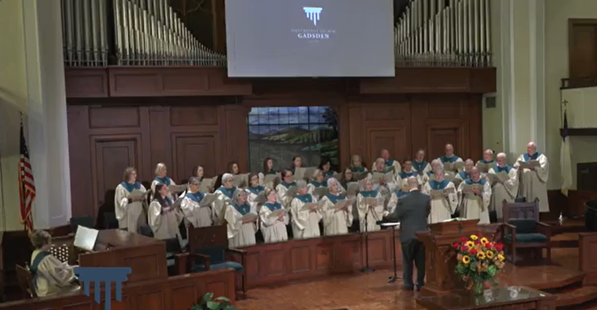
Last Sunday in church, the choir sang a beautiful rendition of one of my all-time favorite hymns, “Great Is Thy Faithfulness” arranged by Dan Forrest. The choir isn’t huge, but their sound is excellent and inspiring.

As I adjust to a more relaxed Sunday schedule following my recent retirement, my wife and I enjoy visiting our friends at the First Baptist Church in Gadsden for worship on the Sundays when we are not traveling. Nathan Edwards serves as Minister of Music and does a great job leading in worship and directing the choir.

As the choir began the anthem, I was reminded never to underestimate the power of a song, especially a song presented in multi-part harmony by a devoted and spirit-infused church choir. On the very first stanza, I noticed to my right a senior adult widow, who sits on the same row with the same friend each Sunday, as she mouthed the words “There is no shadow of turning with thee; Thou changest not, thy compassions they fail not, As thou hast been thou forever will be,” and there seemed to be a tear forming in her eye as though she was being reassured that the God of this universe was not intimidated by the problems in her life.

Just beyond her in the center section I saw a senior couple I assumed were husband and wife. He may have been nearly 90 years old and still had a farmer’s tan. She appeared to be a year or so younger than him yet weathered by the seasons of life. They were both nodding as though in agreement as the choir sang, “Summer and winter and noontime and harvest, Sun moon and stars in their courses above, Join with all nature in manifold witness To thy great faithfulness, mercy, and love.”

A couple of rows ahead of us was a dad seated beside his middle school son. Other than standing for the hymns and bowing his head for the prayers, the student had been completely still the entire service, somewhat tuned out, looking as though he was there because he had to be and not because he wanted to be. But during this choral anthem, I noticed that he began lightly tapping his foot and patting his knee, never taking his eyes off the choir as he kept perfect time with the beat of the song. I wonder if somehow the words of this powerful hymn were being planted in his subconscious and would one day sprout like a seed that would help him to become rooted and grounded in his faith.

Prior to the service I had noted a young adult as she was seated a few rows ahead of us in our section on the piano side. She sat alone and looked around as if she was in a new environment which made me think she might be a visitor, so I was glad to see several regulars greet her and sit near her. I don’t know her story but I was glad she was there. She sang the words to the congregational hymns without looking at the hymnal which indicated to me that this wasn’t her first church experience. As the choir sang, I caught her whispering along, “Strength for today and bright hope for tomorrow, Blessings all mine with ten thousand beside.”

These I’ve mentioned are only a few examples of the lips moving, heads nodding, and spirits being lifted across the congregation as the choir in the loft blended their voices melodiously. For some reason, more than listening to the robed choir, today I found myself looking and listening for the unseen choir. The choir in the loft was infusing the congregation with a song, thereby creating an antiphonal effect with the unseen choir silently singing, nodding, and toe-tapping the anthem in reflexive spiritual response.

Rich Mullins wrote a song popularized by Amy Grant titled “Sing Your Praise to the Lord.” The song was inspired by verse like Psalm 95:1 which says, “Oh come, let us sing to the Lord; Let us make a joyful noise to the rock of our salvation!”  It is certainly appropriate and biblical to sing to the Lord.

However, Ephesians 5:19 also encourages us to “Speak to one another with psalms, hymns, and spiritual songs.” There is something about congregational singing that creates a spiritual bond among people of faith as they sing to one another. Moreso there is something about a church choir singing with a disposition of worship that applies a balm to a wounded heart, that transmits energy to a weary soul, that conveys hope to those steeped in despair, and that plants seeds of faith in fertile minds.

The purpose of a choir is not to impress but to inspire. A church choir is not a show choir to entertain the congregation but rather a “flow” choir who, by immersing themselves in the spirit and message of worship, overflows onto the congregation with God-vibes and good news and contagious song.

Dietrich Bonhoeffer contended, “It is the voice of the Church that is heard in singing together. It is not you that sings, it is the Church singing, and you, as a member of the Church, may share in its song.”

Following the anthem, Pastor Mat Alexander’s well-prepared, well-delivered sermon from Matthew 12:1-21 encouraged us to “Love God, pursue righteousness, and find rest in the Lord.”

After the benediction, as we walked to our car, as the cart driver passed us as he transported a few folks to their cars I heard him humming the tune to “Great Is Thy Faithfulness.”

I wonder if Irving Berlin had the unseen choir in mind when he composed, “The song has ended, but the melody lingers on.”

Yes, it does! I’ve been humming that tune all week long.

(Barry Howard is a retired pastor who serves as a leadership coach and consultant with the Center for Healthy Churches.)

A Funny Thing Happened on Hole #12: 5 Things You Should Know About the Unfairness of Life

Life has a way of throwing obstacles in our path, even on the golf course.

Last week, as my friends and I were playing a round of golf on the Twin Bridges Course in Gadsden, Alabama, a funny thing happened on hole #12. All three of us had hit our tee shot on this short par 3 when I noticed movement in the greenside bunker. A dark figure was emerging from the bunker which at first looked like a large black bear. Then the one figure separated into two, and we realized that two labs, one black and one chocolate, had been napping and were probably roused by the sound of our golf balls landing on the green. Mike hit on the fringe, I hit in the middle of the green (a rare occurrence), and Bruce hit about 6 ft from the pin.

As we started to walk to our cart, I noticed the dogs sniffing Mike’s ball. Then the chocolate lab picked it up, much like a retriever does a tennis ball, and dropped it in the same location he found it. Both dogs then moved onto the green and sniffed Bruce’s ball. The black lab picked it up and carried it over to the fringe some 30 feet away and dropped it beside Mike’s ball. As we drove our carts toward the green, both dogs bolted before playing havoc with my ball. Of course, we returned Bruce’s ball to its rightful location and all three proceeded to par the hole (also a rare occurrence).

In 1998 at the Player’s Championship at TPC Sawgrass in Ponta Vedra, Florida, a bird picked up Brad Fabel’s ball on the island green and dropped it in the water. What is the recourse for the player? The PGA rule book says, “If a bird picks up your golf ball, according to the rules of golf (Rule 18-1), you must replace the ball at its original spot where it was picked up, and no penalty is incurred. If you are unsure of the exact location, you can approximate it.”

Golf is challenging enough without an unexpected culprit giving you an unfair disadvantage. The same is true in other aspects of life. Except in life, you cannot always rectify, replace, or remove the unfairness.

A few years back, my wife and I played a round of golf with friends in north Georgia. One of our friends hit a long fading drive into the trees down the right side of the fairway. But when his golf ball hit the trees, it ricocheted back into the fairway leaving him a clear shot to the green. He grinned and said, “There was a friendly monkey in those trees.” That is a common idiom among golfers. Where did that phrase originate?

Several years ago, I read the book, Play the Ball Where the Monkey Drops It, by Presbyterian minister Gregory Knox Jones. The setting is a time when India was under British colonial rule. Here is a brief summary of his story:

There were British living in Calcutta that found they really missed the game of golf. So, they built a golf course in Calcutta. But playing golf in Calcutta posed a very unique challenge because of obnoxious monkeys.

When golfers would attempt to play golf, the monkeys were fascinated, and they would take the little white balls and just throw them everywhere. This, of course, irritated the British colonialists and golf enthusiasts to no end.

So, they decided they had to come up with a plan. They were going to build a fence around the entire golf course. This sounded like a great plan…on paper. But while a fence can be very effective in keeping other animals from creating mischief, it’s not very effective with monkeys because monkeys love to climb! So, the monkeys would scamper up one side of the fence and scamper down the other and play with the little white golf balls as they did before.

Next, the British tried to lure the monkeys away from the course. But whatever lure they tried to use, nothing was as appealing as watching the human beings go crazy whenever the monkeys messed with the little white balls.

So, finally, the British in Calcutta developed a novel and unique golf course rule. And the rule was, “You simply play the ball where the monkey drops it.”

As you can imagine, playing golf this way could be exasperating. You might have, for the first time in your life, that perfect drive down the center of the fairway, and then a monkey comes along and throws your ball in the rough. Or, you could have a hook or slice that produces a miserable lie, and then a monkey tosses it back out onto the fairway for you. You simply play the ball where the monkey drops it. (Gregory Knox Jones, Play the Ball Where the Monkey Drops It: Why We Suffer and How We Can Hope, New York: HarperCollins, 2001, pp. 3-4).

What can we learn from these stories from the golf course?

  • Just in case no one has told you lately, life is not fair. In his book, Disappointment with God, Philip Yancey explains, “We tend to think, Life should be fair because God is fair.’ But God is not life. And if I confuse God with the physical reality of life- by expecting constant good health for example- then I set myself up for crashing disappointment.
  • Bad things regularly happen to good people. The humorist Grady Nutt insisted, “It rains on the just and the unjust, and not always just on the just.” We like to believe that if we do the right things, life will go smoothly. But the reality is that suffering isn’t always tied to wrongdoing. Illness, loss, and hardship strike the just and unjust alike.
  • We are called to be our best selves in the circumstances we are given, not the ones we wish we were given. Valerie Plame advises, “Despite the obvious fault in the universe, it cannot be used as an excuse for not trying to be your best self. Instead, use unfairness as a starting point to be sure that your actions are the best you can muster, and find peace in navigating your time here with grace and humor whenever possible.
  • Our faith does not exempt us from unfairness but rather teaches us to be people of perseverance and endurance. Our faith doesn’t spare us from tough times. Rather, our faith prepares us for tough times. Rather than running from adversity, it is best to call our challenges by name, look them in the eye, and overcome them with strength and determination. Robert Schuller frequently preached, “Tough times never last, but tough people do.”
  • Faith generates hope, and hope conquers despair. We all experience feelings of despair and that is not a sin. It is, however, a sin to wallow in the muck and mire of despair and dissolve into hopelessness. Lamentations 3:21-22 testifies, “Yet this I call to mind and therefore I have hope:Because of the Lord’s great love we are not consumed, for his compassions never fail.”

Life isn’t fair, but we don’t have to let that reality defeat us. Instead, we can choose to live with faith, resilience, and a commitment to doing what’s right. Hardships will come, but they don’t have to define us. The way we respond to life’s unfairness can shape us into stronger, wiser, and more compassionate people.

As you approach your hole #12 and you see dogs in the bunker or hear monkeys rustling in the trees, remember the words of Ben Hogan: “The most important shot in golf is the next one.” The same is true in life.

(Barry Howard is a retired pastor who serves as a leadership coach and consultant with the Center for Healthy Churches.)
“The Gift of Friendship: Blessed Be the Tie That Binds”

What in the world would we do without friends?

Trusted and treasured friendships bring both joy and stability to life’s adventures. Mark Twain humorously quipped, “Good friends, good books, and a sleepy conscience: this is the ideal life.” While not all relationships are deep or lasting, the bonds of true friendship have a way of grounding us, enriching our experiences, and helping us navigate life’s ups and downs.

Some people remain mere acquaintances, while others—often unexpectedly—become dear friends. The ancient wisdom of Proverbs 18:24 (as rendered in The Message) acknowledges this reality: “Friends come and friends go, but a true friend sticks by you like family.” Friendship is not just about shared interests or proximity; it’s about commitment, loyalty, and a willingness to walk alongside one another through all seasons of life.

C. Raymond Beran offers a poignant description of friendship:

Friends are people with whom you dare to be yourself. Your soul can be naked with them. They ask you to put on nothing, only to be what you are. They do not want you to be better or worse. When you are with them, you feel as a prisoner feels who has been declared innocent. You do not have to be on your guard. You can say what you think, as long as it is genuinely you… Friends understand those contradictions in your nature that lead others to misjudge you… You can weep with them, sing with them, laugh with them, pray with them. Through it all—and underneath—they see, know, and love you.

In a world where competition and self-interest often dominate, how do we develop and sustain meaningful friendships? The answer lies in grace, mercy, patience, and perseverance. True friendship requires intentionality—it may be a gift from God, but it must be proactively cultivated and nurtured.

Churches, at their best, are built not just on faith but also on friendship. A congregation is a diverse collection of people from different backgrounds who stand together in tough times, who challenge and inspire one another, and who—despite their differences—unite in a shared faith and mission. Perhaps the Quakers had it right when they named their faith community “The Society of Friends.”

Friendship is durable. It binds our hearts and minds in a way that bridges theological differences, rises above political disagreements, and weathers the hardships of life.

As we move forward, let us cherish the friendships we have and remain open to forming new ones. Robert Louis Stevenson once wrote, “So long as we are loved by others, I would almost say that we are indispensable; and no man is useless while he has a friend.” Indeed, friendship has a way of affirming our worth and purpose.

E.C. McKenzie insightfully noted, “Some people make enemies instead of friends because it is less trouble.” While friendships may require effort, vulnerability, and sometimes even forgiveness, they are undeniably worth it. After all, life is richer when shared with those who remind us of our song—even when we forget the words.

(Barry Howard is a retired pastor who serves as a leadership coach and consultant with the Center for Healthy Churches.)
I Think I Will Give Up Worry for Lent!

(Revised from 2020)

This year, I think I’ll give up worry for Lent.

Yesterday, I watched news footage from the Fat Tuesday celebrations in New Orleans—a day when many indulge in gluttonous feasting and revelry. Today is Ash Wednesday, marking the beginning of the season of Lent, a time of intentional preparation for Easter. During this sacred season, believers focus on self-examination, reflection, and repentance.

Traditionally, Christians choose to give up something significant to them during Lent. I have friends who forego their favorite indulgences—chocolate, coffee, sugar, or soft drinks—as a form of spiritual discipline. But since I seem to have a genetic predisposition to worry, I think I’ll try giving that up instead—for at least 40 days.

The Burden of Worry

I don’t actually like to worry. In fact, I know it’s not constructive. Worry is like spam or junk mail—it clutters my mind, taking up valuable space needed for creative thinking, planning, visioning, and problem-solving. I function far better when I’m not weighed down by excessive worry.

And yet, worry is persistent. Each time I try to kick it out the front door of my mind, it sneaks around and slips back in through the back.

Years ago, a friend of mine had a giant poster mounted above his desk that read:

“Don’t tell me worry doesn’t help. Half the things I worry about never happen.”

Erma Bombeck humorously captured the futility of worry when she said, “Worry is like a rocking chair: it gives you something to do but never gets you anywhere.”

An Inherited Habit?

I sometimes wonder if worry can be inherited. I watched the wear and tear of worry in my parents and grandparents and have noticed that many of their offspring—including me—struggle with this same mental distraction.

And I’m not alone. Over coffee, I’ve listened to CEOs, ministers, business owners, attorneys, physicians, and educators share their struggles with worry. It’s no surprise—there’s always something to be anxious about:

  • Our businesses
  • Our families
  • Our investments
  • Terrorism
  • The economy
  • Political turmoil
  • Wars and rumors of wars
  • Friends losing their jobs
  • Health concerns
  • The future…

The list seems endless.

A Better Way

Perhaps I’m not the only one who should give up worry for Lent. Since this is a season of intentional preparation for Easter, maybe we should all listen again to the words of Jesus:

“Therefore I tell you, do not worry about your life, what you will eat or drink; or about your body, what you will wear. Is not life more important than food, and the body more important than clothes? Look at the birds of the air; they do not sow or reap or store away in barns, and yet your heavenly Father feeds them. Are you not much more valuable than they? Who of you by worrying can add a single hour to his life?”Matthew 6:25-27

As we begin our Lenten journey, I’m trying to give up worry for at least 40 days. Maybe—hopefully—even longer.

Would you like to join me?

(Barry Howard is a retired pastor who currently serves as a leadership coach and columnist for the Center for Healthy Churches. He and his wife reside on Cove Lake in northeast Alabama.)

What Is Lent and Why Do We Observe It?

Each year, as winter begins to fade and the hope of spring draws near, the Christian calendar marks a sacred season: Lent. But what exactly is Lent? Lent is a 40-day season of reflection, repentance, and preparation leading up to Easter. It begins on Ash Wednesday and ends on Holy Saturday, the day before Easter Sunday. Traditionally observed by many Christian faith communities, Lent is a time for spiritual self-evaluation, often marked by prayer, fasting, and acts of charity.

What is the purpose of Lent? Pope Francis suggests, “Lent comes providentially to awaken us, to shake us from our lethargy.”

Lent is a deeply personal and spiritual journey. It is a time set apart to reflect, reevaluate, repent, refrain, and refocus.

Lent is a time to reflect. Life moves fast, and it’s easy to get caught up in the day-to-day without pausing to consider where we are spiritually. Lent provides a unique opportunity to slow down and reflect. It invites us to ask, How is my relationship with God? Where are my priorities? Is my lifestyle consistent with my faith? Through reflection, we gain clarity about our faith and recognize areas where we need growth.

Lent is a time to reevaluate. In the stillness of reflection, we are led to reevaluate our priorities. The world constantly pulls us in different directions, often distracting us from what truly matters. Lent challenges us to examine our choices, our commitments, and our daily habits. Are we devoting our time and energy to things that nourish our souls? Are we living in a way that aligns with God’s purpose for our lives? This season gives us the space to make adjustments and realign our lives with His purposes.

Lent is a time to repent. At the heart of Lent is repentance—a turning away from sin and a turning toward God. It is a time to be honest about our shortcomings, not with shame, but with a desire for transformation. Scripture reminds us, “Repent, then, and turn to God, so that your sins may be wiped out, that times of refreshing may come from the Lord” (Acts 3:19). Repentance is not about dwelling on our failures; it is about embracing God’s grace and asking God to renew our hearts.

Lent is a time to refrain. One of the most well-known Lenten practices is fasting—giving up something as a way of drawing closer to God. Whether it’s food, social media, entertainment, or another comfort, fasting teaches us discipline and dependence on God rather than earthly things. Refraining is not just about sacrifice; it’s about making space for something greater. When we let go of distractions, we create room for God’s presence to fill our lives in new ways. As we think about the things we might give up for Lent, Amanda Jobs reminds us, “It is not just about giving up our favorite food but it’s about going further and giving up things like hatred and unforgiveness.”

Lent is a time to refocus. Ultimately, Lent is about refocusing our hearts and minds on Christ. It is a season to strip away what is unnecessary and center our lives on what truly matters. As we journey through these 40 days, we prepare ourselves to embrace the joy and victory of the resurrection. By shifting our focus from the temporary to the eternal, we deepen our faith and draw closer to the one who teaches us how to “act justly, love mercy, and walk humbly with God” (Micah 6:8).

The faithful observance of Lent can be both uncomfortable and hopeful. Kate Bowler cautions, “Lent is full of hard truths. And it is a perfect moment for spiritual honesty. We can look on this tragicomedy with love and bemusement as we wait for the someday that will be God’s promised future.”

Lent is not about obligation—it is an invitation. An invitation to reflect, to reevaluate, to repent, to refrain, and to refocus. It is a journey that leads us deeper into God’s love and prepares us for a more meaningful celebration of Christ’s resurrection.

(Barry Howard is a retired pastor who currently serves as a leadership coach and columnist with the Center for Healthy Churches. He and his wife reside on Cove Lake in northeast Alabama.)

Press On! Navigating Life and Faith During Challenging Seasons

Have you ever just wanted to give up? Will Rogers quipped, “The road to success is dotted with many tempting parking spaces.” 

A few years ago, after several consecutive days of conversations with friends and fellow church members who felt their world was unraveling, I sensed the weight of the many concerns entrusted to me. As is my pastoral practice, I withdrew to my study to pray, reflect, and seek wisdom for those navigating difficult seasons.

Many members of my community had suffered from the destruction of property due to storms, the loss of business due to an oil spill, the loss of family members due to a tragedy, or the loss of hope due to a toxic political divisiveness.

While I was honored to listen to their stories—privately and confidentially—I found myself wishing I could gather all of them in the same room and say, “You are not alone. Others in this room are also struggling. You can help each other through this.” And most of all, “In the toughest moments, do not give up. Press on!”

Since I could not bring such a group together, I recorded in my journal the words I wished I could say to them, weaving in real-life dilemmas shared with me (anonymously, of course). The following Sunday, I included those words at the end of my sermon and later shared them in our church newsletter.

Now, we find ourselves in another season where hardship weighs heavily on many, both in our community and around the world. Once again, I feel a deep, cumulative heaviness in my soul. As I lift these concerns in prayer, I realize that the struggles that send us into emotional or spiritual tailspins haven’t changed much. Life is still challenging. Storms still come. Divisiveness still threatens to undo us. Fear and anxiety continue to creep in.

But in every hardship and every circumstance, we are called to press on—with patience, perseverance, and faith.

The words I shared then are still as relevant today as they were years ago. May they encourage you in your journey:

Life is a fragile gift—often unfair, frequently unpredictable, and mostly uphill.
The journey requires faith, courage, and determination.
There will be moments when your commitment is tested and your motivation wavers.

When you are tempted to give up or give in—press on!
When life throws you a curveball and the unexpected happens—press on!
When you are weighed down by sadness or battling deep depression—press on!
When frustration rises because of the incompetence of a neighbor or colleague—press on!
When you stand at the foot of the mountain, facing the long climb of recovery—press on!
When you begin a treatment regimen that weakens your body but must strengthen your health—press on!
When exhaustion settles in, and you are tired of being tired—press on!
When your friends are difficult to deal with, or your family is hard to live with—press on!
When you move to a new town or start at a new school, feeling like a stranger—press on!
When loneliness lingers, even in a crowd—press on!
When the news is filled with gloom and doom—press on!
When your workplace is dominated by chaos or conflict—press on!
When you are tempted to settle for mediocrity or risk losing your integrity—press on!
When death or disease takes away someone you love, in the power of the Spiritpress on!
When life gets turned upside down, steady your nerve and stay the course—press on!

Circumstances can change quickly and none of us are exempt. The Apostle Paul reminds us in Philippians 3:14, “I press on toward the goal to win the prize for which God has called me heavenward in Christ Jesus.”

Maya Angelou counseled, “You may encounter many defeats, but you must not be defeated. Please remember that your difficulties do not define you. They simply strengthen your ability to overcome.”

LL Cool J advises, “When adversity strikes, that’s when you have to be the most calm, take a step back, stay strong, stay grounded and press on.”

Pressing on doesn’t mean ignoring the pain or pretending everything is fine. It means choosing to keep moving, even when the path is difficult. It means holding onto faith when answers seem distant, leaning on the strength of God when our own runs out, and trusting that even the hardest seasons can be navigated with wisdom and courage.

No matter what you face today, know this: You are not alone. The valley will not last forever.

So take a deep breath, lift your head, and press on!

(Barry Howard is a retired pastor who serves as a leadership coach and columnist with the Center for Healthy Churches. He and his wife reside on Cove Lake in northeast Alabama.)

Handle with Care: Sometimes the Labels Don’t Match the Contents

Many years ago, Charles Haddon Spurgeon, the influential pastor from England, preached, “Don’t rely too much on labels, for too often they are fables.”

These days we are wise to remember his warning. Labels are often misleading.

My wife, a true child of the South, loves sweet tea. I, on the other hand, prefer mine unsweetened with a slice of lime or lemon.

At least twice recently, while dining out, our server refilled my wife’s sweet tea glass with unsweetened tea. In both cases, when we pointed it out, the server confidently assured us that the label on the pitcher clearly said “sweet tea.” We suggested that somewhere along the way someone had mistakenly poured the wrong tea into the labeled pitcher.

Both times, the servers were visibly surprised. They had placed complete trust in the label without ever verifying the contents.

In the days that followed, I couldn’t shake that moment. I started noticing how often things are mislabeled—and even more concerning, how frequently people assign misleading or limiting labels to others.

A few years ago as we were preparing to move, we spent weeks sorting, decluttering, and packing. As I was cleaning out a junk box, I came across an old Dymo Label Maker—the kind that embosses letters onto colored plastic tape. I hadn’t used one in years, but just holding it brought back memories of labeling school lunch boxes, storage bins, and light switches.

That little device got me thinking about the way we use labels, not just on objects, but on people. Labels serve a purpose when they help us organize or identify things. But when applied to people, they can be limiting, misleading, and even harmful.

If we’re not careful, we can end up trusting the labels we’ve assigned—or received—without ever questioning whether they truly reflect what’s inside. In the current environment, labels can prompt us to dismiss or oppose certain people simply because of the tag we or others have assigned to them.

Here are a few best practices for using labels—both from my Dymo Label Maker and from life:

  • Label things, not people. As author Philip Pullman once said, “People are too complicated to have simple labels.” No single word or phrase can fully capture someone’s identity, character, or journey.

  • Only label your own stuff. When packing, we didn’t let the moving company decide which box was labeled “books” and which one was marked “kitchenware.” In the same way, we should be cautious about the labels others assign. People should define their own identities, rather than having them imposed by someone else.

  • The contents define the label, not the other way around. Just because a pitcher is labeled “sweet tea” doesn’t mean it contains sweet tea. Likewise, a person’s true character, values, and actions should be what defines them—not the assumptions of others.

  • Old labels don’t always apply. Some of our moving boxes were marked “Christmas decorations” from a previous move, but we repurposed them to store dishes. In life, people grow, change, and evolve. The labels of the past may no longer be accurate.

  • Labels don’t always stick. The adhesive on most labels is temporary. Likewise, the labels we give or receive—whether negative or positive—don’t have to define us forever.

  • Labels can be used to intentionally mislead. If you own valuable jewelry, storing it in a box labeled “Expensive Jewelry” isn’t a wise move. You may choose to write “Hand-me-downs” or such to throw off any robbers or thieves. In a more manipulative way, political, religious, and social labels can be used to misrepresent or mislead others—sometimes intentionally, sometimes carelessly. Some ruthless leaders attach labels to opponents as a way of attacking them, a deceitful ploy to keep the public from knowing the treasure inside.

  • Jesus defied labels, and maybe we should too. Throughout his ministry, Jesus refused to be confined by political, cultural, or religious labels. He welcomed sinners, dined with tax collectors, and challenged the status quo. Instead of trying to fit into a particular category, perhaps our goal should be to live so faithfully that our actions speak for themselves.

In a polarized culture, those from both extremes tend to label others according to their own biases rather than to reflect the character of the one being labeled. Labeling others is often an expression of our naivete. Adam Jones cautions, “I think putting labels on people is just an easy way of marketing something you don’t understand.”

In our house, after some debate, we decided to part ways with our old Dymo Label Maker. In this season of life, we’re striving to use fewer labels, not more of them.

And maybe, just maybe, the world would be a better place if we all used fewer labels—and handled the ones we do apply with extreme care

(Barry Howard is a retired pastor who currently serves as a leadership coach and columnist for the Center for Healthy Churches. He and his wife live on Cove Creek in northeast Alabama.)

Reading Sharpens the Mind and Nourishes the Soul

Joseph Addison contends, “Reading is to the mind what exercise is to the body.”

For me, reading has become a crucial life discipline—one that sharpens the mind and nourishes the soul. Each year, I intentionally select a variety of books—fiction and nonfiction—to complement my study of Scripture, theology, and devotional literature. This habit has not only deepened my understanding but has also kept my mind engaged, my creativity alive, and my spirit refreshed.

Reading brings mental focus in an age of distraction. We live in an era of constant digital stimulation. With screens at our fingertips, it’s easy to settle for passive entertainment—whether through television, social media, or endless scrolling. But merely watching does not stretch or challenge the great mental muscle that God has given us. Reading, on the other hand, requires active engagement. It forces us to think, process, reflect, and imagine in ways that visual media rarely can.

In Luke 10:27, Jesus commands us to love God with all our heart, soul, strength, and mind. To love God with our minds means keeping them sharp, alert, and active—not allowing them to grow dull through neglect.

An inquiring mind needs nourishment. I have noticed a direct correlation between my reading habits and my mental sharpness. During seasons when my schedule interrupts my regular reading routine, I can feel my mind becoming “hungry”—undernourished and sluggish. When I neglect reading, my memory weakens, my creativity fades, and my ability to think deeply diminishes. But when I prioritize time for study and reading, I find that my mind is sharper, my memory is stronger, and my ability to teach and preach is far more effective.

Acquiring a love for reading can be a journey. I wasn’t always a disciplined reader. In high school, working an after-school job left me with little time for required reading, so I often relied on summaries rather than diving into the books themselves. It wasn’t until midway through my university years that I truly discovered the joy of reading. An English professor encouraged me to read multiple books at once, engaging with them as if I were in conversation with different voices and perspectives. This approach transformed my reading habits, and to this day, I often find myself reading several books alternately until I’ve completed them.

For me, reading is a spiritual discipline. For those aiming to grow deeper in their faith, reading should be considered more than just a pastime—it should be recognized as a spiritual discipline. Alongside prayer, Bible study, meditation, worship, and stewardship, reading enriches the soul by expanding our understanding of God’s world and the people in it.

Engaging with a wide variety of genres—novels, biographies, history, poetry, and theological works—broadens our perspective, deepens our wisdom, and helps us see the world through different lenses. Reading cultivates empathy, insight, and a greater appreciation for the richness of God’s creation.

Reading contributes to a healthy life. Several key disciplines contribute to my physical, spiritual, and emotional health:

  • My prayer and devotional life
  • A balanced diet and regular exercise
  • Meaningful time spent with friends and family
  • And, just as important—the ongoing discipline of reading

Reading is not just an academic exercise—it is a lifelong habit that strengthens the mind and enriches the soul. It feeds our intellect, fuels our imagination, and fortifies our faith.

I concur with Holbrook Jackson who reminds us, “ Never put off till tomorrow the book you can read today.”

(Barry Howard is a retired pastor who now serves as a leadership coach and columnist with the Center for Healthy Churches.)
From the “Octopus” to the “Not-So-Secret Secret”: 25 Books I Plan to Read in 2025

A wise person once observed, “We lose ourselves in books. We find ourselves there too.” Some people live to read. I think I read to live. Embarking on a journey through an engaging book is a soul-nurturing, mind-stretching adventure.

My appreciation for reading was slow to develop. But when it emerged, it surged. As a teenager, I perceived reading to be a nuisance and somewhat of a necessary evil to attain decent grades in school. However, at some point early in my college experience, I learned to value the gift of reading, not just for assignments or entertainment, but for personal growth and development.

As a pastor, I needed to read widely to stay current and to speak with fresh relevance on a variety of topics. Now that I am retired, I need books like I need food, to satisfy my cognitive hunger and to probe intellectual curiosity. Books stimulate my thinking, exercise my memory muscles, and challenge my presuppositions. They keep me hono

Once again this year, my reading list will include a variety of genres including fiction, spirituality, theology, history, and biography. Typically, I keep from three to five books going at the same time, a practice that was recommended by Opal Lovett, one of the most influential faculty members at Jacksonville State from my college years. This approach invites a panel of authors to be conversation partners in my internal dialogue.

I also intentionally read books I don’t agree with. Rather than making me combative, the practice of reading opposing viewpoints challenges me to test my assumptions and it familiarizes me with a variety of perspectives. This discipline equips me to converse and debate intelligibly, and not just emotively.

Here are 25 books I plan to read in 2025:

Fiction & Thrillers:

  1. Strangers in Time– David Baldacci
  2. Think Twice- Harlan Coben
  3. The Waiting– Michael Connelly
  4. The President’s Shadow- James Patterson
  5. The Life Cycle of the Common Octopus- Emma Knight

Spirituality & Theology:

  1. God Has a Name: What You Believe About God Will Shape Who You Become– John Mark Comer
  2. The Tears of Things: Prophetic Wisdom for an Age of Outrage– Richard Rohr
  3. The Word of a Humble God: The Origins, Inspiration, and Interpretation of Scripture- Karen Keen
  4. De-sizing the Church: How Growth Became a Science, Then an Obsession, and What’s Next- Karl Vaters
  5.  The Widening of God’s Mercy- Christopher Hays and Richard Hays

Personal Growth & Leadership:

  1. The Gifts of Imperfection: Let Go of Who You Think You’re Supposed to Be and Embrace Who You Are– Brené Browne
  2. Steps: A Guide to Transforming Your Life When Willpower Isn’t Enough- John Ortberg
  3. Culture Is the Way: How Leaders at Every Level Build an Organization for Speed, Impact, and Excellence- Matt Mayberry
  4. Strengthening the Soul of Your Leadership: Seeking God in the Crucible of Ministry- Ruth Haley Barton
  5. Wrestling with Doubt, Finding Faith- Adam Hamilton

Memoirs & Essays:

  1. Hope: The Autobiography- Pope Francis
  2. Dusk, Night, Dawn: On Revival and Courage– Anne Lamott
  3. Democracy Awakening: Notes on the State of America- Heather Cox Richardson
  4. I Guess I Haven’t Learned That Yet– Shauna Niequist
  5. The Most They Ever Had- Rick Bragg

Church & Ministry:

  1. The American Religious Landscape: Facts, Trends, and the Future- Ryan P. Burge
  2. Reappearing Church: The Hope for Renewal in the Rise of our Post-Christian Culture- Mark Sayers
  3. Creating Healthy Church Systems- Brad Ransom
  4. The (Not-So-Secret) Secret to Reaching the Next Generation– Kevin DeYoung
  5. How to Lead When You Don’t Know Where You’re Going– Susan Beaumont

Life would not be as rich without a treasure trove of books. Regarding the importance of reading, I identify with Anne Lamott who said, “For some of us, books are as important as almost anything else on earth. What a miracle it is that out of these small, flat, rigid squares of paper unfolds world after world after world, worlds that sing to you, comfort and quiet or excite you. Books help us understand who we are and how we are to behave. They show us what community and friendship mean; they show us how to live and die.”

I hope the books you choose to read in 2025 enrich your life and enlarge your world!

(Barry Howard is a retired pastor who now serves as a columnist and leadership coach with the Center for Healthy Churches. He and his wife live on Cove Creek in northeast Alabama.)