
How in the World Is the Date for Easter Chosen?

easterdates

Christmas is always on December 25.  Why is Easter not on the same date every year?

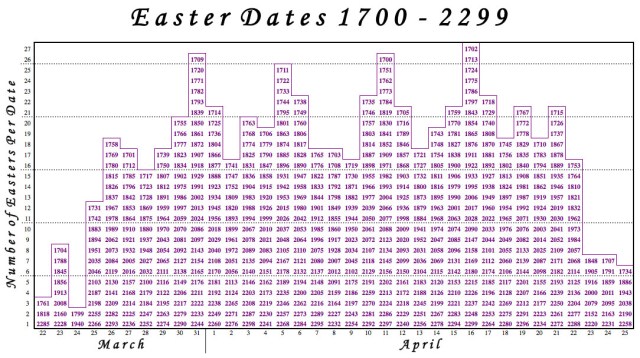
This year, for the first time since 1956, Easter comes on April 1, creating a curious juxtaposition of sorts.  Next year Easter will be celebrated on April 21, just as the redbuds, dogwoods, and azaleas are beginning to bloom. In other years, Easter has come in late March when the weather is still wintry.   Why does the date vary?  Since the date of Easter is not an actual anniversary of the resurrection, when is the most appropriate time to celebrate?

That very question caused considerable debate and controversy in the early church.  A quarrel broke out in the middle of the second century between church leaders in Rome and those in Asia Minor regarding the appropriate date for celebrating Easter.  The practice in the East was to observe Easter according to the moon regardless of the day of the week the observance fell on. The practice in Rome was to wait until the following Sunday.

Bishop Polycarp, who was a disciple of the apostle John, represented the East, and Bishop Anicetus represented the West.  Since they could not agree on the date, each continued to observe Easter according to his own conviction. The controversy became so intense that it threatened the harmony of the Christian world.

Councils were called in Rome and Palestine to debate the merits of both arguments.  Most of the participants generally favored celebrating Easter on Sunday. When the Bishop from Ephesus and many of the churches in Asia Minor refused to change their practice, they were declared “excommunicated” from the church by Bishop Victor of Rome.

Later, the Council of Nicea, convened by Augustine in A.D.325, affirmed the calculation used to determine the official date of Easter and that calculation is still used today. Easter is celebrated on the Sunday following the first full moon falling on or after March 21.  Therefore, Easter cannot come before March 22 or after April 25.

Even though the name, “Easter,” is packed with spiritual connotation, the term is derived from a pagan spring festival. Some believe it was named after the Teutonic god or goddess of spring. However, the name was seized by Christian believers and converted to a day of worship and feasting to celebrate the resurrection of Christ.

To underscore the earth-shaking significance of this day, Dr. Jim Pleitz, the late pastor emeritus of First Baptist Church of Pensacola, often concluded his Easter sermons by proclaiming, “Easter is a blessed reminder that ALL is well….we are victorious even in death!”         

Regardless of when it appears on the calendar, in March or in April, Easter is a high and holy day, a designated occasion to affirm and proclaim the foundation of the Christian gospel: Christ is risen! Christ is risen indeed!

(Barry Howard serves as leadership coach/consultant with the Center for Healthy Churches. He resides in Pensacola, Florida. You can follow him on Twitter @BarrysNotes.)


The Incarnational Pastor: Embodying the Pastoral Vocation

pastor

Being a pastor is much more than being a preacher.

In fact, many of the most influential pastors in my life have been average preachers, but extraordinary pastors. And many of the great conference speakers who have encouraged me with their insightful and entertaining perspectives wouldn’t last very long as pastor of a local church. It’s quite a different skill set.

The pastoral calling requires consistency in “being” and “doing.”

Pastoral work is multi-faceted. I remember taking a course in pastoral work at New Orleans Baptist Theological Seminary taught by Joe Cothen and Harold Bryson, both of whom were veteran pastors. They underscored that the information in our textbook was helpful and necessary, but that the real training of pastoral work is learned on the job.

How right they were! I am grateful for the classroom experience that gave to me a foundational pastoral theology and a framework for understanding my calling. But pastoral skill is mostly acquired in “the practice of ministry.”

In my 38 years of pastoral experience, I have discovered that incarnational pastoral work includes at least five areas of ministry:

1. Pastoral care.

My mentors instilled in me the perspective: “They will never care how much you know until they know how much you care.” Pastoral care involves multiple ways of caring for individuals in your parish or congregation, including hospital visitation, bereavement ministry, and pastoral counseling.

2. Pastoral preaching.

There is a lot written about sermon typology. Is the sermon topical or exegetical, deductive or inductive, evangelistic or equipping? Pastoral preaching can include any or all of the above because pastoral preaching isn’t focused on a particular style but on the spiritual needs of a specific, unique body of believers.

Preaching isn’t a “one size fits all” endeavor. Different than conference speakers or vocational evangelists, pastors preach out of and into the context of a unique local congregation.

My friend, Bill White, pastor of Christ Journey Church in Coral Gables, Florida, insists that as pastors “we are called to exegete the community as we exegete the Scriptures.”

3. Pastoral theology.

Fisher Humphreys reminds us that theology is “thinking about God.” So, pastoral theology for me is first, “thinking about what God is doing in the congregation I am called to serve,” and then connecting that with “what God is doing in the global church.”

4. Pastoral leadership.

A lot of what is written about leadership in the marketplace involves executive leadership that is hierarchical and/or autocratic. A lot of what churches expect from a pastor is democratic leadership wherein a pastor is guided by the will of the majority.

I would contend that pastoral leadership is servant leadership. It requires a stewardship of wisdom and influence.

A pastor is called to guide, shepherd, and protect the congregation, which means pastoral leadership is a calling to “look out for the common good of the congregation, especially when the best interest of the congregation is in conflict with the pastor’s personal preference or the majority of the congregation’s preference.

5. Pastoral intelligence.

This is not related to the pastor’s IQ or academic prowess. Rather, the term refers to the accumulated knowledge and insight of the pastor about the interpersonal dynamics, historical influences, community demographics, and individual and corporate character represented within the congregation.

One of the benefits of a long-term pastorate is that the volume of pastoral intelligence can be preserved and leveraged for kingdom purposes. When a pastor departs, the new pastor must begin acquired a new cache of pastoral data.

Consistency in “being” and “doing” means I am a pastor whether on campus or off campus, and whether “on the clock” or “off the clock.”

Everything about my life bears witness to my being a pastor. The way I conduct myself at a sporting event, the way I manage my finances, and the way I treat the cashier in the department store.

To be incarnational – to fully embody the role of pastor – I must embrace my calling as a summons to live a pastoral life, a life that equips me to be the shepherd of a congregation rather than the CEO of an institution.

(Barry Howard is a retired pastor and leadership coach who resides in Pensacola, Florida. His writings also appear on his blog and in a variety of publications.  You can follow him on Twitter @BarrysNotes.)

Words Matter…Especially When Talking About Faith

words matter

As a young child, I began noticing that folks who attend church regularly tend to use a “normal” vocabulary throughout the week, but when we step foot on our church campus or attend a church function, we often resort to a specialized repertoire of words that are not easily understood by those outside the community of faith. Because it seems abnormal to me for a person to utilize one vocabulary at work and leisure, and revert to another when in the presence of your church friends or minister, I have quietly loathed all flavors of hyper-spiritual dialects. I confess that, on occasion, I have cynically identified and labeled a few of those more frequently heard church dialects as “King James jargon,” “lingo of Zion,” “ecclesial English,” and “pious pontification.”

Recently I came across an old clipping that identifies one of these more frequently employed dialects as “Christianese.” Christianese refers to a language used in the Christian subculture and usually understood only by other members of that subculture. As Christian communicators it’s important to avoid words in our writing that could be misunderstood or fail to communicate — terms that have meaning only in the Christian subculture.

As a public service, here are some common phrases used in the church, along with their English-language equivalents:

Christianese: “If it be God’s will.”
Translation: “I really don’t think God is going to answer this one.

Christianese: “Let’s have a word of prayer.”
Translation: “I am going to pray for a long, long, long time.”

Christianese: “That’s not my spiritual gift.”
Translation: “Find someone else.”

Christianese: “Fellowship”
Translation: “Organized gluttony.”

Christianese: “The Lord works in mysterious ways.”
Translation: “I’m totally clueless.”

Christianese: “Lord willing . . .”
Translation: “You may think I’ll be there, but I won’t.”

Christianese: “I don’t feel led.”
Translation: “Can’t make me.”

Christianese: “God led me to do something else.”
Translation: I slept in instead of going to church.

Christianese: “God really helped me with this test.”
Translation: “I didn’t study but I guessed good, so I’m giving God credit in the hope that He helps me again.”

Christianese: “She has such a sweet spirit!”
Translation: “What an airhead!”

Christianese: “I have a ‘check’ in my spirit about him.”
Translation: “I can’t stand that jerk!”

Christianese: “I’ll be praying for you.”
Translation: “There’s an outside chance I’ll remember this conversation later today.”

Christianese: “Prayer concerns”
Translation: “Gossip”

Christianese: “In conclusion . . . “
Translation: “I’ll be done in another hour or so.”

Christianese: “Let us pray”
Translation: “I’m going to pretend to talk to God now, but I’m really preaching at you.”

Christianese: “You just have to put it in God’s hands.”
Translation: “Don’t expect me to help you.”

Christianese: “God wants to prosper you!”
Translation: “Give me all your money.” (Author Unknown)

My point is that words really do matter. The New Testament was originally written in koine greek, the everyday language of ordinary people, which says to me that the greatest news in the world can be communicated without a specialized religious vocabulary.

The wisdom writer reminds us that, “A person finds joy in giving an apt reply— and how good is a timely word!” (Proverbs 15:23 NIV). This year, as a part of my quest to be a more engaged listener, a more effective speaker, and a more faithful follower of Jesus, is to learn to be a better steward of my words. And, of course, to avoid reverting to Christianese. “Carest thou to joineth me?”


“The Church Is Worth the Effort”

bill selfThere are some moments and memories that we never forget.  One such memory is when I first met Dr. Bill Self in 1981 at a banquet on the campus of Samford University.  I was energized by Bill’s after dinner speech.  He quickly became one of my favorite preachers, not just because he was a captivating and motivating speaker, but because he had a contagious love for the local church.  As the years unfolded, Bill became not only my colleague, but a friend and a strategic encourager.
We were blessed to have Bill and Carolyn spend a weekend with us in Pensacola in May 2014. For many years, Bill had been a close friend with our iconic pastor emeritus, Jim Pleitz. And Bill had served as the guest “evangelist” for a series of memorable revival services at First Baptist Pensacola during the 1970’s. So Bill’s visit to Pensacola to be our guest for Heritage Day was filled with visits, stories, and reunions.

On Saturday evening, Amanda and I took Bill and Carolyn to Peg Leg Pete’s, our favorite seafood restaurant on the beach. We laughed and reminisced, but mostly we talked about the future of the local church.  We discussed the many ways that the church is in a season of challenging transition, and whereas some pundits are prepared to offer a eulogy over the local church, Bill believed that if we seize the opportunity to dialogue poetically and prophetically with our culture, rather than launching hostile verbal missiles at our culture, this could be the church’s finest hour.

From among his many excellent sermons, such as “King for a Day,” “Swimming to the Deep End of the Pool,” and “What Do You Want with Me, Jesus?,” I am glad that Bill chose to preach the sermon, “The Church Is Worth the Effort” for our congregation, a message that continues to be timely and relevant.

Little did we know that our visit with Bill in Pensacola would be our last visit with him this side of heaven.  Bill died on January 9, 2016 from complications with ALS.

So in memory of Bill, each year around this time I give thanks for Bill’s impact on my life and ministry, and I review my notes from his last sermon in Pensacola, a sermon that every pastor and church member needs to internalize as we remind ourselves that the most influential days of the local church can be ahead of us and not behind us:

“I still love the church. I love the church universal, as well as the church local (red brick, white-columned with deacons smoking in the parking lot). With all of its dysfunction and flesh marks, with all of its confusion and humanity, it is still the best thing God has going for Him in this world. We do have a treasure in earthen vessels.

The church is a solid oak tree, not a fragile tea cup. It has withstood Roman Imperialism, Jewish legalism, pagan optimism, medieval institutionalism, the excesses of the reformers, wars and rumors of wars, a youth quake, modern skepticism, southern provincialism, resurgent fundamentalism, and heresies in each generation that seem never to die. It can withstand anything our generation can throw at it.

It has been victimized by unprepared and selfish clergy, tone-deaf musicians, manipulative members, argumentative deacons, demanding denominations, unloving reformers, and greedy politicians. Still it continues to provide love, affirmation and community to the fallen in the face of alienation.

The church is worth the effort!

Preach on, Brother Bill. Preach on!


10 Opportunities Knocking at Your Church’s Door in 2018

church doors 1As we begin 2018, the challenges to local congregations are real, but so are the opportunities. Generational attrition, rotating attendance, deferred facility maintenance, and the decline of denominationalism are realities that affect most churches. What if the healthiest way to address the challenges is to focus on seizing the opportunities at our door?

Analysts who look only at declining Sunday attendance statistics declare that the challenges facing local communities of faith are almost insurmountable, and they are composing their eulogy for the church prematurely. Other indicators, including the fertile soil of opportunity, suggests that a local church is on the threshold of vibrancy and is ripe for ongoing transformation. How can a local church best address the new dynamics and extraordinary challenges of their current context?

Rather than acting in desperation or jumping into a protectionist “survival mode,” what if a church analyzed their giftedness, re-evaluated their calling, and identified their clear and present opportunities? Even the most rigid of congregations have more elasticity than they realize. These opportunities before us may actually serve as portals to the future, concourses that proactively lead us toward clarifying our purpose and reinforcing our mission.

There are specific opportunities correlated to economic trends and social demographics that are unique to given communities. However, the following 10 opportunities are common to almost all congregations:
Love your community. Your church doesn’t exist for the sake of its own perpetuity, but to serve your community in Jesus’ name.
Unite your congregation in prayer. Prayer has a cohesive affect, bonding diverse and at times cantankerous believers into spiritual family.
Cultivate intergenerational relationships. Rather than focusing on one age group, such as millennials, focus on perennials, those who are there for the long haul.
Be proactive, not reactive. “Let’s do whatever we have to do to keep the doors open,” is not a vision but a reaction. A proactive strategy envisions how congregational gifts and resources can be appropriated and applied to human need.
Major on your niche and maximize it. Paul’s confession that “I have become all things to all people…” (I Corinthians 9:22), is a statement of pastoral flexibility, and should not be interpreted, “We should do all ministries for all people.”
Partner with neighboring congregations. We should perceive other churches as our colleagues, not our competitors. When a church ministers out of the wellspring of their giftedness, their giftedness partners well with the giftedness of their neighboring congregations.
Welcome all guests generously, especially the “stranger.” Hospitality fosters community. The church is the one body that welcomes the CEO and the indigent with equal enthusiasm.
Complement your staff. Compliment your staff, for sure. But it is even more important to complement your staff. Like parishioners, staff ministers have a limited number of spiritual gifts. In a healthy congregation, members of the congregation utilize their unique gifts and talents to complement the spiritual gifts of staff.
Learn to respect diversity. Churches of all shapes and sizes are experiencing an explosion of diversity….theologically, politically, and socially. Since the body of Christ is diverse, we are wise to claim diversity as a congregational asset, not a liability.
Right size your ministry by downsizing your menu. Churches are notorious for starting new ministries without bringing closure to ministries whose effectiveness has expired. A church may be more effective by doing fewer things with excellence than by attempting many things with mediocrity.

In his book, Church: Why Bother?, popular author Philip Yancey underscored that: “Jesus gave us a model for the work of the church at the Last Supper. While his disciples kept proposing more organization ─ Hey, let’s elect officers, establish hierarchy, set standards of professionalism ─ Jesus quietly picked up a towel and basin of water and began to wash their feet.”

In 2018, opportunity is knocking. Let’s take up a towel and basin, and answer the call.

A healthy church is a community of Jesus followers with shared vision, thriving ministry, and trusted leadership. The consultants of the Center for Healthy Congregations are committed to the local church. We believe the critical functions of a congregation build faith in individual members. We help churches re-vision their mission and create strategies that provide the faith-giving experiences of past generations to this generation – and to generations yet unnamed. For more information about our services please contact us.

(Barry Howard serves as a leadership coach and consultant with the Center for Healthy Churches. His writings also appear on his blog, Barry’s Notes. You can follow him on Twitter @BarrysNotes.)


Eighteen Books I Plan to Read in 2018

harper lee on readingAlthough my affinity for reading was slow to develop, when it emerged, it flourished. During my teenage years, I perceived reading to be a nuisance and necessary evil. At some point during my college years, however, I learned to enjoy reading, not just for assignments or entertainment, but for personal growth.

As a minister, writer, and pastoral counselor, I need to read widely to stay current and relevant. More importantly, in my current stage of life, I need books like I need food, to satisfy cognitive hunger and to probe intellectual curiosity. Books stimulate my thinking, exercise my memory muscles, and challenge my presuppositions.

Typically, I read a variety of genres including fiction, spirituality, theology, history, and biography. I concur with Diane Duane who argued that, “Reading one book is like eating one potato chip.” Therefore, I usually keep from three to five books going at the same time, a discipline that was recommended by Opal Lovett, one of the most influential faculty members from my college years. This practice invites a variety of authors to be conversation partners in my internal dialogue.

For the past several years, around the first of January, I make a list of books that I plan to read during the coming year. While I hope to read 40-50 books this year, I have already compiled a list of eighteen of the books I want to be sure to read in 2018:

1. Whisper: How to Hear the Voice of God by Mark Batterson
2. Hallelujah Anyway: Rediscovering Mercy by Anne Lamott
3. The Orphan’s Tale by Pam Jenoff
4. I’d Like You More If You Were More Like Me by John Ortberg
5. Gift and Task: A Year of Daily Readings and Reflections by Walter Brueggemann
6. Surviving the Bible: Devotions for the Church Year 2018 by Christian Piatt
7. Smoke of this Altar by T. H. Williams
8. The Best Cook in the World: Tales from My Momma’s Table by Rick Bragg
9. The Rooster Bar by John Grisham
10. A Gentleman in Moscow by Amor Towles
11. The Brain Warrior’s Way by Daniel and Tana Amen
12. Secrets in the Dark: A Life in Sermons by Frederick Buechner
13. A Crazy, Holy Grace: The Healing of Pain and Memory by Frederick Buechner
14. The Emotionally Healthy Leader: How Transforming Your Inner Life Will Deeply Transform Your Church, Team, and the World by Peter Scazzero
15. As Kingfisher’s Catch Fire: A Conversation on the Ways of God Formed by the Words of God by Eugene Peterson.
16. Don’t Let Go by Harlan Coben
17. Holy Envy: Finding God in the Faith of Others by Barbara Brown Taylor
18. Braving the Wilderness: The Quest for True Belonging and the Courage to Stand Alone by Brene’ Brown.

Reading books written by authors who write from diverse perspectives stretches my thinking and expands my capacity to relate to variety of people. I find that it is intellectually healthy and pastorally helpful to read “outside the box” of my personal ideology. In other words, don’t just read the kind of stuff that reinforces what you think you know with certainty. Dare to read something that challenges you to think about life and faith from a different point of view.

Perhaps Mortimer Adler was right: “In the case of good books, the point is not to see how many of them you can get through, but rather how many can get through to you.”

Happy reading in 2018!

Goals for 2018… More or Less

2018 goalsThe beginning of a New Year is traditionally perceived as a season for clean slates and new beginnings. Depending on your perspective, you might consider New Year’s Day as a time to turn over a new leaf, to start that post-holiday diet, to begin that exercise regimen, or to generally clean up your act and put your life in order.


I am not usually inclined to compose a list of resolutions for the New Year, but as we welcome 2018 there are some specific things I want to work on personally and professionally. As I prepare for 2018, here are ten goals I am targeting…more or less:

  • Eat less, exercise more. My physician keeps reminding me that I can increase the probability of enjoying prolonged good health if I begin now to eat a little less and to exercise more.
  • Talk less, listen more. Several times in children’s sermons I have emphasized that God created us with two ears and one mouth so that we could listen twice as much as we talk. As I grow older, I am discovering the need for me as an adult to limit my speech and to be more intentional and focused in my listening.
  • Criticize less, encourage more. Maybe I’m just weary of caustic political banter, but I have heard enough criticism and negativity in 2017 to last a life time. While constructive criticism may be of great value, negative and petty criticism tends to be contagious and demoralizing. Our local and national leaders, our ministers, and our neighbors need our prayers and encouragement more than they need darts of non-constructive criticism flying their way.
  • Judge less, respect more. As a follower of Jesus, I am called to live out of the wellspring of my convictions, and respect the rights of others to do the same.  That means leaving the judging to the ultimate Judge, and respecting those whose life choices and perspectives are different than my own.
  • Spend less, give more. As I strive to be a more effective manager, I am persuaded that I need to spend a little less this year on frivolous things and to give a little more to organizations, ministries, and missional groups that make a difference in the lives of others, especially the disadvantaged.
  • Worry less, trust more. I am convinced worry is a genetic trait handed down to me from previous generations. I know that worry is a waste of time and energy, but a little voice in my head is wrongly convinced that worry is productive. This year I want to proactively address those things that are within my realm of responsibility, to cease worrying about those things over which I have no influence, and to trust God for daily guidance and provision.
  • Hurry less, focus more. Because my task list can get long, I tend to spend a lot of time hurrying from one task to the next. This year I want to slow the pace and focus on the present moment, even if that means I don’t check every task off my to-do list.
  • Watch less, read more. I enjoy good tv shows and good books. I especially enjoy watching Scorpion, NCIS, and NCIS LA. My personal downfall, however, is reruns. I spend too much time watching shows I’ve already seen, and that cuts into my reading time. Reading exercises and stretches the mind more than watching TV. This year I am determined to spend more time wrapped up in a good book and less time watching repeats.
  • Connect less, disconnect more. Electronic communication can be a technological blessing and social networking can be the next best thing to being there. However, staying connected 24 hours a day can be counterproductive and may increase stress, reduce productivity, and incite attention deficit. This year I want to maximize the benefits of being connected by strategically choosing times to disconnect.
  • Reminisce less, engage more. Reminiscing about the past can be inspiring and educational. But when I become preoccupied with the past, I end up becoming a curator of yesterday’s blessings rather than envisioning new possibilities and working toward a positive future. Reminiscing helps me to treasure the experiences of yesteryear. But there comes a time to put the past behind me and the future before me, and to fully engage the challenges and opportunities that are knocking at the door this year.

As I welcome 2018, I want to maximize the opportunities, navigate the obstacles, and “press toward the mark of the high calling” with hope, optimism, and determination.


Marching to a Counter-Cultural Cadence

barrysnotes's avatarCove Creek Reflections

by Barry Howard

The poinsettias are ablaze with holiday red. And the crèche is in the window for all to see. The Advent wreath is in place and we are on our countdown toward lighting the Christ Candle on Christmas Eve. Among the poinsettias, the wreaths, and the candles, there are numerous Christmas trees adorned with ornaments, Chrismons, and white lights. Our church campus is colorfully and beautifully decorated.  And in addition to the traditional green Christmas trees, there stands a drum tree. You heard correctly.  A drum tree! A tree-shaped display made of assorted historic drums.

wp_20161127_001

Vick Vickery, our esteemed Scoutmaster emeritus, assembles this drum tree each year out of 34 percussion instruments from different eras in history.  Included in this display are replicas of the rope drum used in the Revolutionary War and the Civil War. Historically, these instruments were crucial for conveying instructions and maintaining morale, for in the days prior to advanced…

View original post 400 more words

Don’t Let the Darkness Eclipse the Light of Christmas

barrysnotes's avatarCove Creek Reflections

winter-solstice-2015-777x437The people walking in darkness have seen a great light; on those living in the land of deep darkness a light has dawned.” Isaiah 9:2

It’s dark outside, and today seems even darker than usual. And it should. Today is the darkest day of the year.

For those of us who live in the northern hemisphere, the shortest day of the year, the Winter Solstice, usually occurs on December 21. The solstice, which literally means “sun stood still,” officially marks the beginning of winter. More notably, with the shortest day also comes the longest period of darkness.  The Earth’s axial tilt is at its furthest point from the sun, allowing the least amount of daylight to reach the earth.

While it may be merely coincidental that the darkest day arrives just prior to our customary celebration of Christmas, from my experience as a pastor, I am aware that holidays…

View original post 418 more words

Advent: ‘Tis the Season for Hope

Advent Hope

In seasons of despair, hope is never lost, but it is often misplaced. Advent is a time to rediscover and re-kindle the hope we have in Christ. And this year, we need a revival of hope.

Our frustration with the political theatre, our anguish over economic uncertainty, and our anxiety over threats of war or terrorism can feed a growing sense of hopelessness. Or, they can inspire us to rise up from our sackcloth and ashes, and to proactively address the issues of our day. St. Augustine imagined, “Hope has two beautiful daughters – their names are anger and courage; anger at the way things are, and courage to see that they do not remain the way they are.”

Real hope is neither blind nor naïve. Real hope motivates us to rise above despair and deal with challenging circumstances constructively, collaboratively, and courageously. Our hope in Christ reminds us that through the ever-changing circumstances and seemingly insurmountable challenges of life, “with God all things are possible” (Matthew 19:26).

A few years ago, I read of a rather profound exchange between two clergy who were working together during a season filled with monumental changes. In 1960, John Claypool began his tenure as pastor at the Crescent Hill Baptist Church in Louisville. Shortly after his arrival, Claypool became friends with a Jewish rabbi who was forty years his senior. Their friendship grew deeper as they worked together in the civil rights movement. After a tense and unproductive meeting one day, Claypool looked at his Jewish friend and said, “I think it is hopeless. This problem is so deep, so many-faceted, there is simply no way out of it.”

The rabbi asked Claypool to stay a few minutes after the meeting and said, “Humanly speaking, despair is presumptuous. It is saying something about the future we have no right to say because we have not been there yet and do not know enough. Think of the times you have been surprised in the past as you looked at a certain situation and deemed it hopeless. Then, lo and behold, forces that you did not even realize existed broke in and changed everything. We do not know enough to embrace the absolutism of despair. If God can create the things that are from the things that are not and even make dead things come back to life, who are we to set limits on what that kind of potency may yet do?”

Do you not know? Have you not heard? The Lord is the everlasting God, the Creator of the ends of the earth. He will not grow tired or weary and increases the power of the weak. Even youths grow tired and weary, and young men stumble and fall; but those who hope in the Lord will renew their strength. They will soar on wings like eagles; they will run and not grow weary, they will walk and not be faint. (Isaiah 40:28-31)

When underscoring the therapeutic value of hope, Norman Cousins proposed, “The capacity for hope is the most significant fact of life. It provides human beings with a sense of destination and the energy to get started.”

Advent is a season to rediscover our hope and to renew our strength, a hope inspired by God’s perspective and strength that motivates us toward God’s future, on earth as it is in heaven.

(Barry Howard serves as a leadership coach and consultant with the Center for Healthy Churches. His writings also appear on his blog, Barry’s Notes. You can follow him on Twitter @BarrysNotes.)