The holidays arrive each year wrapped in ribbons of nostalgia, music, gatherings, and celebration. But for those who are grieving, this season can feel less like “the most wonderful time of the year” and more like an emotional obstacle course. Bright lights can intensify the shadows. Joyful songs can amplify the silence. Festive moments can sharpen the memory of the one who is no longer with us.
Grief is never easy, but during the holidays it can feel heavier, louder, and more relentless. According to the American Psychological Association, 38% of adults say their stress increases significantly during the holiday season, and those who are grieving report even higher spikes. Our senses, emotions, and memories all operate on high alert this time of year, which makes grief more vivid and unavoidable.
Author Alan Wolfelt reminds us, “Healing happens when we allow ourselves to mourn.” Not repress. Not deny. Not avoid. Not power through. Allow.
So what can help us navigate the holidays when our hearts are hurting?
Here are a few practices that offer hope, clarity, and gentle strength along the way.
Tend your emotional landscape.
Pretending everything is fine rarely helps. Repressed grief doesn’t disappear; it simply finds another way to surface. In fact, mental health research shows that unaddressed grief can increase the risk of depression, anxiety, and physical illness.
Healthy grieving begins with honest naming: “This is hard. This hurts. This season is different.”
Give yourself permission to feel whatever you feel—whether that’s sadness, numbness, gratitude, anger, or even surprise moments of joy.
Think of your grief like a holiday “app update.”
Your smart device doesn’t operate the same way after a major software update. Familiar screens move. Icons shift. Some features no longer exist. Others appear for the first time.
Grief works similarly. The internal operating system of your life has changed, and the holidays—full of rituals and memories—highlight that change.
Be patient as you give yourself time to adjust to this “new version” of life.
Let memories be a bridge, not a burden.
Tell the stories. Look at the photos. Cook the favorite recipe. Share the funny moments. Memories don’t have to reopen wounds—they can help stitch them. Storytelling is both therapeutic and sacred; it transforms absence into presence, even if just for a moment.
As one writer noted, “Grief is love with no place to go.” The holidays give that love a place to land.
Create new rituals of commemoration.
Hang an ornament that honors your loved one. Set aside a moment at dinner to light a candle in their memory. Donate to a cause they cared about.
Even a small ritual can become a lifeline—something that grounds you, centers you, and reminds you that love doesn’t end.
Don’t walk the holiday journey alone.
Isolation intensifies grief. Community softens it.
Protect your alone time. Be faithful to your quiet time. But be intentional about spending time with friends, even if at first you don’t feel like it. Attend a Blue Christmas service. Gather with people who understand.
The National Alliance on Mental Illness reports that supportive social connection significantly reduces the emotional burden of grief, especially this time of year.
Don’t force yourself to be overly cheerful. Just being with a small group of friends who care about you, and whom you care about, can be like a soothing ointment for your soul.
Make room for both grief and grace.
The goal is not to “get over” grief before the holidays arrive—it’s to make space for grief and grace to coexist.
Your grief isn’t going away anytime soon. And griefs tends to be a more frequent guest during the holidays. Some moments will sting. Others will surprise you with peace. Let both be welcome.
In the words of Henri Nouwen: “Joy does not simply happen to us. We have to choose joy and keep choosing it every day.” Even in grief, joy can appear in tender, quiet moments—unexpected, but real.
Let the Light be your guide, especially in your dark moments.
Yes, people of grounded faith can be shaken, even overwhelmed at times, by the deep darkness of grief. Although the holiday season doesn’t erase grief, the Light of Christ can illuminate a path through it.
This year, as you navigate the mix of sorrow and celebration, remember: You are not weak because you grieve. You are not alone because you hurt. And you are not without hope.
The message of this season—Emmanuel, “God with us”—is especially for the weary, the wounded, and the grieving.
May you find moments of calm, courage, and comfort. And may the Light shine gently on your path, even in the lingering shadows.
Every December, the world starts rushing as seasonal lights go up, calendars fill up quickly, and Christmas playlists spill from department store speakers before the Thanksgiving leftovers have even cooled. There is a cultural trend to rush in and rush through the holiday season.
But Advent invites a different rhythm. It invites us not to hurry, but to wonder.
Advent beckons us to wander slowly, thoughtfully, hopefully down the long road toward Bethlehem. And somewhere along that road, if we allow it, wonder begins to rise inside us like a sacred warmth.
The old Appalachian Christmas carol “I Wonder as I Wander” captures this spirit fittingly. Its haunting melody and simple lyrics invite us into a posture of awe as we contemplate the mystery of Christ stepping into our world. The song itself echoes Advent’s message: as we wander toward Bethlehem, it is the wondering that prepares our hearts and minds to welcome the Christ child, yet again.
Over a century ago, when crowds gathered in Kitty Hawk, North Carolina, waiting for news of the Wright brothers’ first flight, they lived in a moment thick with anticipation. Before anyone saw an airplane lift off the ground, people gazed at the horizon, holding their breath, wondering if something extraordinary was about to break into the ordinary. That is Advent. It is the pause before the miracle.
Wonder cultivates the fertile soil of our minds, readying us to learn and grow. As Socrates reasoned, “Wonder is the beginning of wisdom.”
Advent isn’t a day trip. It is a progressive journey. Think of Advent as the “loading bar” on your computer or phone. It moves slowly from 6%…to 28%…to 75%. You can’t rush it, and you can’t ignore it. That little bar is doing important behind-the-scenes work—downloading, preparing, aligning things so the device can function as it should.
Advent does the same for the human heart. It prepares us, steadies us, and positions us to receive Christ not with fatigue but with awe.
We are not the first ones to travel this path. Scripture is full of wanderers whose journey shapes our own:
The prophets wandered with hope (Isaiah 9:2–7).
Mary wandered toward Bethlehem with courage (Luke 1:38).
Joseph wandered with obedience (Matthew 1:20–24).
The shepherds wandered with expectancy (Luke 2:8–15).
They did not rush. They wandered faithfully, trusting that God would help them navigate the journey.
And so do we.
In December of 1941, with the world engulfed in war, Winston Churchill stood beside President Franklin Roosevelt on the White House lawn for a Christmas Eve service. The future felt frightening, the headlines heavy. Yet together they read John 1:5: “The light shines in the darkness, and the darkness has not overcome it.”
That night, in the shadow of conflict, nations heard a reminder that has anchored believers for centuries: even in the world’s darkest winters, God’s light shines in the dark places and spaces of life, a message we need to hear resoundingly this year.
Perhaps we must learn to wonder again. Advent prompts us to slow down enough to see grace glowing at the edges of our days, sort of like candlelight in a dark sanctuary, gentle yet unignorable.
This season is not about racing toward a date on the calendar. It is about traveling with intention and a spirit of inquiry. About noticing God’s presence in the challenges, in the questions, in the silences, and in the small mercies. It is about recapturing the holy wonder that first stirred in Bethlehem, a holy curiosity that echoes the humble, searching tone of “I Wonder as I Wander.”
Isaiah invites us to walk this road with hope: “The people walking in darkness have seen a great light” (Isaiah 9:2). Mark calls us to prepare the way (Mark 1:3). Mary teaches us to magnify the Lord (Luke 1:46).
As you wander the road to Bethlehem this year, may wonder rise in you again, wonder that steadies your spirit, softens your pace, and opens your heart and mind to the One who is coming.
Don’t rush there. Wander. And wonder.
Because those who wander the road to Bethlehem with wonder do not merely celebrate Christmas—they are ready to welcome the Christ child when they arrive, and then to follow him from the manger to the cross and beyond.
(Barry Howard is a retired pastor who now serves as a leadership coach and consultant with the Center for Healthy Churches. He and his wife live on Cove Lake in northeast Alabama.)
Throughout the years, my grandmother gave us cuttings or babies derived from several of her houseplants, including a philodendron, a pencil cactus, and a Thanksgiving cactus. My wife and I have tended the philodendron and Thanksgiving cactus across the 40-plus years of our marriage, and the pencil cactus didn’t survive the journey.
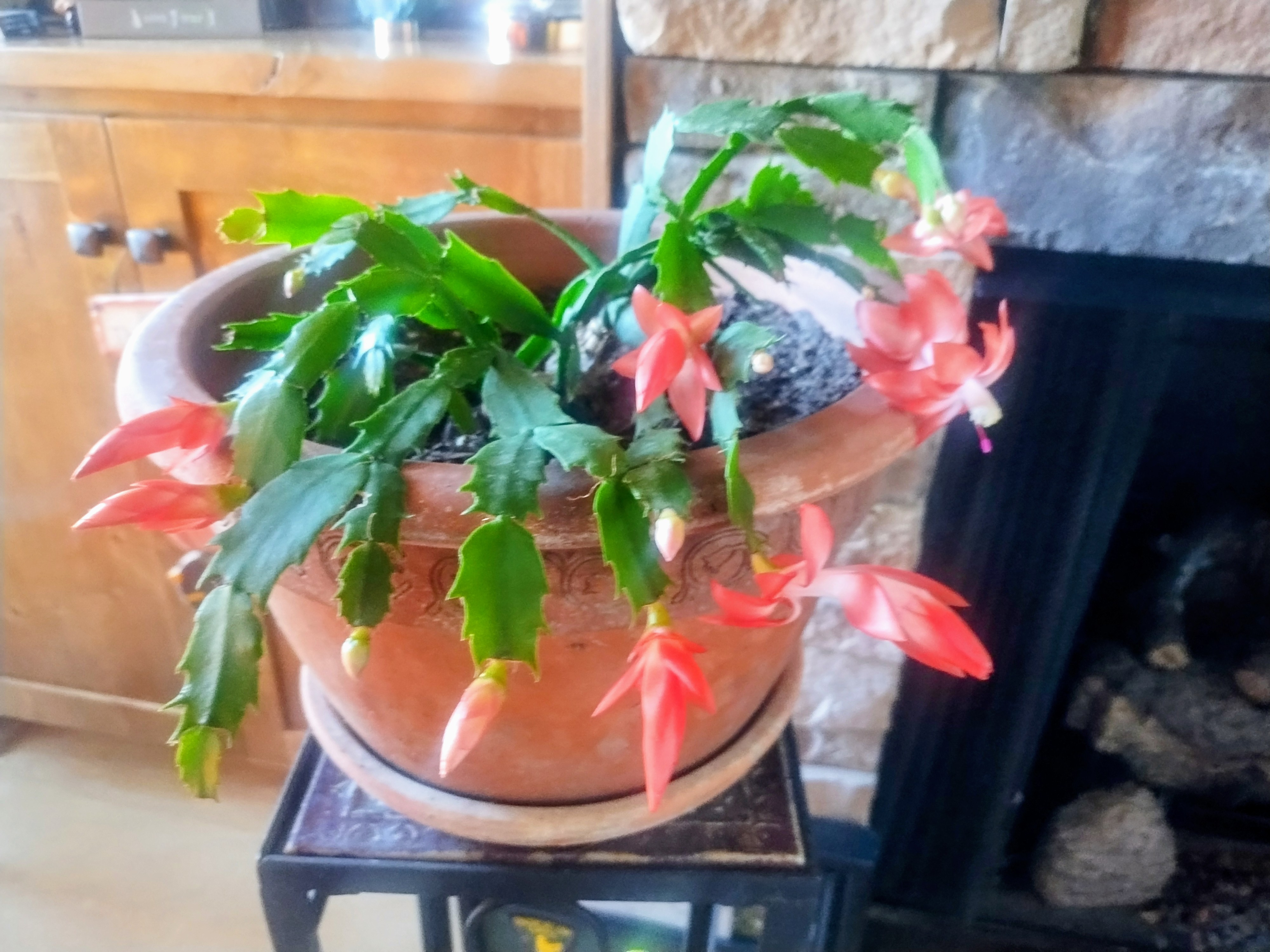
Yesterday, the buds on our Thanksgiving cactus began to open. This morning, the plant is almost in full bloom. As I gazed at the salmon color, I began reflecting on the history and morphology of the plant.
Every year as the holidays approach, you can find various colors of these holiday cacti for sale at your local garden center or grocery store.. They’re often lumped together under the name “Christmas cactus,” but not all holiday cacti celebrate Christmas. Some arrive a full month early, bursting into bloom right around Thanksgiving.
If you’ve ever wondered what kind of cactus you actually own, or why it blooms when it does, here are a few tips:
1. Start With the Leaves: The Easiest Way to Tell Them Apart
Holiday cacti don’t have traditional leaves. Instead, they have flattened segments called phylloclades, and their shapes reveal their identity.
Thanksgiving Cactus (Schlumbergera truncata)
Edges are pointed, like little hooks or claws.
Segments look more jagged and angular.
Sometimes called the “claw cactus.”
Christmas Cactus (Schlumbergera × buckleyi)
Edges are smooth and scalloped, with a rounded shape.
The overall look is softer, gentler, and less spiky.
If your cactus looks like it’s growing tiny crab claws, it’s probably a Thanksgiving cactus, even if the label said “Christmas.”
2. Bloom Time: What the Calendar Can Tell You
Bloom time is the next biggest giveaway.
Thanksgiving Cactus: Late October through November
These are the early bloomers of the holiday cactus world. They often hit their peak just in time to sit next to the giblet gravy.
Christmas Cactus: Mid-December through January
These bloom closer to Christmas and sometimes even keep going into the New Year.
That said, bloom times aren’t locked in stone. Light and temperature play a huge role, so a Christmas cactus may bloom early—or a Thanksgiving cactus may bloom twice.
3. How the Blooms Look and Grow
Beyond timing, the flowers themselves offer clues.
Thanksgiving Cactus Blooms
Grow more horizontally, sticking out like little trumpets.
Look slightly more pointed and dramatic.
Christmas Cactus Blooms
Tend to hang downward, bell-like and delicate.
Appear fuller and more symmetrical.
Either way, holiday cactus blossoms are stunning—long-lasting, vibrant, and perfectly timed to bring color to shorter days.
4. Why Your Cactus Blooms When It Does
Holiday cacti are photoperiod plants, meaning they respond to:
Long nights
Shorter days
Cooler temperatures
Give them 12–14 hours of uninterrupted darkness and temps around 55–65°F, and they’ll start forming buds. A plant near a warm lamp may bloom late; one in a cool, darker room may bloom early.
Sometimes they even surprise you with a bonus bloom in spring.
Whether yours blooms at Thanksgiving or Christmas—or both—it’s one of the few houseplants that comes decorated right out of the box. Understanding their subtle differences helps you appreciate the unique beauty each brings to the season.
So next time you see a holiday cactus, take a closer look. You might just discover whether you have a Thanksgiving cactus showing up early, or a Christmas cactus right on time. Whether you bought your cactus this year or you have an heirloom edition, you have a living plant adding its color to your holiday décor.
(This article is curated from a variety of sources.)
Over the years, I have observed that family gatherings during the holidays, especially at Thanksgiving, can be a great opportunity for the family to visit, share highlights of the previous year, and to enjoy a delicious meal. But I have also noted that such occasions can serve as a potential theatre for family drama.
Thanksgiving can be a glorious blend of turkey, dressing, sweet potato casserole, and pecan pie. But Turkey Day can also serve as the annual reminder that every family has at least one person who stirs the pot—literally and figuratively. If your family gatherings resemble a cross between a Norman Rockwell painting and Family Feud, this list is for you.
Here are 7 ways to minimize family drama at Thanksgiving,or at least keep it to the level that doesn’t require professional referees or emergency pie rations:
1. Strategically assign seating like you are planning the Geneva Convention.
Whether your family includes the nephew who loves to “just play devil’s advocate,” or the sister who lives up north and believes every conversation is a debate tournament, strategic seating is essential.
Put peaceful people together.
Put calmer personalities in the middle
Seat the jokester between potentially rival factions.
This is a diplomatic summit, and not just dinner. Think of your table like a diplomatic summit. Your mission is to prevent World War III between those who prefer gravy and those who opt for cranberry sauce.
2. Declare a pre-meal politics ban.
Make a gentle announcement: “Friends, family, and beloved relatives who may or may not test my sanctification… this is a politics-free zone.”
If someone starts drifting in that direction, have a few pre-approved diversion lines ready:
“Speaking of election results, did anyone bring dessert?”
“Fascinating—pass the gravy!”
“Let’s save that conversation for Arbor Day.”
If diversions fail, distract with pie. Pie always wins.
3. Give everyone a job—preferably a safe one.
Idle hands are the playground of unnecessary opinions. Assign tasks.
The person who can’t cook? Napkin duty.
The one who always shows up late? Butter the rolls—they may still be warm.
The family perfectionist? Organize the drink station. And let them color-coordinate to their heart’s content.
A busy family is a calm family.
4. Preemptively hide the board games that cause trouble.
Every family has that game. You know the one.
Monopoly: ruins relationships.
Phase 10: awakens competitive spirits not seen since the Colosseum in Ancient Rome.
Uno: historically responsible for more wars than Europe.
This year, choose something cooperative, like a puzzle. Or a walk. Or staring peacefully at the wall.
5. Establish a “drama-free zone” table rule.
It can be a simple set of guidelines.
No gossip.
No passive-aggressive comments.
No discussing who is “still single,” “still unemployed,” “still gluten-free,’ “still unwed,” or “still without child.”
No family wagers on which school Lane Kiffin is going to.
The turkey deserves better than that.
6. Prepare preemptive conversation starters.
Keep a short list of prompting, harmless questions on standby:
“What’s one thing you’re thankful for this year?”
“What’s a favorite Thanksgiving memory?”
“What is the best book, movie, or TV show you’ve enjoyed this year?
These are mostly safe questions.
7. Have at least three emergency exit lines ready.
You’re not fleeing the family—you’re strategically preserving your sanity.
Try:
“Excuse me, I think the sweet potatoes are calling my name.”
“Hold that thought—I need to check the oven.”
“Did someone hear a knock at the door? Let me double-check.”
Gracefully step away. Return with pie.
For almost every family, Thanksgiving gatherings are a blend of gratitude and quirks, tradition and chaos, sweetness and spice, and not just on the dessert table. Family drama may not disappear entirely, but with humor, grace, and a few strategic decisions, you can minimize the meltdowns and maximize the moments worth remembering.
And if all else fails, just keep passing the rolls. People have a hard time arguing when their mouths are full.
Do you need an attitude adjustment? As we navigate the uncertainty and anxiety of living in a polarized culture, it is possible for our attitude to get so significantly out of alignment with our faith and values that we need more than an attitude adjustment. We may need an extreme makeover.
Gratitude is more than a polite habit or a holiday theme—it is a transformative force that recalibrates the way we see the world. As the poet Ralph Waldo Emerson once wrote, “Cultivate the habit of being grateful for every good thing that comes to you, and give thanks continuously.” Gratitude doesn’t just decorate life; it upgrades it.
Think about the way our smart devices regularly ask for software updates. Whether we accept them or avoid them, those updates are designed to stabilize the system, fix hidden issues, and improve overall performance. In a similar way, practicing gratitude is like installing an internal “attitude update.” It doesn’t change all our circumstances, but it changes the way we engage them. Gratitude strengthens the emotional operating system that carries us through the day.
During the dark winter at Valley Forge in 1777, General George Washington encouraged his weary troops not simply by calling them to endure hardship, but by helping them reflect on what they were fighting for. That shift—from hardship to meaning—sparked renewed resolve. Gratitude for a higher purpose sustained them when supplies were limited and conditions were brutal. Their circumstances didn’t change overnight, but their attitude toward them did.
Modern psychology confirms what wisdom and faith traditions have taught for centuries. In his groundbreaking research at the University of California–Davis, Dr. Robert Emmons found that individuals who practice gratitude—especially through habits like journaling—experience noticeable emotional, physical, and relational benefits. Participants who regularly reflected on what they were thankful for reported fewer illness symptoms, increased optimism, stronger immune responses, and greater overall life satisfaction. Gratitude, in other words, literally upgrades the mind and body.
Gratitude can totally reshape our attitude.
Even in the daily grind, we see gratitude driving resilience. A young professional recently shared how her morning practice of listing three things she was thankful for—even on difficult days—helped her push through burnout, manage workplace stress, and regain clarity in her relationships. She said, “I didn’t change my job. Gratitude changed me.”
Gratitude does not deny hardships, erase grief, or eliminate challenges. But it reframes our experience of them. It shifts our focus from what is missing to what is present, from scarcity to abundance, from complaint to contentment. And over time, it transforms us—quietly, steadily, faithfully—from the inside out.
With good reason, Scripture encourages us to “give thanks in all circumstances.” Gratitude is not merely a mood. It is a spiritual discipline, a psychological booster, and a daily choice that enriches our lives far beyond the holiday table.
When we practice gratitude consistently, we don’t just feel better—we become better. A more enjoyable friend. A more appreciated colleague. A more pleasant neighbor. A better human being.
Years ago, at a Baptist Student Union event, minister and humorist, Grady Nutt, challenged us to live with “an attitude of gratitude.” At that time, I began to see the correlation between attitude and gratitude.
Now, across several years of serving as a pastor, I have observed firsthand the transformative impact of gratitude.
(This past Sunday, I was privileged to share the homecoming sermon at the First Baptist Church of Williams on the occasion of their 175th anniversary, a church I was blessed to serve from 1987-1995, and a church that is like family to us. Today’s column is the message I shared.)
Good morning, friends! What a blessing and an honor it is to be here with you as we celebrate the 175th anniversary of First Baptist Church, Williams.
Think about that for a moment — 175 years! Generations have been baptized here, taught here, married here, and sent out from here. Families have rejoiced together, grieved together, prayed together, and walked with Christ together in this place.
Today we stand on holy ground — not because of bricks or mortar, but because of the faith that has grounded us here for nearly two centuries. Yet, this anniversary is not simply a moment for nostalgia. It’s a moment to remember why this church exists and to recommit ourselves to the mission of God’s church for the future.
On this occasion, and in the days ahead, I encourage you to treasure the past, embrace the present, and prepare for the future.
Let us begin with the scripture reading from Matthew 16:13-18:
13 When Jesus came to the region of Caesarea Philippi, he asked his disciples, “Who do people say the Son of Man is?” 14 They replied, “Some say John the Baptist; others say Elijah; and still others, Jeremiah or one of the prophets.” 15 “But what about you?” he asked. “Who do you say I am?” 16 Simon Peter answered, “You are the Messiah, the Son of the living God.” 17 Jesus replied, “Blessed are you, Simon son of Jonah, for this was not revealed to you by flesh and blood, but by my Father in heaven. 18 And I tell you that you are Peter, and on this rock I will build my church, and the gates of Hades will not overcome it.”
In this exchange between Jesus and his disciples, Jesus not only promises to build his church on a solid foundation, but he goes further and declares that the Gates of Hades will not prevail against his church.
Let me share a little background on that last phrase: In the first century, Caesarea Philippi, where Jesus spoke these words, was known for its pagan temples and shrines, including a notable cave dedicated to the false god Pan. Ancient sources referred to the cave’s chasm as the “Gates of Hades,” symbolizing a doorway to the netherworld. For Jesus’ disciples, his declaration carried distinct imagery that conveyed the message that even in the face of what many viewed as a literal entrance to the underworld, God’s kingdom would stand strong.
For us today, it means that realities such as principalities and powers, evil motives, conspiracy theories, and deceitful or manipulative political systems are no match for the Church as long as the Church stays focused on Jesus and does not co-opt with them.
By the way, you may have heard that since we retired across the mountain in Hokes Bluff, Mike Duncan, Bruce Boozer, Alan Boozer, and I play golf together at the Twin Bridges Golf Course in Gadsden. What a great group of guys!
At Twin Bridges, there is a senior golf group notoriously known as the “Saints and Sinners.” The group is so well known that when Mike went for his doctor’s visit in Birmingham, his doctor asked him where he plays golf in Gadsden. When Mike told him he plays at Twin Bridges, the doctor asked, “Are you a part of the Saints and Sinners?”
A few weeks later, one of the Saints and Sinners invited us to join their group. We were honored to be asked, but we politely declined. Afterward, as we were preparing to tee off, I asked Mike, “If we had joined the group, which would you be… a saint or a sinner?” I’ve known Mike for over 50 years, and that’s the first time I’ve ever seen him speechless. Just kidding! As the conversation continued, we discussed how there is a little bit of saint and sinner in all of us.
Retired pastor and social worker, Bob Lockhart, was a member at the First Baptist Church of Corbin where I served following my tenure here. Bob was sort of the Will Campbell of Kentucky. Will Campbell, who wrote Brother to a Dragonfly was a minister, civil rights activist, and outspoken advocate for the “least of these.”
During one of Bob’s sermons at First Baptist Church of Corbin, Kentucky, where I served after my tenure at Williams, as he was talking about Paul’s description of the “spiritual man” versus “the carnal man,” Bob offered this poignant illustration: I think that inside of me there are at least 10 voices that are voting members on everything I do. I became a Christian when at least 6 of those voting members formed a majority, leading me to commit my life to Jesus. But I’ve never known a person whose inner constituents voted unanimously to follow Jesus at the same time. In the beginning, it’s almost always a simple majority. However, after our baptism, we spend the remainder of our days convincing the other internal voices and motives to align with Jesus. And we backslide and get in trouble when the prodigal voices within compel one or more of the committed voices to vote with them, which is why even Christians are capable of choosing the wrong path again.
I’ve never forgotten that illustration. If Bob is right, then discipleship is all about getting inner voices and motives in line and in tune with what Jesus teaches. And the work of the church is about inviting people to follow Jesus, and loving them through all the seasons of life as they continue to be transformed into the Jesus way of life..
As we think about the work of First Baptist Church of Williams, let us treasure the memories of the past.
For me and Amanda, some of our best memories are from this church and this community. When I think about the Williams community, I can’t help but smile at the memories that have shaped me, encouraged me, and that continue to inspire me.
I remember Aunt Johnnie’s homemade rolls and her communion bread made from homemade pie crust.
I remember early morning coffee at E.L.’s store with a few grounds still in the bottom of every cup.
I remember Candlelight Christmas Eve services where you could almost hear the baby cry and the angels sing.
I remember a familiar rugged two-tone 1972 Dodge Ram driven by Ralph Green.
I remember Reuben Boozer’s articulate and heartfelt prayers.
I remember Phoebe Birkhimer’s handwritten notes of encouragement, and her sending me a thank-you note for sending her a thank-you note.
I remember outdoor baptisms at Hammonds Farm.
I remember youth mission trips to New Orleans and youth retreats to Gatlinburg.
I remember the Williams Travel Group going to Niagara Falls and the Grand Canyon.
I remember Harold Wallace tickling the keys of the piano with an old gospel classic.
I remember Bob McLeod strumming his guitar as he shared one of his homespun tunes about Green’s Store, missing dentures, or a simple man called Jesus.
I remember Pascal Hamby and Lamar Denkins verbally sparring as they walked around the new track.
I remember the trucks and buses that pulled up to the church cemetery to film an episode of the TV show “Unsolved Mysteries.”
I remember Hubert and Herman telling me for the umpteenth time how they installed these durable ceiling tiles here in the sanctuary.
I remember convincing George McKerley to fill in for us on the organ for a couple of Sundays, and he never departed until his health prohibited him from continuing.
I remember Roy Barker, who Pat still says was the best bass singer to come from the Barker family, defeating almost all the youth and college students in ping pong.
I remember Dean Norton teaching a well-prepared and grammatically correct Sunday School lesson to her professional women’s class.
I remember Ralph Langley’s passionate and personal revival sermons.
I remember Perry Green taking my rough drawings of the proposed new fellowship hall and educational wing, and enlisting one of his students to make a complete architectural design on Auto-Cad.
And I remember Butch Welch, John English, Kevon Green, Ty Green, and so many of you working day in and day out to make that dream a reality.
And the list goes on.
Each memory tells a story — of faith, friendship, laughter, and love. This church has been a place where saints and sinners have gathered side-by-side, learning to follow Jesus and practice his teachings.
We give thanks for those who have gone before us — the faithful men and women who built this church, taught its children, prayed through its challenges, and dreamed of its future. Their faithfulness is the foundation on which we now stand.
As Hebrews 12 reminds us, “Since we are surrounded by so great a cloud of witnesses, let us run with perseverance the race set before us.”
On this momentous anniversary, let us embrace the challenges and opportunities of the present. A church is not just an institution but a community of people sharing life as they better learn to follow Jesus. Jesus didn’t say, “Come, join an organization.” He said, “Follow me.”
The Book of Acts gives us a model of this in the early church: “They devoted themselves to the apostles’ teaching, to fellowship, to the breaking of bread, and to prayer.” They weren’t perfect, but they were learning together what it meant to love God and neighbor.
That’s what this congregation has been for 175 years — a group of disciples who are learning, growing, stumbling, forgiving, and pressing on together. Jesus teaches us to love the Lord with all of our heart, soul, mind, and strength. Here at Williams, we have been taught through the years that intellectual integrity, emotional maturity, physical energy, and biblical fidelity are co-laborers and not adversaries in building God’s kingdom.
Bishop Michael Curry, author of Crazy Christians: A Call to Follow Jesus, wrote, “Let us build a house where love can dwell and all can safely live… built of hopes and dreams and visions, rock of faith and vault of grace. Here the love of Christ shall end divisions: all are welcome, all are welcome, all are welcome in this place.”
Our community needs a church that loves deeply, welcomes broadly, and stands firmly on the teachings of Christ. Our nation needs a church that embodies the grace, truth, and love of Jesus. And our world needs a church that is authentic, compassionate, and proactive.
As we look ahead, let us prepare for a future where God is doing a new thing. Our God does not tend to give repeat performances. Isaiah 43 says, “See, I am doing a new thing! Now it springs up; do you not perceive it?”
I don’t know what the future of the church looks like — but I know it doesn’t look exactly like the past. God is always doing something new. Our loyalty is not to structures or systems, but to the living Lord.
My friend Reggie McNeal, author of Missional Renaissance, persuasively contends, “The Spirit of God is at work doing a new thing in the world, and it’s the job of the church to get on the same page with the Spirit — not the job of the Spirit to get on the same page with the church.”
For 175 years, this church has been the hands and feet of Jesus in this community. As St. Teresa of Ávila observed, “Christ has no body now but yours, no hands, no feet on earth but yours.”
That means the mission continues — but with new tools, new creativity, and new courage.
Here is the good news: God has sent you a minister with a pastor’s heart and a scholar’s mind named Ryan Linkous, who is just the right person for a time such as this.
Ryan, I want you to know that all of us who have served this community (Floyd, Tad, Lamar, me, Mike, and Chris) have all planted and cultivated this pastoral soil to the best of our ability. Now you have inherited the same fertile soil we have tilled. You not only have our support. You have our respect, our admiration, and our prayers. May you and this congregation continue to enjoy a fruitful partnership. You are already nurturing a healthier family of faith in this great community.
I am passionate about helping churches become healthier. A healthy church in the next century will reflect traits like these:
A healthy church embraces and utilizes the full giftedness of both men and women.
A healthy church leverages diversity as a kingdom asset.
A healthy church teaches all ages to love God with heart, mind, and strength.
A healthy church prays, “Not my will, but yours be done.”
A healthy church employs multiple ways to invite people to follow Jesus, and then teaches them how by example.
A healthy church is faithful to the gospel message while being flexible in method.
And yes — a healthy church treasures the past, embraces the present, and prepares for the future.
God is not nearly finished with this church yet. Your reach goes wider and farther than you’ve ever imagined.
Here is just one example: Many of you remember Mike and K.T. Jack. They moved here in the early 1990s and lived on New Liberty Road. K.T. was a drill sergeant at Fort McClellan, and Mike was a contractor. They had one daughter when they arrived here and soon had another on the way. They joined First Baptist Williams soon after moving, and K.T. was baptized at Hammonds Farm. K.T. ran on the track here at the church regularly. In fact, she was seen running just a few days before the birth of their second daughter, and back on the track just a few days after. She was tough. None of us were surprised when she was selected to be the first woman to lead the 4th Regiment of Cadets at West Point.
Near the end of her first year, tragedy struck. Mike called me early on the Saturday after Labor Day in 1996 to report that K.T. had been involved in a motorcycle accident on the base, and she was killed instantly. We were in shock. Later that morning. Chaplain Sonny Moore from West Point called to ask me if I could speak at K.T.’s memorial service in the Chapel at West Point. He further explained that 3 cadets had died earlier in the year, and the West Point community was experiencing compounded grief. Then he added that most of K.T.’s friends and those in her office had seen the photo of me baptizing K.T., a photo which hung proudly above her desk. It was a story she told frequently and a story about First Baptist Williams that I shared at her service.
And there are more stories of grace, influence, and witness to come as we move forward into the future. But we must move forward.
Back in the 1980s and 90s, Ralph Green served as church custodian. Ralph was loyal, good-hearted, and always on time. One morning, as I arrived and was parking, I noticed Ralph pulling up to the stop sign at the store — backward. He came through the intersection and pulled into the church parking lot going in a forward position with the tailgate first, and he had done so all the way from home. When I said, “What’s going on with the truck, Ralph?” he explained that his transmission had locked up, and reverse was the only gear that worked! Then he added, “And I wasn’t about to miss work.”
To this day, Ralph is the only man I’ve ever seen move forward by going backward. But in over thirty years of ministry, I’ve seen a lot of churches try to do the same thing — trying to move forward while looking backward. It just doesn’t work. And when we try, it ends in calamity.
As a church, your transmission still works, and you have multiple gears, so press on toward the high calling of God in Christ Jesus.
So, as we celebrate this 175th anniversary, the call is clear: Let the church be the church.
When storms arise and fears dismay — let the church be the church. When the fields are white unto harvest and the laborers are few — let the church be the church. When politics divides, and friends deride — let the church be the church. When others ridicule you and say unkind things about you — let the church be the church. When tragedy strikes or death invades — let the church be the church. When life throws you a curveball and the unexpected happens — let the church be the church. When times are tough, let the church be tougher — let the church be the church.
The church is not a building, or a program, or an institution. Always remember, the church is the resilient, determined, courageous people of God, redeemed by Christ, empowered by the Spirit, and sent into the world to share the light and love of the Creator of the universe.
This is my word of blessing for you: “As you move forward in faith, may your resolve be clear and your mission sure: Let the church be the church — for the glory of God, for the good of this community, and for the hope of the world. Amen!
Baseball legend Yogi Berra once said, “Baseball is ninety percent mental and the other half is physical.” His humorous math aside, Yogi was right about one thing—life, like baseball, tests not just your skill but your mindset.
If you’ve ever stood at the plate waiting for a pitch that suddenly veered in a direction you didn’t expect, you know what it’s like to face a curveball. There are fastballs, knuckleballs, curveballs, and sliders. However, a curveball is challenging because it looks like it’s going one way at first, then it breaks, leaving you off balance, uncertain, and struggling to adjust.
Life does that too. One day everything feels steady; the next, something changes—a diagnosis, a loss, a financial setback, or a relationship that takes a painful turn. The pitch looked straight, but it curved.
Psalm 46:1 teachers, “God is our refuge and strength, an ever-present help in trouble.”
Romans 8:37 also reminds us, “In all these things we are more than conquerors through him who loved us.”
So, what do you do when life throws you a curveball? Here are five timeless lessons that can help you stay grounded and faithful when the unexpected comes your way.
Be still! Take time to get your bearings.
When life takes a sudden turn, our instinct is to panic or overreact. But the psalmist offers better advice: “Be still, and know that I am God” (Psalm 46:10).
Stillness doesn’t mean inaction—it means spiritual calm. It’s the posture of trust that says, “God, even when I don’t understand what’s happening, I trust that You are still in control.”
During World War II, British citizens gathered daily in bomb shelters while air raids shook the city. On one of those shelters, someone scribbled a simple phrase: “I believe in the sun even when it isn’t shining. I believe in love even when I don’t feel it. I believe in God even when He is silent.”
That kind of faith is forged in stillness, not in noise.
When life throws you a curve, take a breath. Be still. Listen for God’s whisper. God may not change the situation immediately, but God can shape your mindset and guide your steps as you deal with it.
Be attentive! Adversity can be a wise teacher.
Curves aren’t just interruptions; they can also be instructions.
In baseball, a good hitter studies the pitcher’s habits—his arm angle, his release, his spin—learning how to anticipate the break. Likewise, wise people learn from life’s challenges rather than running from them.
When Thomas Edison was asked how he felt about failing thousands of times while inventing the lightbulb, he replied, “I have not failed. I’ve just found 10,000 ways that won’t work.”
Adversity has a way of teaching us what comfort cannot. It humbles us, sharpens us, and clarifies what truly matters. There is an old African proverb that says, “Smooth seas do not make skillful sailors.”
When facing one of life’s curveballs, ask, “What can I learn from this?” That question doesn’t erase the pain, but it transforms the experience.
Be flexible! God doesn’t work according to our timetable or expectations.
When the curve breaks differently than you expected, rigidity doesn’t help—you have to adjust.
Flexibility in life is a form of faith. It means trusting that even when plans change, God can still accomplish God’s purpose. Romans 8:28 reminds us, “In all things God works for the good of those who love Him.”
When the Apollo 13 mission was launched in 1970, no one expected it to become a near-tragedy. An onboard explosion crippled the spacecraft, forcing NASA engineers to improvise new life-support systems on the fly. Against all odds, the crew returned safely to Earth.
Their mission patch later bore the Latin words Ex Luna, Scientia—“From the Moon, Knowledge.” What could have been a disaster became one of NASA’s finest hours.
God can work that way, too. What begins as disappointment can become discovery. What feels like chaos can become creativity.
There’s a folk beatitude that says, “Blessed are the flexible, for they shall not be bent out of shape.”
Be thankful! Grit, grace, and gratitude equip us to deal with life’s challenges.
Gratitude doesn’t change your circumstances, but it changes how you see them.
Even in the darkest seasons, choosing to be thankful keeps you anchored in God’s goodness. It reminds you that the story isn’t over yet.
After losing both her husband and her sight in a tragic accident, Fanny Crosby could have given up. Instead, she wrote over 8,000 hymns, including “Blessed Assurance” and “To God Be the Glory.” When asked how she could write about joy while living in darkness, she replied, “The first face I’ll ever see will be the face of Jesus.”
That’s gratitude rooted in faith, not circumstance.
When life throws you a curve, thank God for guidance, comfort, courage, and for the people who stand beside you.
Be hopeful! This season will not last forever.
The best hitters don’t walk away after missing a curveball—they step back up to the plate.
In the same way, hope keeps us stepping forward, believing that God calls us to be overcomers even when we face what looks like defeat.
When Abraham Lincoln lost election after election before finally becoming President, a friend once told him, “You’ve failed at everything you’ve tried.” Lincoln replied, “My concern is not whether God is on our side; my greatest concern is to be on God’s side.”
Hope doesn’t deny pain; it declares that pain doesn’t have the final word. The cross was not the end of the Jesus story—resurrection was.
Whatever curve life throws your way, keep your eyes on the One who never misses a pitch.
Curveballs come to everyone—no one gets through life without a few surprises. But as people of faith, we face them with confidence that God is still at work, even when the path bends in unexpected directions.
So when the next curve comes, and it will, remember: the God who guided you through yesterday’s storms will still be with you in tomorrow’s surprises.
When life throws you a curve, step up to the plate and give it your best swing.
(from the sermon “When Life Throws You a Curveball” preached at FBC Pensacola in 2010.)
The mornings are a bit cooler, the days are a little shorter, and the leaves are undergoing a slight change of color. All these indicate we are experiencing a change of seasons.
Arthur Rubenstein observed, “The seasons are what a symphony ought to be: four perfect movements in harmony with each other.”
The writer of Ecclesiastes reminds us that life moves in rhythms and cycles, much like the seasons of the year. “For everything there is a season, and a time for every purpose under heaven.” (3:1) There are times of planting and times of harvest, seasons of joy and seasons of grief, moments of building and moments of letting go.
The wisdom of this ancient passage isn’t just poetic; it’s profoundly practical. It reminds us that life is not static. Just when we think we’ve figured out the season we’re in, life shifts again. As the philosopher Heraclitus once said, “The only constant in life is change.”
Learning to navigate these changes with faith and perspective may be one of the most important spiritual disciplines of all.
1. Life has many seasons—and each one has value.
Just as winter, spring, summer, and fall each have their beauty, so do the seasons of life. The joys of youth, the responsibilities of adulthood, and the wisdom of later years all carry purpose.
In the early 20th century, author L.M. Montgomery wrote in Anne of Green Gables,“I’m so glad I live in a world where there are Octobers.” She wasn’t just talking about weather—she was celebrating change itself.
Each season of life, whether vibrant or quiet, gives us new ways to experience grace and growth.
2. Change is inevitable—growth is optional.
We can’t control when the seasons of life change, but we can control how we respond. Some resist every shift; others adapt and grow stronger through it.
When the Boll Weevil infestation devastated cotton crops in Alabama in the early 1900s, farmers could have given up. Instead, they adapted—planting peanuts and diversifying their farms. The town of Enterprise, Alabama even erected a monument to the boll weevil, calling it “the herald of prosperity.”
Change is often uncomfortable, but when we face it with courage and creativity, it becomes the soil for new growth. William Arthur Ward surmised, “The pessimist complains about the wind; the optimist expects it to change; the realist adjusts the sails.”
3. There’s a time to hold on and a time to let go.
Ecclesiastes 3:6 says there is “a time to keep and a time to throw away.” That may be one of life’s most challenging lessons.
Sometimes faith calls us to persevere. Other times, wisdom calls us to release. Letting go of resentment, of unrealistic expectations, of past hurts all create space for new beginnings.
Insightful counselors call this “decluttering the soul.” When we release what weighs us down, we find new freedom to move forward.
4. Every season has the potential to be a blessing or a burden, and sometimes both.
Even the most joyful seasons carry challenges, and even the most painful seasons can reveal hidden blessings.
When Helen Keller lost her sight and hearing at a young age, she faced unimaginable obstacles. Yet through her teacher Anne Sullivan’s perseverance, she learned to communicate and became a global voice for hope. Keller later reflected, “Although the world is full of suffering, it is also full of the overcoming of it.”
Our seasons of struggle can shape us in ways comfort never could.
5. We are not defined by the season we are currently experiencing.
If you’re in a season of loss, don’t assume it will last forever. If you’re in a season of blessing, don’t take it for granted. Seasons pass, but identity rooted in God’s love endures.
The prophet Isaiah spoke of this divine constancy: “The grass withers, the flower fades, but the word of our God will stand forever.” (Isaiah 40:8)
Whatever your current chapter, remember that your circumstances do not define your worth. Your worth is instilled in you by your Creator.
6. God Is present with us always and helps us navigated every season.
The writer of Ecclesiastes does not suggest that God only works in the pleasant seasons. God is present in the times of mourning and in the times of dancing, in the tearing down and in the building up.
Corrie ten Boom, who survived the horrors of a Nazi concentration camp, once said, “There is no pit so deep that God’s love is not deeper still.” Even in seasons of suffering, the presence of God remains our steadying force.
Bengali poet Rabindranath Tagore reminds us, “Faith is the bird that feels the light when the dawn is still dark.”
7. Seasons of waiting are not wasted time.
Waiting seasons can feel like winter—quiet, still, and unproductive. But just as winter prepares the soil for spring, God often uses our waiting to strengthen us for what’s next.
When Nelson Mandela was imprisoned for 27 years, he could have let bitterness consume him. Instead, he used that season of confinement to cultivate wisdom and patience. When he emerged, he led South Africa toward reconciliation rather than revenge.
Seasons of waiting may slow us down, but they also deepen our character.
8. The season you are in will not last forever.
Every chapter has its closing paragraph. If you’re in a difficult season, take heart—it won’t last forever.
Maya Angelou penned, “Every storm runs out of rain.” And when the storm does pass, you’ll often find that your roots grew deeper while the rain fell.
Likewise, when you’re in a joyful season, savor it. Celebrate it. Write it down. Because the seasons are continually changing.
9. Gratitude Is the key to navigating every season.
Gratitude is what turns survival into peace. Whether life feels easy or hard, gratitude grounds us in God’s goodness.
Psychologists have shown that people who practice daily gratitude experience greater joy and lower stress. Long before modern studies proved it, scripture taught us to “Give thanks in all circumstances.” (1 Thessalonians 5:18)
10. Embrace the journey, not just the destination.
In every stage of life, God is shaping us through beginnings and endings, sunshine and rain.
When C.S. Lewis lost his wife, Joy, he wrote, “The pain I feel now is the happiness I had before. That’s the deal.” He had learned that love and loss are part of the same sacred story.
So be careful not to rush through the seasons. Don’t resent the winters or idolize the summers. Embrace the full journey, trusting that God is at work in every one of them.
Life, like nature, moves through cycles—birth and death, gain and loss, laughter and tears. You may not choose the season you’re in, but you can choose how to live in it.
As you navigate your current chapter, remember the message behind the poetry of Ecclesiastes: Every season can clarify meaning, cultivate faith, and convey beauty—if we’ll slow down long enough to notice.
You do not travel this journey alone. God, who governs the seasons of the earth, will guide you through the changing seasons of life.
Most of us learned the bedtime prayer long before we understood its meaning:
“Now I lay me down to sleep, I pray the Lord my soul to keep. If I should die before I wake, I pray the Lord my soul to take.”
As children, we prayed those words without fear. As adults, they sound a little more sobering. That simple prayer confronts a reality we spend much of our lives trying to avoid — the fact that life is fragile, and death is certain.
The anonymous writer of Hebrews put it bluntly: “Just as people are destined to die once, and after that to face judgment” (Hebrews 9:27).
Facing our mortality is not morbid; it’s clarifying. As the philosopher Socrates once said, “The unexamined life is not worth living.” Facing death honestly helps us live more intentionally, more gratefully, and more faithfully.
Here are 10 reflections on mortality to help us live with hope and die with peace.
1. Life is a gift that should never be taken for granted. James 4:14 reminds us that life is “a vapor that appears for a little while and then vanishes.” Every sunrise is a gift, every breath a miracle.
Holocaust survivor Viktor Frankl observed that the difference between those who survived the concentration camps and those who didn’t was often the ability to find meaning, even in suffering. “When we are no longer able to change a situation,” he wrote, “we are challenged to change ourselves.”
Gratitude transforms survival into living. Don’t take the ordinary for granted; it’s where the extraordinary hides.
2. Death Is a certainty we should not fear. Emily Dickinson penned, “Because I could not stop for Death — He kindly stopped for me.” Her calm acceptance captures a truth many of us resist: death is inevitable, but not necessarily tragic.
The older I get, the less I fear death itself, and yet the more I want to avoid a prolonged dying process. While we don’t get to choose the way we depart this world, I often tell my wife, “If I don’t wake up tomorrow morning, I’ve had a good life. And you can say, ‘Thank you, Lord. That’s the way he wanted to go.’”
For followers of Christ, death is not the end of the story. As Paul wrote, “To live is Christ and to die is gain” (Philippians 1:21). Our hope isn’t in escaping death, but in trusting the One who conquered it.
3. The ultimate mortality rate Is 100%. Every generation learns the same lesson: no one gets out of this life alive. But that doesn’t have to sound grim. It can actually sharpen our focus.
Benjamin Franklin once quipped, “In this world nothing can be said to be certain, except death and taxes.” But even Franklin understood that certainty can bring clarity. Living with the end in mind helps us prioritize what truly matters.
4. You write your own eulogy each day that you live. Every decision, every conversation, every act of kindness or cruelty writes another line in your story. The question is — what will your story say?
The tombstone’s “dash” between birth and death represents your life. What fills that dash? Maya Angelou wrote, “People will forget what you said, people will forget what you did, but they will never forget how you made them feel.”
When you reach the end of your days, may people remember that your words healed, your presence mattered, and your faith endured.
5. Focus on things of eternal significance. Buford Green, a wise friend of mine, once said, “I’ve never seen a hearse pulling a U-Haul.” You can’t take it with you. But you can leave something behind—faith, love, integrity, and kindness.
Jesus taught us not to store up treasures on earth, but in heaven. Eternal investments look like compassion for the poor, forgiveness for the wounded, and service for the overlooked. The things that outlive us are usually the things we did for others.
6. The best way to prepare for death is to live every day to the maximum. The Latin phrase carpe diem—“seize the day”—was first written by the poet Horace more than 2,000 years ago. It still holds wisdom.
In our era of constant distraction, we can spend hours scrolling, comparing, and worrying. But as author Annie Dillard observed, “How we spend our days is, of course, how we spend our lives.”
Live fully present. Watch a sunrise. Call your mother. Forgive someone. Laugh often. Reggie McNeal once said, “The enemy of your soul whispers fear and worry all the time, and if you listen to that roar, you’ll never hear the Spirit speak.” Tune out the noise and tune in to the sacred.
7. Prepare for death spiritually and logistically. As Jesus said, “Love the Lord with all your heart, mind, and soul, and love your neighbor as your self.” Confess your sins regularly and receive God’s gift of forgiveness. But also make the practical plans. Writing a will, organizing your affairs, or discussing end-of-life wishes with family members isn’t pessimism—it’s love in practical form.
Years ago, a parishioner told me, “I don’t want my kids to have to guess about my funeral. I want them to be free to grieve, not to argue.” Her preparation became one of the greatest gifts she left beh
8. Live with a sense of mission and purpose. In other words, serve God by serving others, especially the disadvantaged and underserved. And live so that there’s no doubt about what you believe or who you follow. Dietrich Bonhoeffer, who faced death in a Nazi prison, said before his execution, “This is the end—for me, the beginning of life.”
Build your life around Christ’s teachings and compassion. The best way to prepare to die is to live each day as a gift to God and to others
9. Wake up before you die. The late preacher Tony Campolo told of a Buddhist monk who once said, “You Christians teach your children to pray all wrong. You teach them to say, ‘If I should die before I wake.’ It would be better if you taught them to pray, ‘If I should wake before I die.’”
Campolo explained that many people go through life half-awake—distracted, numb, and unaware of the sacred all around them. The tragedy isn’t dying before you wake up—it’s never waking up while you’re alive.
Take time to wake up to God’s love, to beauty, to laughter, to grace.
10. Let death catch you from behind, living generously and faithfully. You can’t control the timing of your death, but you can control the quality of your life. Live so that death finds you authentic in faith, generous in spirit, and awake to God’s presence.
Don’t sit around dreading death, or awaiting its arrival drearily. Whatever your limitations, live with a grateful heart and a positive spirit.
When I was a teenager, I once spent the night in a casket. A friend invited me to go camping behind his house. However, a storm rolled in unexpectedly. His stepfather worked in a funeral home and had shipping caskets in the storage barn. So when the rain began, we moved our campout to the barn and converted two of the shipping containers to beds. It was eerie but unforgettable. I agreed to this arrangement under one condition: That we leave the lids open.
There will come a day when the casket lid will close on my life. But until then, I want to make every day count. As the writer of Romans reminds us, “Whether we live or die, we belong to the Lord” (Romans 14:8).
Someone once asked, “How do you know if God’s purpose with your life is complete?” The answer is, “If you have breath, God is not finished with you.”
We prayed the old bedtime prayer as children, but maybe, just maybe, we should also pray this prayer as adults:
“If I should die before I wake, I pray the Lord my soul to take. But if I should wake before I die, I pray the Lord to teach me how to live.”
Life is short. Death is certain. As long as we have a pulse, may God give us the grace to be fully alive.
Some days start fine and end hard. Other days seem tough from the first cup of coffee. Whether it’s the loss of a loved one, a financial setback, a work crisis, or just an accumulation of small frustrations, we all have days when our spirits feel heavy and our energy runs low. Those are the moments when we most need perspective, patience, and grace.
Here are 10 things to remember when you’re having a tough day—truths that can anchor your spirit when everything else feels uncertain:
1. This day will not last forever. When life feels like it’s closing in, it helps to remember that tough days don’t last forever. As Psalm 30:5 promises, “Weeping may last through the night, but joy comes with the morning.”
In the middle of a storm, it’s easy to believe the clouds are permanent. But even the longest storm eventually gives way to light. When you’re in a dark season, hold on to hope—it’s the bridge that carries you to the other side.
Albert Camus discovered, “In the depth of winter, I finally learned that within me there lay an invincible summer.”
2. You are not alone. When we struggle, isolation often follows. But even when you feel alone, God is near. God hasn’t gone silent; God does however invite us to lean in closer.
Sometimes comfort comes from others, such as a text from a friend, a prayer from a pastor, or a quiet reminder that you matter. Don’t hesitate to reach out. Connection can be holy medicine.
During the early months of the recent pandemic, when many people were struggling in solitude, I remember a church member saying, “I can’t fix everything that’s broken, but I can still pick up the phone.” That one call, that one connection, can change someone’s entire outlook.
3. You don’t have to have it all together all the time. There’s a lot of pressure to appear strong, capable, and composed. But pretending you are fine when you are not is exhausting.
As author Brené Brown reminds us, “Vulnerability is not weakness; it’s our greatest measure of courage.” God never asked us to be flawless—however, God does call us to be faithful. Even the Apostle Paul admitted, “When I am weak, then I am strong” (2 Corinthians 12:10).
4. Take one day at a time, one step at a time, and one issue at a time. When life feels overwhelming, break it down. You don’t have to solve everything today—take the next right step.
Think of marathon runners. They don’t conquer 26 miles all at once. They take it stride by stride, breath by breath. The same is true in life: progress comes through small, steady steps.
Lao Tzu surmised, “The journey of a thousand miles begins with a single step.”
5. Practice the pause. Even Jesus often withdrew to quiet places to pray (Luke 5:16). If he needed moments of rest and renewal, so do we.
A few deep breaths and a simple prayer, like “Lord, give me peace for this moment,” can steady your soul. Step outside, feel the sunlight, listen to the rhythm of creation. Sometimes that pause is not a break from real life; it’s the moment that helps you remember what’s real.
6. Gratitude changes perspective and clarifies our focus. Gratitude doesn’t erase hardship, but it transforms how we see it. When you start naming blessings, even small ones—a sunrise, a child’s laughter, a quiet cup of coffee—you begin to notice that goodness still surrounds you.
A Harvard study found that people who kept gratitude journals were happier and more resilient. Long before that, Scripture reminded us, “Give thanks in all circumstances” (1 Thessalonians 5:18). Gratitude doesn’t ignore pain—it redeems it.
7. It’s okay to ask for help. You’re not designed to carry everything alone. Seeking help from a counselor, a mentor, or a trusted friend is not weakness but wisdom.
During one of my toughest seasons in ministry, a friend reminded me, “Even shepherds need shepherding.” She was right. Asking for help is not a sign of failure; it’s a step toward healing.
There’s an old African proverb that advises, “If you want to go fast, go alone. If you want to go far, go together.”
8. Remind yourself of what is true, and not just how you feel in the moment. Feelings are powerful, but they aren’t always accurate. When the noise of fear or disappointment gets loud, anchor yourself in what you know is true: God loves you, your life has purpose, and this struggle will not define you.
A wise therapist told me, “Your emotions are real, but you have to let them know they’re not the boss.” Let faith be the compass that steadies you when feelings fluctuate
9. Rest Is sacred. Fatigue makes small problems look like giants. God built rest into creation not as a luxury, but as a rhythm of grace. Sometimes the most spiritual thing you can do is take a nap, eat something healthy, or get outside.
Even Jesus took time to sleep in the middle of a storm (Mark 4:38). Rest is not giving up—it’s gearing up.
10. God is at work in seen and unseen ways. When life is chaotic, it’s hard to see God’s hand. But faith reminds us that even when we can’t trace God’s plan, we can trust God’s heart.
Romans 8:28 assures us that God works in all things for good—not that all things are good, but that God can bring good out of even the hardest experiences. Like a tapestry, the threads don’t make sense up close, but step back and you see the design.
Back in his day, Charles Spurgeon famously preached, “God is too wise to be mistaken, and too good to be unkind.”
Bad days happen. But they don’t have the final word. Every tough day offers a chance to rediscover grace, lean into faith, and grow in resilience.
So if today feels heavy, hang tough! Your story is not yet complete. And whether you have been bruised by the unfairness of life, stung by the cruelty of others, or wounded by self-inflicted mistakes, you can write a better chapter tomorrow than the one you are living today.







 Cove Creek Reflections