
“Flowering the Cross: The Message of Spring”

On Easter Sunday at FBC Pensacola,  we invite worshippers to bring freshly cut flowers for the flowering of the cross.  This colorful floral symbol is usually displayed on our north lawn, but this year, due to the forecast of inclimate weather, the flowering of the cross is being relocated to the church atrium.

As we prepare for Easter, I am sharing an article entitled The Message of Spring, written by Rebecca Andrews Adrian, one of our home-grown ministers who now serves as a chaplain in the Dallas area. The Message of Spring was published a few years ago in the newsletter of the Baylor Health Care System:

Spring is my favorite season. The air warms and the earth begins to come back to life after a long winter’s sleep.

My hometown of Pensacola comes to life. The grays and browns of winter are giving way to the vibrant pinks, reds and orange of azaleas, white and red dogwoods, yellow daffodils and a host of other flowers. All of nature is coming into full bloom, and fills me with a sense of hope, new life and new possibility.

This spring, the Christian church celebrates the Easter season, the story of how God brought life out of death. At my home church in Pensacola, we started a tradition several years ago. A 12-foot cross made of wood and covered with mesh wire is placed on the lawn of the church a couple of weeks before Easter Sunday. The cross is shrouded in purple until Good Friday, when the royal purple is replaced with the black cloth of mourning. The black shroud stays in place until Easter Sunday morning. 

Before sunrise, members of the congregation gather, sing hymns and place flowers they have brought from home at the foot of the cross. As the families stand around and sing, the flowers are placed in the mesh wire. The sun comes up shining not on a shrouded cross, but on one covered with all the brilliant colors of spring.

This ritual is a powerful symbol of what God is doing in our lives and in the world each day. We serve a God whose joy it is to bring life out of death. The death and resurrection of Christ is a reminder of that. We see it clearly in nature as the pinks, yellows, reds, and greens of spring begin to burst forth. We can also see it in our lives if we look closely. 

In Isaiah 43:18-19, God tells us, “Do not remember the former things, or consider the things of old; I am about to do a new thing; now it springs forth, do you not perceive it? I will make a way in the wilderness and rivers in the desert.”

So, the next time you see a flower beginning to bloom or new leaves budding on the trees, be reminded that each of us is part of the new life and beauty set in motion by the God who is able to bring life out of death.

Come rain or shine, Easter reminds us that we can spring to life because Christ is Risen! Christ is Risen indeed!
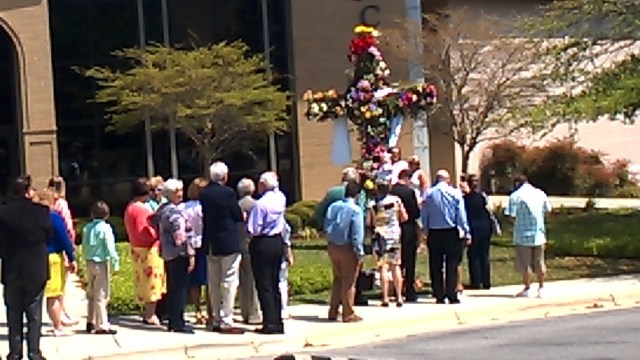
Flowering cross

5 Things to Remember on Election Day

As voters head to the polls this year, some are elated, some are frustrated, and some are just downright angry. Some citizens question the honesty of the candidates, others are concerned about hidden agendas, and still others are disheartened about the personal attacks between candidates within the same party.

Let us not forget that voting is a privilege and a responsibility.  No matter who I agree with or disagree with, I have an obligation to vote my convictions, and to encourage others to do the same. Larry Sabato reminds us that “Every election is determined by the people who show up.”

As you prepare to cast your ballot, here are five things I hope you will remember:

  1. Polls can change quickly.
  2. Your vote counts
  3. Character and integrity really do matter.
  4. Faith talk is not the same as faith walk.
  5. Think for yourself and don’t let others tell you how to vote.

Vote wisely, my friends.

(Barry Howard serves as Senior Minister at the First Baptist Church in Pensacola, Florida)

Lessons from Storms Past and Present

by Barry Howard

Early this morning, I drove north on Scenic Highway, one of the most beautiful coastal drives in America. And yet, as the sunrise glistened over Escambia Bay, the picturesque Florida scenery was scarred by nature’s whim.  Stately oaks were uprooted, townhomes were blown from their foundation, homes stood minus their roofs and windows, and neighbors were helping neighbors sift through the debris.

The scene is far too familiar to me. In 1994 I was serving at the First Baptist Church of Williams near Jacksonville, Alabama when a tornado touched down on Palm Sunday near Ragland, Alabama and cut a trail to Rome, Georgia, demolishing hundreds of homes, destroying five church campuses, and taking 29 lives before leaving that area.

In 2005, when I began serving at FBC Pensacola, we dealt with a series of destructive storms including Hurricanes Ivan, Cindy, Dennis, and Katrina. Later, we sent teams to assist with repair and rebuilding after tornadoes in Enterprise, Alabama and Sipsey, Alabama.

Now, here in Escambia County, we have once again experienced two destructive storms within the same week. As we help others put life back together, let us employ the lessons learned from storms past as we help our neighbors rebuild after the storm.

Once a storm passes, residents are faced with a haunting reality. Life will never be the same.  For many, friends have been injured, homes have been destroyed, and irreplaceable family heirlooms lost. A sense of despair prevails.  But for most, at least, life will continue. In fact, this week’s storm cut an 8 mile path damaging over 300 homes, yet there were no fatalities and only minimal injuries.

Following the Palm Sunday tornado and the coastal hurricanes, the communities I served learned a lot about patience and perseverance. We learned a lot about grace and hope. We learned the importance of looking forward and not backward.  We learned that our dreams trumped our nightmares. We learned a lot about faith and life.

At least seven crucial lessons learned from storms past have helped us to heal and move forward, slowly and progressively:

  1. Life goes on after the storm. Once the initial shock of the devastation has been absorbed, it’s time to channel all of your energy to re-building and moving forward. Despite the grief over things lost, there is a unique kind of joy that arises when you begin dreaming of the new things you can build…together. And interestingly, the challenge of re-building had a healing effect and can be a healthy way to process the grief of storm-associated losses.
  1. When a storm hits, no one is exempt. Storms result from a chaotic weather pattern and they tend to strike indiscriminately. Contrary to religious superstition, storms are not typically God’s way of punishing the most wicked of sinners. Storms affect everyone in their path, whether you are rich or poor, young or old, faithful or faithless. As Grady Nutt used to remind us, “It rains on the just and the unjust, and not always just on the ‘just’.”
  1. When the going gets tough, people of faith mobilize and work together cooperatively. After each of the aforementioned storms, a variety of churches and missional partners organized, rolled up their sleeves, and went to work. Volunteers from faith-based groups often organize quickly and dispatch to the scene, while professional and government groups are often slowed by paperwork and red tape restrictions. I distinctly remember many of the professional workers who partnered with us telling me how they admired the work ethic, the productivity, and the cooperative spirit of the volunteer teams from churches and faith-based organizations.
  1. All kinds of talents and skill levels are needed for clean-up and re-building. We were fortunate to have a huge corps of skilled personnel who managed chain saws, dozers, cranes, and front-end loaders. However, we also needed folks to cook food, drive trucks, pick up debris, run errands, care for children, visit the elderly, sweep the floor, manage communications, and do household cleaning. In disaster relief, every job is important and every volunteer has something to offer. Never underestimate the importance of doing all the good you can, where you can, when you can.

If you want to volunteer, always connect with a group such as the Red Cross, the Salvation Army, BRACE, or a church group. Don’t just strike out on your own. Our staff is currently exploring the best ways for us to connect in Century and Pensacola.

  1. Relief work builds community. We learned that remarkable bonding occurs in the field. The sense of community born among those who work together following a storm forges a spiritual kinship that lasts for a lifetime… or longer.
  1. You are wise not to live in fear of the next storm. Those affected by storms may be inclined to experience storm phobia, a fear of storms. Many begin to live in such a heightened state of anxiety, that every cloud invokes a near panic attack.  One alternative to living in fear is to be better prepared for the next storm. Perhaps that means creating a storm preparation checklist.  Or possibly that means better implementation of a storm safety plan.  Time and energy spent worrying about something as unpredictable as a future storm is wasted energy. It is best to find creative ways to transform that energy into constructive preparation.
  1. The process of going through a storm can deepen your spiritual faith. For some, simply the experience of having a “close call” with death provokes a profound sense of one’s mortality. For others, there is a sense of a “new lease on life,” that translates into a commitment to live in a deeper and more meaningful sort of way. For still others, during the rebuilding process they discover a community of friends who inspire them toward a more authentic and honest understanding of faith, a faith they want and often claim for themselves.

This week many of us have grieved with and prayed for friends and neighbors after storms have wreaked havoc in local neighborhoods. I am sure the local residents are feeling shock, anger, and a nearly overwhelming sense of despair.

But the people of Escambia County are resilient. In the next few days, relief agencies and churches will mobilize labor pools and resource centers.  And residents will be drying their tears, rolling up their sleeves, and getting ready to repair and rebuild, because there are some things deep inside that the strongest storm cannot destroy.

(Barry Howard serves as the Senior Minister at the First Baptist Church in Pensacola, Florida.)

Politics in the Pulpit: One Pastor’s Approach

by Barry Howard

Election years can be volatile, unpredictable, and filled with heated political rhetoric. And these days, it is not unusual for prominent pastors and local clergy to join the fray of bombastic oratory. While I do not think pastors should be silent, I do think a pastor’s tone and message should be helpful, encouraging, and non-partisan.

Especially during election years, pastors are faced with the dilemma of how to address political issues fairly, legally, and biblically from the pulpit. While some on both the left and the right attempt to hijack the pulpit in order to support their cause or their favored candidate, many of us in ministry strive to encourage members to participate in the political process but we refuse to endorse any specific candidate.

This year marks the ninth presidential election since I began serving as a pastor. Additionally, during my ministerial tenure, I have observed numerous local elections and dozens of referendums. Early in my ministry, thanks to wise mentors, I committed to a strategy for dealing pastorally with political issues from the pulpit.

This strategy is based on four objectives: 1) To maintain a non-partisan pulpit. 2) To protect the separation of church and state. 3) To respect the diverse political convictions within the congregation. 4) To highlight the biblical texts concerning respect for our government and our governmental leaders.

When I hear accounts of ministers who publicly endorse candidates from the pulpit, of churches who provide biased or partisan voters’ guides and of churches who have invited political candidates or their spokespersons to speak in Sunday worship services, I am troubled. From a historical Baptist perspective, for a pastor to engage in partisan politics would be considered an abuse of pastoral privilege and a violation of a pastor’s civil and spiritual responsibility. Historically, when the church and state become intertwined, the church doesn’t fare well.

If blatant partisan political activism in the pulpit is inappropriate, what is an appropriate and proactive strategy for addressing election-related issues from the pulpit without violating the wall of separation? Here are four things that a pastor can do to encourage good citizenship:

  1. Encourage members to vote. Words like these have frequented my sermons as election time nears: “We are blessed to live in a country that values political and religious freedom, and you have both the opportunity and responsibility to participate in the electoral process as you vote your convictions.” I have never suggested to a church member, either explicitly or implicitly, for whom they should vote, only that they should vote. In fact, I have never revealed to a congregation the name of the candidate I intend to vote for. (Actually, I seldom tell my wife which candidate I plan to vote for.)
  1. Challenge church members to pray for candidates and for those elected to leadership. I believe that persons of faith should pray for their political leaders, whether they approve of a leader’s performance or not. Additionally, I also encourage church members to pray for candidates seeking office. Choosing to seek public office requires tremendous sacrifice and takes its toll on a candidate’s entire family whether they win or lose. The average citizen cannot fathom the wear and tear of the political process for all candidates, no matter their political party.
  1. Encourage members to participate in the political process. Challenge members to listen carefully to the candidates, to engage in civil dialogue about the important issues, and to consider campaigning for their preferred candidate. When considering which candidate to support, it is fair to evaluate the competency, character, and ideological convictions of the candidate. However, I strive to remind others that name-calling, broad-brushing, and dishonesty, though prevalent at times, do not enhance the political process.
  1. Finally, I invite church members to consider running for public office. Just as I invite members to consider a vocation ministry, mission service or a host of other careers, I also invite members to consider political service as a part of their spiritual calling. I have been privileged to serve as pastor to candidates on the local, state and national level, many of whom were elected and enjoyed multiple terms of effective service. Although an individual should never enter the political arena naively, many individuals find political office to be a significant avenue of service for the common good of society.

Although the Bible instructs believers to “render unto Caesar,” the Bible does not seem to anticipate a democratic process wherein citizens participate in choosing “Caesar.” Therefore, there is not a specific “how to behave during an election year” passage in scripture. However, many of the texts that equip us for life, verses such as “let all things be done decently and in order” (I Corinthians 14:40), “pray for your leaders” (I Timothy 2:2), and “do not slander one another” (James 4:11), are especially relevant and applicable for an election year.

The pulpit is a place to accent the privilege and responsibility of choosing our leaders, not a place to dictate the decision.

(Barry Howard serves as the Senior Minister at the First Baptist Church in Pensacola, Florida.)

The View from Where Dr. King Stood

I grew up in Alabama in the heat of the Civil Rights Movement. I was a child when the Freedom Riders’ bus was attacked by a hostile mob and burned a few miles from our home near Anniston.  The name of Dr. Martin Luther King, Jr. was vaguely familiar to me, but only as a name in a news headline or a textbook. I knew little about the man himself. That is, until 1982.

During my senior year at Jacksonville State University, I participated in a field trip to Atlanta with the Sociology Club. We visited several sites of social and cultural significance including the Atlanta Federal Corrections Facility, the Grady Hospital, the Ebenezer Baptist Church and the King Center.

While touring the sanctuary of the Ebenezer Baptist Church, another student and I ventured into the pulpit and stood briefly where Dr. King had stood to preach. The hostess immediately reprimanded us, informing us that in their church tradition, only ministers of the gospel were allowed to “stand behind the sacred desk.”  I relieved her sense of alarm by informing her that I was a “licensed” Baptist minister and that my friend was preparing to be an Episcopal priest, a claim which our faculty sponsor, Dr. Rodney Friery, confirmed for the hostess.

Upon learning of our ministerial affiliation, the hostess allowed us to take in the view from one of the most strategic pulpits in our nation’s history.  Then she invited us to follow her to the King Center adjacent to the historic church where she led us through the Archives Area, and then through a door that was labeled “Authorized Personnel Only.”

Once inside, we discovered we were in an expansive storage facility with row after row of shelves containing hundreds of boxes. She took a couple of boxes from the shelves, opened them, and allowed us to view the contents. We quickly realized that the hostess was giving us the privilege of examining some of Dr. King’s personal sermon notes, and speeches, and correspondence. This information was being stored temporarily and would soon be processed for the archives.

The notes we scanned were mostly handwritten on hotel stationary, restaurant napkins, used mailing envelopes, and on the backside of “incoming” personal letters. While many respected orators labor intensively over manuscripts, revising multiple drafts in order to arrive at just the right script, it was obvious that Dr. King had a rhetorical gift for rendering a speech extemporaneously from a few scribbled notes.

After a half an hour or so, our time was up and we rejoined the others in our group. Only years later have I come to realize the distinct privilege given to us that day in Atlanta. Since that time, I have read most of Dr. King’s published writings as well as many commentaries and editorials about Dr. King’s life.

I will remember Dr. King as a distinguished Baptist minister. Following seminary, he served as pastor of the Dexter Avenue Baptist Church in Montgomery, Alabama. Later, he succeeded his father, Dr. Martin Luther King, Sr., as pastor of the Ebenezer Baptist Church in Atlanta.

I will remember Dr King as an insightful theologian. After graduating from Morehouse College in 1948, he went on to study theology at the Crozer Theological Seminary in Chester, Pennsylvania. He completed a doctorate in systematic theology at Boston University in 1955.  His study of the prophets served as a catalyst for his own prophetic vision.

I will remember Dr. King as a courageous civil rights advocate. His dream of equality for all people became contagious and continues to inspire a commitment to liberty and justice for all people in our nation and around the world.

In March of 1964, Dr. King was named Time Magazine’s “Man of the Year.” In December of 1964, he was awarded the Nobel Peace Prize. On April 4, 1968 Dr. King was assassinated in Memphis, Tennessee. The voice and vision of Dr. Martin Luther King, Jr. helped shape a movement that transformed a nation.  And we would do well to learn from his prophetic voice, his relentless pursuit of freedom, and his strategy for nonviolent protests and peaceful resistance.

(Dr. Barry Howard serves as the Lead Pastor at the First Baptist Church in Pensacola, Florida.)

Sixteen Books I Plan to Read in 2016

by Barry Howard

My love for reading was slow to develop. During my teenage years, I perceived reading to be a nuisance and necessary evil. At some point during my college years, however, I learned to enjoy reading, not just for assignments or entertainment, but for personal growth. In my current stage of life I need books like I need food, to satisfy cognitive hunger and to probe intellectual curiosity. Books stimulate my thinking, exercise my memory muscles, and challenge my presuppositions.

Typically, I read a variety of genres including fiction, spirituality, theology, history, and biography. And I usually keep from three to five books going at the same time, a discipline that was recommended by Opal Lovett, one of my favorite university professors. This practice invites a variety of conversation partners into my internal dialogue.

As the current year comes to a close, I make a list of books that I plan to read during the coming year. While I hope to read 40-50 books this year, I have already compiled a list of 16 of the books I plan to read in 2016:

    1. Grounded: Finding God in the World__ A Spiritual Revolution by Diana Butler Bass
    2. My Southern Journey: True Southern Stories from the Heart of the South by Rick Bragg
    3. The Call: The Life and Message of the Apostle Paul by Adam Hamilton
    4. Chosen?: Reading the Bible Amid the Israeli-Palestinian Conflict by Walter Brueggemann
    5. Searching for Sunday: Loving, Leaving, Finding the Church by Rachel Held Evans
    6. Lasting Impact: 7 Powerful Conversations That Will Help Your Church Grow by Carey Niewhof
    7. Accidental Saints: Finding God in All the Wrong People by Nadia Bolz-Weber
    8. I Will: Nine Traits of the Outwardly Focused Christian by Thom Rainer
    9. Preaching: Communicating Faith in an Age of Skepticism by Tim Keller
    10. Thinking About God: An Introduction to Christian Theology (3rd edition) by Fisher Humphreys
    11. Did God Kill Jesus? Searching for Love in History’s Most Famous Execution by Tony Jones
    12. Rogue Lawyer by John Grisham
    13. The Guilty by David Baldacci
    14. Albert Einstein: The Life of a Genius by Jack Steinberg
    15. All the Light We Cannot See by Anthony Doerr
    16. A Fellowship of Differents: Showing the World God’s Design of Our Life Together by Scot McKnight

I have discovered that reading authors who write from diverse perspectives stretches my thinking and expands my capacity to relate to variety of people.

This year don’t just read the spiritual stuff that reinforces what you think you know with certainty. Dare to read something that challenges you to think about life and faith from a different point of view.

Happy reading in 2016!

(Barry Howard serves as the Lead Pastor at the First Baptist Church in Pensacola.)

Making Our List, Checking It Twice

At our house we make a lot of lists, especially in December…the grocery list, the Christmas card list, the gift list, the guest list, the holiday event list, and the end-of-year giving list. During this week between Christmas and the beginning of the New Year, all of the items on those lists have been checked off and completed except for the final list. Today we are working on our end-of-year giving list.

Throughout the year, our tithe, the first tenth of our earnings, goes to the ministries of our church. For us, this is first and foremost an act of obedience to what we believe the Bible teaches about Christian stewardship. But through the years we have also observed that the cumulative ministry projects of a local church make the most significant impact in meeting physical and spiritual human needs, locally and globally. So in addition to the work of our local church, every December we give a gift to our Christmas Missions Offering, which supports the work of missionaries around the globe.

Amanda and I are blessed to be able to contribute to a few other ministries and organizations that we are passionate about. While there are many agencies that do extremely good work, we tend to support missional entities who aim to equip, inform, or complement the work of the local church because we believe “the local church is where the action is.”

In recent years the process has become much easier due to the advent of electronic giving.   Most ministries and charitable organizations, including our church, now have an “online giving” link that enables us to transfer our gifts directly from our account to the designated recipient. Of course you can still mail a check or personally deliver a contribution, but we have discovered electronic giving to be safe and immediate, and electronic receipts are provided for good record keeping.

In contrast to high pressured, guilt-riddled solicitations for contributions, the Bible encourages discernment and good cheer in giving: “Each of you should give what you have decided in your heart to give, not reluctantly or under compulsion, for God loves a cheerful giver” (2 Corinthians 9:7).

As you determine and designate your end-of-year gifts, be cheerful, generous and wise. And remember, as you prepare to submit end-of-year gifts, the IRS requires that all contributions for this fiscal year be received, electronically transferred, or postmarked by December 31.

So today, we are making our list, checking it twice, and then hitting “send.”

(Barry Howard serves as Senior Minister at the First Baptist Church in Pensacola, Florida.)

Let There Be Peace on Earth

by Barry Howard

He will judge between the nations
and will settle disputes for many peoples.
They will beat their swords into plowshares
and their spears into pruning hooks.
Nation will not take up sword against nation,
nor will they train for war anymore.
Isaiah 2:4 NIV

Since childhood, I have been singing and praying, “Let there be peace on earth.” But this prayer has not been answered…yet.  To date, we cannot identify an era in human history when the world was completely devoid of conflict or warfare.

On the second page of Genesis, the paradise called Eden is contaminated by sin, and then a couple of pages later, a fatal conflict erupts between Cain and Abel. The notion of war is born.

In the Old Testament, not only is there regional conflict between the Israelites and a variety of enemies, there is also internal conflict between Israel and Judah. This civil war eventually led to the establishment, at least for a few years, of the Southern Kingdom and the Northern Kingdom, often referred to as the Divided Kingdom.  That’s what war does. It rouses suspicion, ramps us rhetoric, breeds hostility, and divides people into adversarial camps like the North and the South.

Fast forward to 2015. This year there are at least 10 active wars and 20 ongoing armed conflicts.  The most lethal war is currently being waged in Syria, an ancient biblical land, where it is reported that over 250,000 people have been killed during the past three years.

But the promise of scripture is that there will come a day when they will transform their instruments of war into tools for agriculture (Isaiah 2:4). Just not yet.

Until then we cannot recline in naïveté. In a world where systemic evil exists, when efforts at negotiation and arbitration have failed, military initiative is often an unfortunate but necessary option to destabilize tyrants, to rescue hostages, and to thwart terrorism. But even then, for civilized nations, the goal is to be protective, not vindictive.

Especially in these days of escalated fear, let us pray for peace, let us work for peace, let us practice peace-making, and let us keep singing:

Let there be peace on earth
And let it begin with me.
Let there be peace on earth
The peace that was meant to be.
With God as our father
Brothers all are we.
Let me walk with my brother
In perfect harmony.”
-Jill Jackson Miller and Sy Miller

As we prepare to celebrate the birth of the Prince of Peace this Christmas, let us continue advocating for discernment, containment, peaceful negotiations, and the eventual end of all wars, until that day when peace prevails.

(Barry Howard serves as the Senior Minister of First Baptist Church of Pensacola.)

Don’t Let the Darkness Eclipse the Light of Christmas

by Barry Howard


It’s dark outside, and today seems even darker than usual. And it should. Today is the darkest day of the year.

For those of us who live in the northern hemisphere, the shortest day of the year, the Winter Solstice, usually occurs on December 21. The solstice, which literally means “sun stood still,” officially marks the beginning of winter. More notably, with the shortest day also comes the longest period of darkness.  The Earth’s axial tilt is at its furthest point from the sun, allowing the least amount of daylight to reach the earth.

While it may be merely coincidental that the darkest day arrives just prior to our customary celebration of Christmas, from my experience as a pastor, I am aware that holidays can be dark days emotionally for many of us. While there are a variety of events, experiences, and emotions that cast dark shadows over our lives, some even bleak enough to obscure the joy of Christmas, a prominent culprit is grief.

Grief comes in many shapes and sizes. In the human experience, we grieve over the death of friends and loved ones. We grieve over disintegration of a marriage. We grieve over friction within the family. We grieve over the loss of a job. We grieve over tragic events around the globe. At times we may even grieve over our diminishing health, the loss of our dreams, or the fading of opportunities.

Let me be quick to affirm that grieving is healthy as long as we are progressing through the grief process as opposed to becoming stuck in our grief. The Bible never tells us not to grieve, but it does counsel us not to grieve “as those who have no hope” (I Thessalonians 4:13).

Be aware that the empty chair at the Christmas dinner table, the Christmas card labeled “return to sender,” or the empty pillow on the other side of the bed can all trigger a seemingly overwhelming sense of darkness, loneliness, or grief.

Unprocessed grief is unhealthy and can lead to anger, depression, or even physical illness.   During the holidays, rather than being overwhelmed by the darkness of grief, look your grief in the eye and call it by name. Don’t deny it or ignore it.  And certainly don’t let grief dictate or dominate the mood or conversation of your holiday celebration.

I am convinced that because we are “fearfully and wonderfully made” (Psalm 139:14), our faith gives us the capacity to experience the pangs of grief and “the peace of God, that transcends all understanding” (Philippians 4:7) simultaneously.  Our faith does not exempt us from the darkness, but our faith does equip us to deal with our grief with deep-seeded hope.

Hinting at what life will be like when the promised Messiah comes, Isaiah 9:2 envisions that, “The people walking in darkness have seen a great light; on those living in the land of deep darkness a light has dawned.”

Walk through the darkness with courage. Just don’t take up residence in the shadows. Grief does not have the final word. After the long night of darkness, then comes the light.

Don’t let the darkness eclipse the Light of Christmas.

(Barry Howard serves as Senior Minister of the First Baptist Church of Pensacola.)

An Unforgettable Visit to Pearl Harbor

As a kid growing up in rural Alabama, I never dreamed I would have the opportunity to travel broadly. For us, making the journey from Anniston to Eastwood Mall in Birmingham was like a mini-vacation.

Going to an exotic location, like Hawaii, seemed out of the question.  However, in 1995 I made my first trip to Hawaii, and of course, Pearl Harbor was high on my list of sites to visit.  The 4414 mile trek from my hometown to the Aloha State was quite an enjoyable adventure, however, my first trip to Pearl Harbor would not be the most memorable of my visits there.

I was raised near Pelham Range and Fort McClellan in Calhoun County. Seeing military convoys traveling the highways and hearing artillery fire from the range was a routine part of life. Later, when I served as an associate minister at the First Baptist Church of Weaver, near the army base, and even later, as I taught on the adjunct faculty at the college on the base, I developed significant friendships with military personnel. As long as I can remember, I have had a deep sense of gratitude for veterans and a profound sense of gratitude for all of our military personnel.

I think anyone who visits Pearl Harbor is overwhelmed with emotion. As I watched tourists and veterans alike walk around the monument reading the list of names with reverent silence and then gaze in the water at the rusted vessel, I thought about the families who never saw their young men and women return home.

Mostly due to a missions partnership we had developed through our church, I made subsequent visits to Hawaii in 1996, 1998, 1999, and 2000. My most memorable visit occurred in 1999. That year I had the privilege of taking my friend, Mack Jones of Corbin, Kentucky, on his first trip to Hawaii. Mack’s brother, Edward, died January 5, 1944 in the aftermath of the attacks on Pearl Harbor and is buried at the National Cemetery of the Pacific, also known as “Punchbowl.”

On a prior trip, a group of us, including Mack’s wife, Wylene, had visited Punchbowl, located the headstone for Edward W. Jones, taken a few photos, and then did a pencil tracing of the gravemarker to take home to Mack.

The next year, we were privileged to return, and this time Mack went with us. First we traveled up the hill to Punchbowl and visited Edward’s grave. Then we traveled to Pearl Harbor to visit the memorial. As a group of us stood alongside our friend, whose brother never returned home to Kentucky, we were even more aware of the sobering reality of war, and even more appreciative of the sacrifices of those who paid the price of our freedom with their own blood.

Since I have moved to Pensacola, I have conducted over 125 services at Barrancas National Cemetery located at the Naval Air Station here. As a minister, I am honored to share words in memoriam for veterans of all ages.

And today, as I think about that unforgettable visit to Pearl Harbor and Punchbowl, and my many other visits to Barrancas, Eisenhower, and Arlington National Cemeteries, I am also praying that somehow, in a world threatened by “wars and rumors of wars,” we can advance toward “peace on earth and goodwill to all humankind.”

(Barry Howard serves as the senior minister at the First Baptist Church in Pensacola, Florida.)