

10 Life Lessons I Am Learning from Golf

Even in my 30s, I never imagined myself playing golf. Our high school didn’t have a golf team at the time. I didn’t enjoy watching golf on TV. There were only a few courses in our part of the state. Apart from pastoral responsibilities, most of my time was spent on continuing education.

Once we moved to Kentucky and I finished my educational programs, I took an occasional walk at the course near our home. One afternoon, a few friends from my breakfast group put a seven-iron in my hand and challenged me to hit toward the green. I was hooked.

The next morning, my friend, Bob, left a golf bag containing an old set of Power Built clubs and a few golf balls on my porch. I called my friend, Darrell, who had been a high school golf coach earlier in his career, and asked him to give me a few lessons. And I’ve been learning to play the game ever since.

Golf is more than a sport. It’s a mirror of life—frustrating at times, exhilarating at others, and always filled with opportunities to learn. Over the years, I’ve discovered that golf is a surprisingly good teacher, offering lessons that extend far beyond the fairway. Here are ten life lessons golf continues to teach me:

1. Be patient. Progress is gradual. Golf is not a game of instant gratification. The pace is slow, and progress occurs over a prolonged period of time. Bobby Jones once said, “Golf is a game that is played on a five-inch course—the distance between your ears.” Like in life, patience isn’t passive. Patience is the active discipline of steady focus.

2. Every shot counts, but one shot doesn’t define you. One bad swing can feel catastrophic, but the round isn’t lost. Ben Hogan, who came back from a near-fatal car accident to win majors, reminded us: “The most important shot in golf is the next one.” That’s also true in life. Mistakes don’t define us unless we stop moving forward.

3. Practice and preparation matter. Arnold Palmer became famous for his pre-shot routine. He believed consistency in preparation led to consistency in play. The same is true in life: the habits we practice daily—prayer, reflection, study, planning, exercise, visioning, work ethic—shape how we perform when it counts.

4. There are many factors outside your control. A sudden gust of wind, a bad bounce off a tree, or a tricky lie in the rough all remind us of life’s unpredictability. As in faith, the key is learning to let go of what we cannot control and focus on how we respond.

5. Respect the game and the other participants. Golf is built on etiquette, which includes things like replacing divots, being quiet during another’s swing, and respecting the pace of play. This culture of respect is a life lesson we need off the course, too. One of those lessons is to treat others with dignity in all kinds of circumstances.

6. Be flexible and learn to adapt to unfairness. Courses are different, weather changes, and no two rounds are the same. Jack Nicklaus once said, “Golf is not, and never has been, a fair game.” Adaptability, whether on the 18th green or in the twists of life, is the difference between frustration and resilience.

7. The mental part of the game is as important as the physical. Golf legends like Tiger Woods talk often about mental toughness. You can have the best equipment, but without focus and confidence, the game unravels. Our mindset in life can determine our outcome or effectiveness.

8. Relationships enrich the game. While golf can be played alone, it is most often enjoyed with others. I have continued playing golf more for the friendships than the progress of my game. Some of the best conversations happen walking down a fairway. Similarly, life is richer when shared in community with others such as your family, friends, and church. A deep sense of community is what makes life’s journey meaningful.

9. Enjoy the scenery along the way. Another reason I’ve continued playing golf is that I enjoy the outdoor landscape. Golf courses are often constructed in beautiful settings. If all you focus on is your score, you’ll miss the sunrise over the trees or the quiet stillness of a lake or the deer running across the fairway or the eagle soaring overhead. Life, too, is more than deadlines and goals. Life goes better when you take time to notice the beauty of creation.

10. No matter how you start, you can finish well. A round of golf is judged by how you finish, not how you start. Gary Player, known for his determination, once said, “The harder you work, the luckier you get.” The same applies to life. Finishing with integrity, faithfulness, and determination, especially when you’ve experienced a few setbacks, is challenging but rewarding.

Golf, like life, is both humbling and inspiring. It teaches patience, resilience, and gratitude. It sharpens our focus and tests our ability to remain calm under pressure. The next time you step on the course, remember, golf is not just about the score. It’s about enjoying the day and soaking up the lessons learned along the way. And I’m still learning.

Teeing It Up: A Brief History of the Golf Ball

Long before I started playing golf, I collected golf balls as a hobby. Some were gifts from friends and church members. Others I picked up while walking near the local golf course. I kept the ones with interesting logos and gave the others to high school students or local golfers.

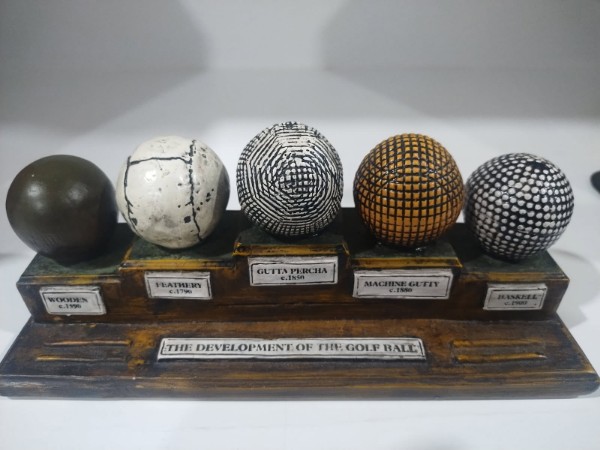
Once I started learning to play golf, the gifts of golf balls increased, as did other golf décor such as artwork, divot repair tools, and ball markers. One of my favorite items is a desktop display of the history of the golf ball. It was presented to me by a dear church member who purchased it at yard sale and said, “When I saw this, I thought of you and your love for golf and for history.” She was right, of course.

Golf is a game of paradox, quiet and contemplative, yet competitive and exacting. It tests patience, precision, and perspective. Among all the tools of the game, the golf ball might be the most underestimated. Small, round, and seemingly ordinary, the golf ball has a rich history that mirrors not only the development of the game, but also the art of resilience, innovation, and persistence.

From hardwood cores to high-tech polymers, the evolution of the golf ball mirrors not only the development of a game but the spirit of persistence, innovation, and redemption.

The Wooden Ball

Before golf was golf as we know it, players in 14th and 15th century Scotland struck solid hardwood balls made from boxwood, beech, or elm. These early golf balls were heavy, durable, and prone to unpredictable bounces. They didn’t fly far, but they rolled, and that was enough to get the game started.

In those early days, the course was the rugged Scottish terrain, the club was a curved stick, and the ball was whatever would move. The simplicity is humbling.

The Feathery

By the 1600s, the feathery emerged as the elite standard. A feathery was a leather pouch hand-stitched and tightly packed with boiled goose feathers. Once dried, it hardened into a compact sphere. These balls were works of art with each one hand-crafted by artisans who could produce only a few per day.

They were expensive and fragile. Wet weather or a mis-hit could ruin them. Still, they flew straighter and farther than wooden balls, and for nearly 200 years, the feathery reigned supreme.

Golf historian David Hamilton wrote, “The feathery was as delicate as it was costly. A single mis-hit could ruin it.”

The Gutta Percha

In 1848, Scottish clergyman Rev. Robert Paterson introduced the gutta-percha ball, made from the hardened sap of Malaysian sapodilla trees. It was moldable, affordable, and much more durable than featheries.

Known as the “gutty,” this ball democratized golf. More people could play. Courses expanded. The game grew.

At first, gutties were smooth, but golfers soon realized that nicked and scuffed balls flew better, straighter, and farther. So they began carving and hammering patterns into the surface, laying the foundation for the dimpled design still used today.

The Machine-Made Gutty

By the late 1800s, manufacturers began mass-producing gutties using metal molds. This introduced consistency and availability at scale. Golf was no longer just for elites. The industrialization of the gutty helped usher in a new era of public courses, amateur leagues, and expanding global interest.

The Haskell Ball

In 1898, American inventor Coburn Haskell, in collaboration with Bertram Work of the B.F. Goodrich Company, revolutionized the golf ball once again by introducing a wound-rubber core ball. It featured a solid rubber core wrapped in rubber thread, encased in a gutta-percha shell.

The Haskell ball flew farther than any ball before it and changed the competitive dynamics of the game almost overnight. Within a few years, it had replaced the gutty and became the new standard.

In the 1960 U.S. Open, a young Jack Nicklaus famously outdrove Arnold Palmer during a practice round. Palmer, never one to be outdone, asked what ball Jack was using. Nicklaus replied, “The same one you are. I just hit it better.”

No matter how good the golf ball becomes, it will always be dependent on the quality of the swing.

Today’s high-tech, dimpled golf balls are marvels of physics and design. But they owe everything to the wooden spheres, feathery stitches, tree sap, and rubber threads that came before.

So, the next time you tee it up with a Titleist, a Callaway, a Bridgestone, or your favorite brand, remember, you are holding a legacy of resilience and adaptation.

Whether your next shot soars down the fairway or sinks into the sand trap, remember that the game goes on, and so do you.

Swing again. Overcome adversity. Learn. Grow. That’s the story of the golf ball. And maybe, that’s the story of life.

(Barry Howard is a retired pastor who now serves as a leadership coach and consultant with the Center for Healthy Churches. He and his wife live on Cove Lake in northeast Alabama.)

A Funny Thing Happened on Hole #12: 5 Things You Should Know About the Unfairness of Life

Life has a way of throwing obstacles in our path, even on the golf course.

Last week, as my friends and I were playing a round of golf on the Twin Bridges Course in Gadsden, Alabama, a funny thing happened on hole #12. All three of us had hit our tee shot on this short par 3 when I noticed movement in the greenside bunker. A dark figure was emerging from the bunker which at first looked like a large black bear. Then the one figure separated into two, and we realized that two labs, one black and one chocolate, had been napping and were probably roused by the sound of our golf balls landing on the green. Mike hit on the fringe, I hit in the middle of the green (a rare occurrence), and Bruce hit about 6 ft from the pin.

As we started to walk to our cart, I noticed the dogs sniffing Mike’s ball. Then the chocolate lab picked it up, much like a retriever does a tennis ball, and dropped it in the same location he found it. Both dogs then moved onto the green and sniffed Bruce’s ball. The black lab picked it up and carried it over to the fringe some 30 feet away and dropped it beside Mike’s ball. As we drove our carts toward the green, both dogs bolted before playing havoc with my ball. Of course, we returned Bruce’s ball to its rightful location and all three proceeded to par the hole (also a rare occurrence).

In 1998 at the Player’s Championship at TPC Sawgrass in Ponta Vedra, Florida, a bird picked up Brad Fabel’s ball on the island green and dropped it in the water. What is the recourse for the player? The PGA rule book says, “If a bird picks up your golf ball, according to the rules of golf (Rule 18-1), you must replace the ball at its original spot where it was picked up, and no penalty is incurred. If you are unsure of the exact location, you can approximate it.”

Golf is challenging enough without an unexpected culprit giving you an unfair disadvantage. The same is true in other aspects of life. Except in life, you cannot always rectify, replace, or remove the unfairness.

A few years back, my wife and I played a round of golf with friends in north Georgia. One of our friends hit a long fading drive into the trees down the right side of the fairway. But when his golf ball hit the trees, it ricocheted back into the fairway leaving him a clear shot to the green. He grinned and said, “There was a friendly monkey in those trees.” That is a common idiom among golfers. Where did that phrase originate?

Several years ago, I read the book, Play the Ball Where the Monkey Drops It, by Presbyterian minister Gregory Knox Jones. The setting is a time when India was under British colonial rule. Here is a brief summary of his story:

There were British living in Calcutta that found they really missed the game of golf. So, they built a golf course in Calcutta. But playing golf in Calcutta posed a very unique challenge because of obnoxious monkeys.

When golfers would attempt to play golf, the monkeys were fascinated, and they would take the little white balls and just throw them everywhere. This, of course, irritated the British colonialists and golf enthusiasts to no end.

So, they decided they had to come up with a plan. They were going to build a fence around the entire golf course. This sounded like a great plan…on paper. But while a fence can be very effective in keeping other animals from creating mischief, it’s not very effective with monkeys because monkeys love to climb! So, the monkeys would scamper up one side of the fence and scamper down the other and play with the little white golf balls as they did before.

Next, the British tried to lure the monkeys away from the course. But whatever lure they tried to use, nothing was as appealing as watching the human beings go crazy whenever the monkeys messed with the little white balls.

So, finally, the British in Calcutta developed a novel and unique golf course rule. And the rule was, “You simply play the ball where the monkey drops it.”

As you can imagine, playing golf this way could be exasperating. You might have, for the first time in your life, that perfect drive down the center of the fairway, and then a monkey comes along and throws your ball in the rough. Or, you could have a hook or slice that produces a miserable lie, and then a monkey tosses it back out onto the fairway for you. You simply play the ball where the monkey drops it. (Gregory Knox Jones, Play the Ball Where the Monkey Drops It: Why We Suffer and How We Can Hope, New York: HarperCollins, 2001, pp. 3-4).

What can we learn from these stories from the golf course?

  • Just in case no one has told you lately, life is not fair. In his book, Disappointment with God, Philip Yancey explains, “We tend to think, Life should be fair because God is fair.’ But God is not life. And if I confuse God with the physical reality of life- by expecting constant good health for example- then I set myself up for crashing disappointment.
  • Bad things regularly happen to good people. The humorist Grady Nutt insisted, “It rains on the just and the unjust, and not always just on the just.” We like to believe that if we do the right things, life will go smoothly. But the reality is that suffering isn’t always tied to wrongdoing. Illness, loss, and hardship strike the just and unjust alike.
  • We are called to be our best selves in the circumstances we are given, not the ones we wish we were given. Valerie Plame advises, “Despite the obvious fault in the universe, it cannot be used as an excuse for not trying to be your best self. Instead, use unfairness as a starting point to be sure that your actions are the best you can muster, and find peace in navigating your time here with grace and humor whenever possible.
  • Our faith does not exempt us from unfairness but rather teaches us to be people of perseverance and endurance. Our faith doesn’t spare us from tough times. Rather, our faith prepares us for tough times. Rather than running from adversity, it is best to call our challenges by name, look them in the eye, and overcome them with strength and determination. Robert Schuller frequently preached, “Tough times never last, but tough people do.”
  • Faith generates hope, and hope conquers despair. We all experience feelings of despair and that is not a sin. It is, however, a sin to wallow in the muck and mire of despair and dissolve into hopelessness. Lamentations 3:21-22 testifies, “Yet this I call to mind and therefore I have hope:Because of the Lord’s great love we are not consumed, for his compassions never fail.”

Life isn’t fair, but we don’t have to let that reality defeat us. Instead, we can choose to live with faith, resilience, and a commitment to doing what’s right. Hardships will come, but they don’t have to define us. The way we respond to life’s unfairness can shape us into stronger, wiser, and more compassionate people.

As you approach your hole #12 and you see dogs in the bunker or hear monkeys rustling in the trees, remember the words of Ben Hogan: “The most important shot in golf is the next one.” The same is true in life.

(Barry Howard is a retired pastor who serves as a leadership coach and consultant with the Center for Healthy Churches.)