Tyler Knott insists, “Mountains know secrets we need to learn. That it might take time, it might be hard, but if you just hold on long enough, you will find strength to rise up.”
This year we are spending Labor Day weekend in a cabin in Hiawassee, which is one of our favorite places to visit. Our cabin is high on Bell Mountain, just below the historic park and overlook.
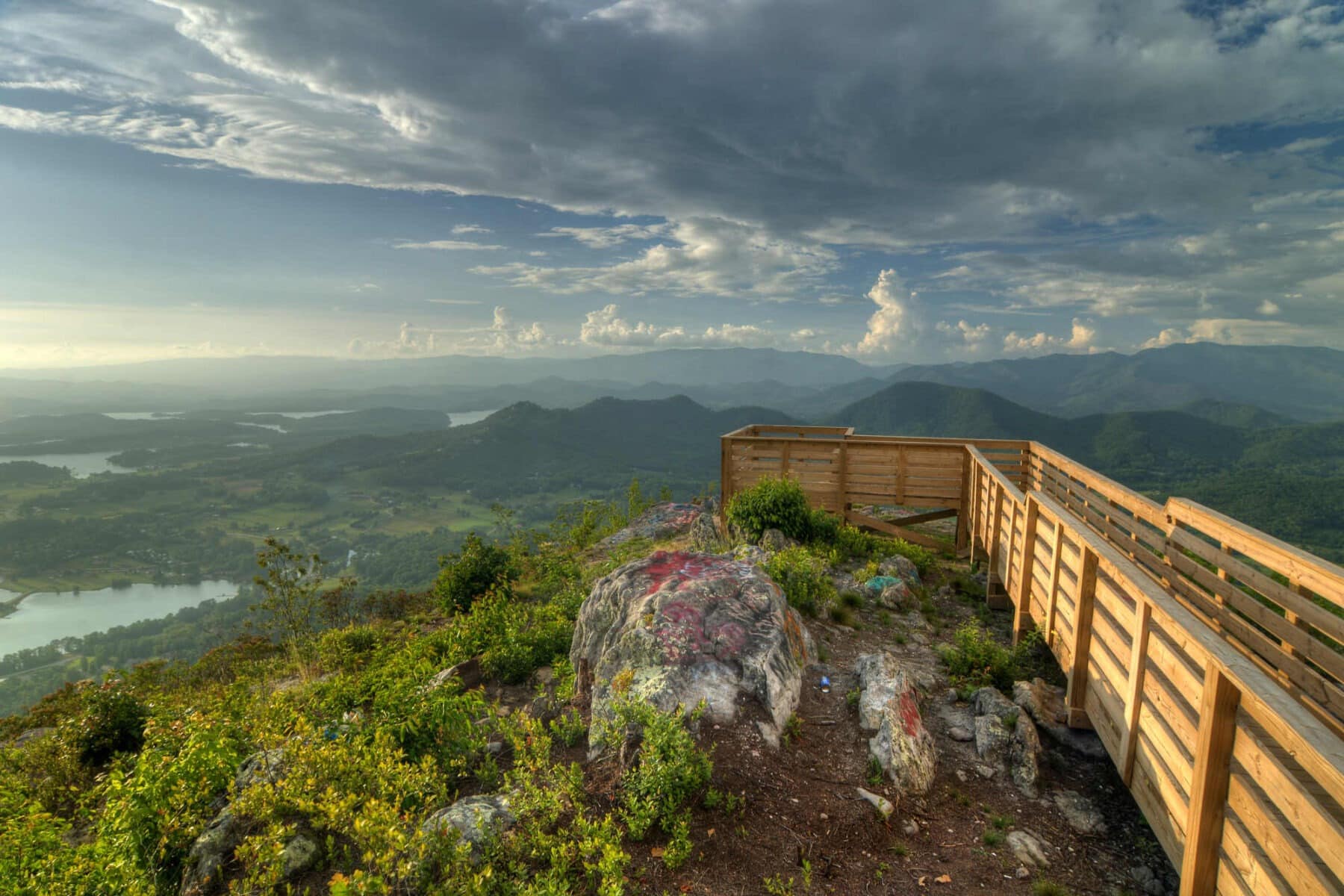
Perched high above Lake Chatuge in the Blue Ridge Mountains, Bell Mountain offers one of the most breathtaking views in North Georgia. But its story is about more than scenery—it’s about scars, preservation, and a community that saw beauty where others saw only rock.
Nowadays, Bell Mountain provides one of the most scenic overlooks in the Appalachian chain. When most travelers think of the peaks of North Georgia, they automatically think of Brasstown Bald, which boasts the highest elevation in the Peach State. However, Bell Mountain, which looms above Lake Chatuge and overlooks the valley to Brasstown Bald, offers a panoramic postcard view of the lake and the North Georgia and Western North Carolina mountainscape.
In the 1960s, Bell Mountain was targeted by the Hiawassee Stone Company, which blasted away at the peak in search of quartzite. The mountain’s once-smooth crown was left jagged and scarred, leading some locals to call it an “eyesore.” Yet others believed that even broken landscapes could hold meaning and purpose.
One such believer was Hal Herrin, a local businessman and conservationist. In 1971, he purchased the mountain and willed it to Towns County so it could be preserved for future generations. For decades, access remained limited, but Herrin’s gift ensured that Bell Mountain would not be lost to industry. In 2016, the county developed the Bell Mountain Park and Historic Site, complete with observation decks and interpretive signs.
Today, visitors can stand where dynamite once shattered stone and instead experience serenity—watching the sun dip behind the peaks or the mist roll across Lake Chatuge. The graffiti that now covers the rock face has become a kind of cultural quirk: while controversial, it is also a reminder of how humans leave their marks, both destructive and creative.
Bell Mountain’s story is one of transformation: what was once blasted and scarred has become a place of reflection and wonder. Standing there, I am reminded that mountains, like people, even wounded ones, still rise to inspire.
 Cove Creek Reflections