Building Bridges Across the Great Divide

http://www.rarehistoricalphotos.com

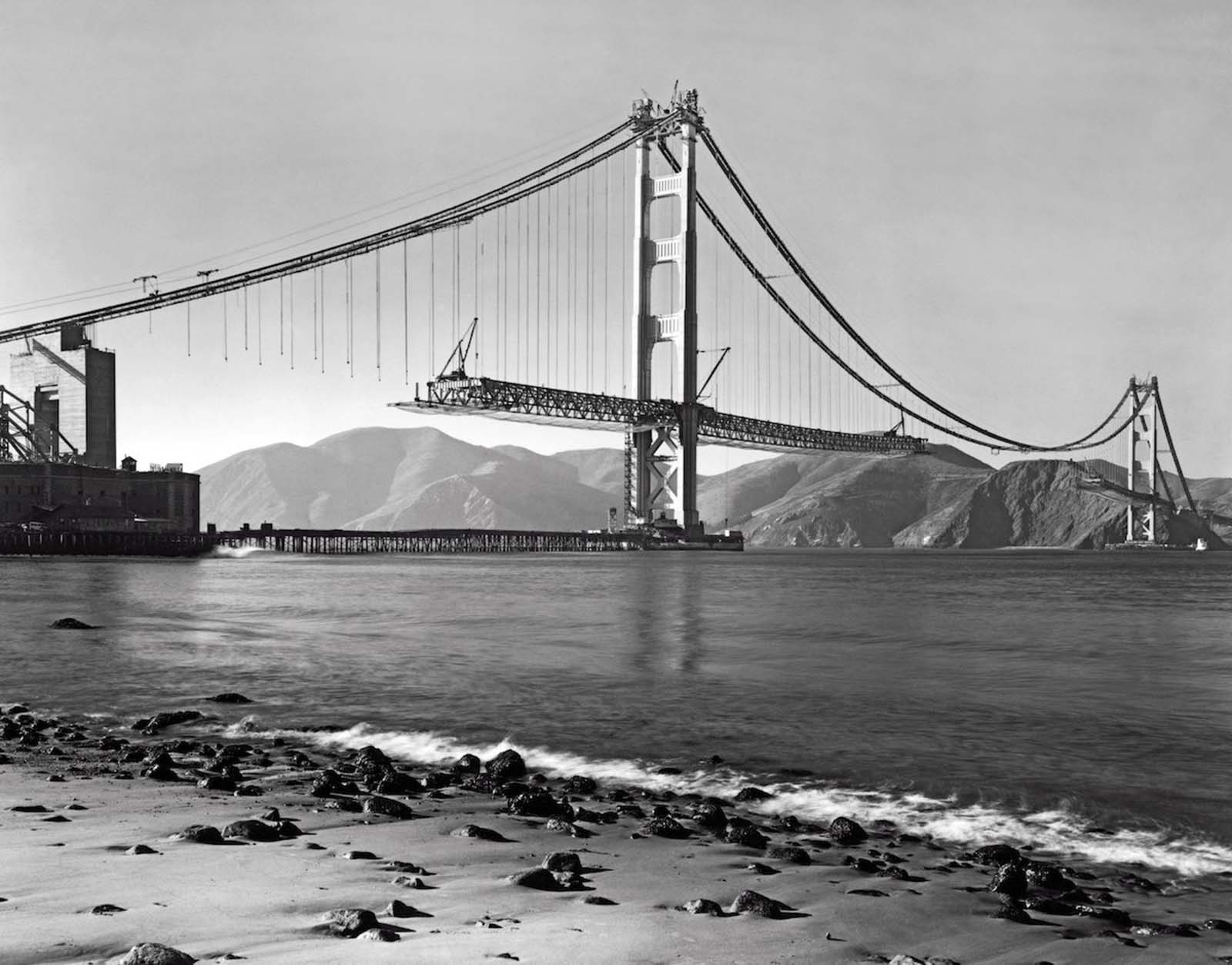
When construction began on the Golden Gate Bridge in 1933, skeptics said it couldn’t be done. The winds were too fierce. The fog too dense. The span too long. But through grit, innovation, and vision, workers united across trades and backgrounds to connect two shores that had long been separated. Against enormous odds, the bridge was completed in 1937 and still stands today. It is not just as an engineering marvel, but a symbol of what’s possible when people work together to span what divides them.

Our nation needs that kind of bridge-building again, not with steel and cables, but with courage, empathy, and dialogue.

We are living in a time when division feels more visible and more visceral than ever. Political debates become personal battles. Social media threads unravel into shouting matches. Families gather around dinner tables, uncertain about how to talk about the world without tearing each other apart.

We are, in many ways, a nation of silos, more comfortable in our echo chambers than in conversations that challenge us. But if we want to build a better future, we cannot afford to remain divided. The health of our democracy and the well-being of our families and communities depend on our ability to build bridges across the great divide.

A wise person once remarked, “Unity is not the absence of differences but the presence of mutual respect in the midst of them.”

Division is not new, but it has been amplified. Fueled by polarized media, ideological entrenchment, and the fast-paced spread of misinformation and disinformation, we’ve drifted into a mindset that sees those who disagree with us not as fellow citizens but as threats. That’s a dangerous place for any society to be.

As the late Senator John McCain once warned, “We weaken our greatness when we confuse patriotism with tribal rivalries that have sown resentment and hatred and violence across all the corners of the globe.” Civility isn’t cowardice. It’s a form of courage. And dialogue isn’t defeat; it’s a doorway to understanding.

After the Civil War, President Abraham Lincoln worked not only to reunite the nation politically but to heal it relationally. When criticized for showing kindness to Confederate sympathizers, Lincoln replied, “Do I not destroy my enemies when I make them my friends?” His commitment to unity, even amidst deep division, laid a foundation for national healing, one conversation and one gesture at a time

Recently, I read about a local church and a nearby civic group who hosted a community roundtable with people from across the political spectrum. The conversation was slow and awkward at times, but also honest, respectful, and hopeful. Participants left not with total agreement, but with mutual appreciation and a shared desire to keep the conversation going.

That’s where healing begins: not in uniformity, but in humility and respect.

A shared future requires shared values. Most of us, regardless of political leanings, want similar things: safe communities, healthy families, meaningful work, a stable economy, and a sense of dignity and belonging for all people. When we begin with the values we hold in common, we can face what divides us with greater grace.

To live in unity does not require uniformity of thought, perspective, or conviction. It does require that we build on our common values, even when we don’t share the exact same viewpoint. Rick Warren wisely reminds us, “We don’t have to see eye to eye to walk hand in hand.”

The work of bridge-building is not glamorous. It won’t trend on social media. But it is deeply necessary. It happens in quiet conversations, in community service projects, in choosing curiosity over caricature.

If we want to leave a better world for our children and grandchildren, we must begin not by shouting louder, but by listening deeper. We must become savvy builders who construct bridges, cultivate relationships, and collaborate as problem-solvers. And we must dare to believe that across even the widest divide, bridges can still be built.

Let us be those who build them.

(Barry Howard is a retired pastor who now serves as a leadership coach and consultant with the Center for Healthy Churches. He and his wife live on Cove Lake in northeast Alabama.)

Memorial Day: 5 Reasons Why Remembering Is Important

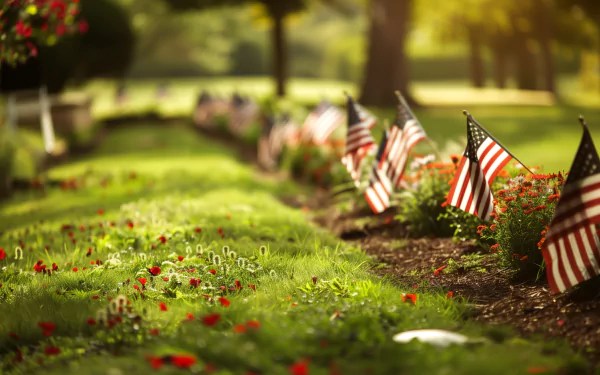
Memorial Day is more than a three-day weekend or the unofficial start of summer. It’s a sacred invitation to pause, reflect, and remember. In a culture that moves at the speed of a scrolling screen, practicing the discipline of remembering has become both countercultural and essential.

This day, set aside to honor those who have given their lives in service to our country, invites us into something deeper than nostalgia. It calls us to gratitude and beckons us to learn from the past.

When we fail to remember the sacrifices of those who came before us, we succumb to a convenient amnesia that gradually robs us of the freedoms we cherish. To fail to remember creates a contagious apathy that leads to a neglect of both our responsibility and our citizenship. To fail to remember can produce a false sense of security and an inaccurate perception that we are exempt from dictatorship and autocracy. If for no other reason, we should remember in order to guard against what George Washington called “the impostures of pretended patriotism.”

As we observe Memorial Day, here are five reflections about the importance of remembering:

  • Remembering is a sacred act. Throughout Scripture, God’s people are called to remember. “Remember the wonders He has done,” the psalmist writes (Psalm 105:5). Jesus, at the Last Supper, told his disciples, “Do this in remembrance of me.” Remembering anchors us. It shapes our identity. It gives context to our present and guidance for our future.

  • Remembering reminds us our freedom was not free. The liberties we enjoy come at a cost. Franklin D. Roosevelt cautioned, “Those who have long enjoyed such privileges as we enjoy forget in time that men have died to win them.”  Memorial Day reminds us that peace is preserved by those willing to risk—and sometimes give—their lives. Honoring the fallen should stir in us a sense of responsibility to live in a way that upholds the values they died defending.
  • Remembering evokes both grief and gratitude. For many, Memorial Day carries deep personal loss. It’s not just a day of flags and flowers—it’s a day when grief resurfaces. And yet, gratitude finds space there too. As one veteran said, “We don’t remember them because they died. We remember them because they lived.” Their stories of courage and selflessness inspire us to live with more purpose and compassion.
  • Remembering can shape us for the better. When we take the time to remember, we grow in empathy. We honor courage. We rediscover our shared humanity. And we are reminded that our freedom, our peace, and our way of life are built on the backs of those who stood in harm’s way for the sake of others. We are also inspired to protect and preserve freedom for those who come after us.
  • Remembering prompts us to pass the memories along to the next generation. Ronald Reagan cautioned, “Freedom is never more than one generation away from extinction. It must be fought for, protected, and handed on for them to do the same.” Our children and grandchildren won’t understand the meaning of Memorial Day unless we tell the stories. Visit a veterans’ cemetery, attend a memorial service, or share the history of someone in your family or community who served. Let them see remembrance in action.

This Memorial Day, let us do more than enjoy a day off. Let us pause. Let us give thanks. Let us reflect on the cost of the liberties we enjoy. Let us teach our children the stories of valor and sacrifice. And let us recommit ourselves to building a world worthy of the lives that were given.

John F. Kennedy insisted, “As we express our gratitude, we must never forget that the highest appreciation is not to utter words, but to live by them.”

Kennedy’s words seem even more relevant today. It’s not enough to say thank you—we must live in a way that honors the gift. Memorial Day challenges us to turn remembrance into action: by serving others, standing up for justice, and living with integrity.

(Barry Howard is a retired pastor who currently serves as a leadership coach and consultant with the Center for Healthy Churches. He and his wife reside on Cove Lake in northeast Alabama.)

Calendaring Easter: Why the Date Changes Every Year

Each spring, folks begin asking a familiar question: “When is Easter this year?”

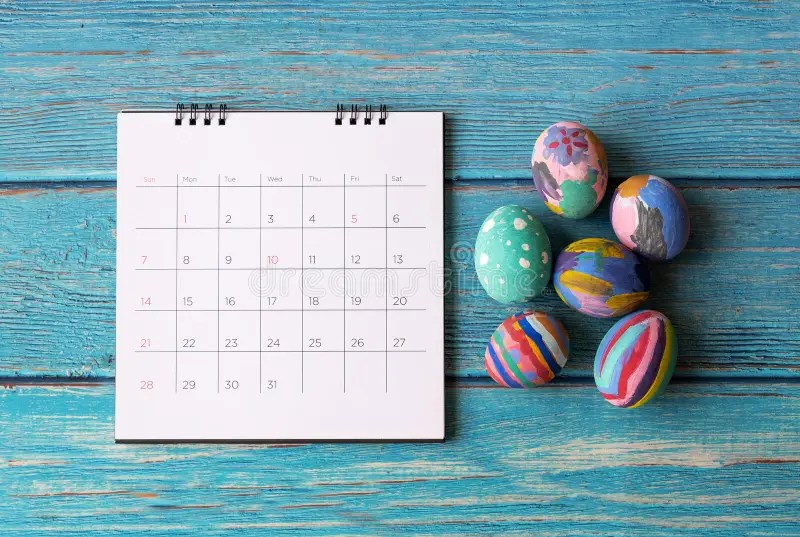
Unlike Christmas, which is fixed on December 25, Easter is on a flexible date—it can fall as early as March 22 or as late as April 25. In 2024, we celebrated Easter on March 31. This year, it arrives on April 20. Next year, it will be April 5. Why the variation?

The date of Easter is not based on the historical anniversary of the resurrection, but rather on a formula tied to the cycles of the moon and the spring equinox. But why?

This very question stirred considerable controversy in the early church. In the middle of the second century, a dispute arose between Christian leaders in Rome and those in Asia Minor over the correct date for Easter. Churches in the East celebrated Easter based on the timing of the Jewish Passover, regardless of the day of the week. Meanwhile, churches in the West believed it should always be observed on a Sunday—the day Jesus rose from the dead.

The debate came to a head when Bishop Polycarp of Smyrna, a disciple of the apostle John, met with Bishop Anicetus of Rome. Though both leaders held deep respect for one another, they could not reconcile their positions. Each continued to celebrate Easter according to his own tradition. Eventually, the controversy escalated to the point where Bishop Victor of Rome excommunicated those who refused to adopt Sunday as the proper day of celebration.

It wasn’t until the Council of Nicaea in A.D. 325, convened by Emperor Constantine, that a standardized formula was adopted: Easter would be observed on the first Sunday following the first full moon on or after March 21 (the approximate date of the spring equinox). This formula is still in use today, tying Easter to both the lunar calendar and the rhythm of spring.

The connection to Passover is not accidental. Jesus celebrated the Last Supper with his disciples during Passover, and his crucifixion and resurrection occurred within that sacred week. The lunar basis of the Easter calendar is a theological reminder of Christianity’s Jewish roots and of God’s redemptive timeline in history.

Even the name “Easter” has curious origins. While the term itself is thought to derive from a pre-Christian spring festival—possibly named for the Teutonic goddess Ēostre—it was reclaimed by the early church as a name for the highest holy day in the Christian faith: the celebration of Christ’s resurrection.

So whether Easter arrives in late March or late April, its timing reminds us that resurrection does not operate on a fixed human schedule. It breaks through at just the right time—according to divine rhythm—not just to mark a date on the calendar, but to awaken new life in our hearts.

Theologian and author N.T. Wright puts it well:

“The message of Easter is that God’s new world has been unveiled in Jesus Christ—and that you’re now invited to belong to it.”

(Barry Howard is a retired pastor who currently serves as a leadership coach with the Center for Healthy Churches. He and his wife reside on Cove Lake in northeast Alabama.)

Love, Faith, and Simplicity: Remembering Our Visit in the Home of President and Mrs. Carter

What is it like to visit the home and the church of a former president?

In the spring of 2012, my wife and I were blessed to spend a week in Plains, Georgia, where I had been invited to lead in revival services at the Maranatha Baptist Church. Their most famous members, Jimmy and Rosalynn Carter, were present in every service.

I first met Governor Jimmy Carter in 1975 when I was a sophomore in high school and he was the featured speaker for the Alabama State FFA Convention in Montgomery. Interestingly the delegates at those conventions were seated in alphabetical order according to the school they represented, and since I served as a delegate from Alexandria High School, I had a front row seat.

Then in 2004, Amanda and I made the pilgrimage to Maranatha to attend President Carter’s Sunday School class and to stand in line with the other worshippers to have a photo taken with the 39th president. On that particular Sunday, Mrs. Carter was traveling internationally with an initiative related to the Carter Center.

Never would I have guessed in 1975 that I would become a pastor and someday preach in President Carter’s home church. After the first service in 2012, the worshippers formed a line to greet the guest preacher and his wife and welcome them to Maranatha. The Carters stood in line like every other member, and when they greeted us, Mrs. Carter welcomed us and commended the sermon, while President Carter shook my hand and kissed my wife on the cheek. She was so in awe of President Carter she quipped, “I may never wash my face again.”

The tradition at Maranatha is for the guest preacher to have lunch with the Carter’s during the revival week. We met the Carter’s at Dylan’s Diner on Wednesday, and then accompanied them to their home for dessert and conversation.

Before departing the restaurant, President Carter took me to every table in the restaurant, asked the patrons where they were from, introduced me as the guest evangelist for their revival, and invited every person in the diner to attend the final service that night. Then he added to his invitation, “If you come, you can sit with me and Rosalynn.” That night the attendance peaked, and the Carters were surrounded by the guests he invited from the restaurant.

The Carter’s home is modest and welcoming. President Carter built most of the furniture. We talked about his upbringing in Plains, his career in the Navy, his visits with world leaders, his work with Habitat for Humanity, his love for the Gulf Coast, and the well-being of several of our mutual friends. It was remarkable to hear stories of his recent conversations with Fidel Castro, and I was particularly interested in his recollections of Israeli Prime Minister Menachem Begin and Egyptian President Anwar Sadat.

Mrs. Carter, who insisted that we call her Rosalynn, had prepared sugar-free banana pudding for our dessert. She served it in a Corningware dish much like my grandmother’s. When I went to the kitchen to assist her with the coffee, I noted that she used a white older model Mr. Coffee coffeemaker, just like the one we use at home. Our visit was rich in simplicity and authenticity.

After we finished dessert, President Carter gave us a tour of his study, where he gave us an overview of some of his newest commentaries, followed by a tour of his workshop, where he showed us a few of his paintings and samples of his woodworks.

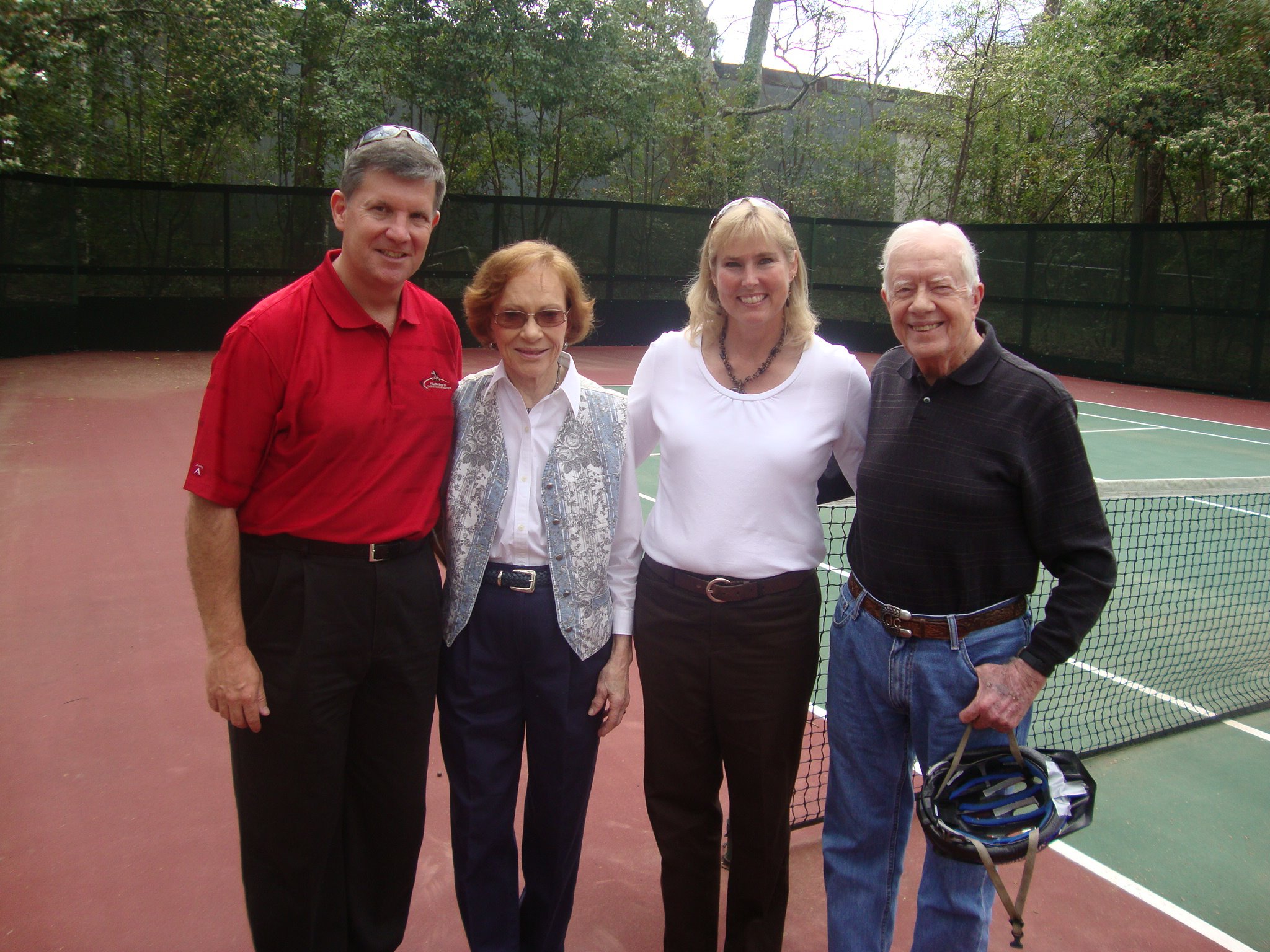
Then he said to Amanda, an avid tennis player, “Would you like to see our tennis court?” After he shared a few tennis stories, he said, “We normally take a photo of the guest minister on the front porch, but since Amanda loves tennis, we can take a photo of the four of us here on the tennis court.” Then he requested that one of the Secret Service Agents take the picture, a photo that we will continue to treasure for the remainder of our days.

After the photoshoot, we returned to the house to retrieve a few books he had signed for us, and then they walked us to our car, so we could return to the Plains Inn to freshen up before the evening service.

On the casual walk to our vehicle, as the two of them held hands, they shared with us that their home had been given to the National Park Service so that visitors could continue to visit Plains for years to come. Then Mrs. Carter pointed to a gardenesque area in the front yard and said, “And this is where we will be buried.” And President Carter squeezed her hand and said, “But not yet, Rosie. Not yet.”

In his book, A Full Life, President Carter confessed, “Earlier in my life I thought the things that mattered were the things that you could see, like your car, your house, your wealth, your property, your office. But as I’ve grown older I’ve become convinced that the things that matter most are the things that you can’t see — the love you share with others, your inner purpose, your comfort with who you are.”

Before our visit, we knew the Carters were faithful servants and influential advocates for the poor, the persecuted, and the underserved. During our visit, we learned they were gracious, down to earth, and comfortable in their own skin.

Nearly two years ago, the world learned President Carter was beginning hospice care at home, rather than continuing to go back and forth to the local hospital. And then, surprisingly, Rosalyn died before him.

This past week, as President Carter’s completed his journey, I can imagine that his beloved Rosie was there to squeeze his hand and say, “Welcome home, Jimmy! Welcome home!”.

(Barry Howard serves is a retired pastor who serves as a leadership coach and columnist with the Center for Healthy Churches. He and his wife, Amanda, currently reside on Cove Creek in northeast Alabama.)

A Day for Remembering

Elie Wiesel proposed, “Without memory, there is no culture. Without memory there would be no civilization, no future.

Today is Memorial Day. Because our military appreciation holidays have specific purposes, someone has clarified that Armed Forces Day honors those who are serving, Veterans Day honors those who have served, and Memorial Day commemorates those who died while serving.

No one knows for sure the exact number of men and women who have lost their lives in service of our country, but most veteran service agencies agree the number is 1.2 million or higher.

During my 46 years of ministry, I have been privileged to serve in two distinguished military communities: Anniston (former home of Fort McClellan) and Pensacola (home of Pensacola Naval Air Station). I continue to share life with those who currently serve or have valiantly served our country. Over the past three years I have enjoyed conversations with multiple military chaplains, officiated a wedding for a naval aviator, presided over the memorial service of a World War II veteran, and listened to the career story of a former navy pilot, now in his eighties.

In each of the communities where I have served, an extraordinarily large number of residents have lost a son, daughter, father, mother, brother, sister, friend or neighbor on the field of battle. During my tenure in Pensacola, I offered eulogies at the Barrancas National Cemetery, where over 32,000 are interred, for more than a hundred memorial services for veterans or their family members.

For this reason, Memorial Day evokes in me more of a sense of somber observance than of celebration. On this one weekend of the year, in the words of Aaron Kilbourne, “The dead soldier’s silence sings our national anthem.”

Although the final Monday in May can often become a holiday marking the beginning of summer, we should be careful that the meaning of this day does not become lost in the business of our activities. Memorial Day is not just another day off from work but a day to remember those who have lost their lives in the military service of our country.
HeH

A nation that fails to remember the sacrifices of those who came before us will inevitably succumb to a convenient amnesia, a loss of corporate memory that eventually robs succeeding generations of acquaintance with our national heritage. To fail to remember creates a contagious apathy that leads to a neglect of both our freedom and our citizenship. To fail to remember can produce a false sense of security and an inaccurate perception that we are exempt from future warfare. If for no other reason, we should remember in order to guard against what George Washington called “the impostures of pretended patriotism.”

Perhaps our virtual reality world is becoming too much of a fantasy world. When we mute the self-serving and accusative political rhetoric, remembering our unabridged heritage can stir in us both a gut check and a reality check. The kind of remembering we need to do on Memorial Day is an uncomfortable but necessary discipline, a practice that forges vision from memory and distills wisdom from history.

As we observe Memorial Day this year, it’s okay to grill the burgers and brats. It’s okay to watch the baseball game. It’s okay to play 18. And it’s okay to take a boat ride with the family. But whatever we do, let us take time to remember the women and men who served with extraordinary courage to establish and preserve our freedom to do all these activities and more. By remembering our history, may we be better prepared to engage the enemies of our day with the weapons of peace, not war.

(photo- Barrancas National Cemetery, Naval Air Station, Pensacola, Florida.)

(Barry Howard serves as pastor of the Church at Wieuca in North Atlanta. He also serves as a leadership coach and columnist with the Center for Healthy Churches. You can follow him on Twitter at @barrysnotes.)