
Carved in the Desert: A Camel Bone Nativity

Every year as Advent approaches, our home fills with familiar scenes of the manger. Some families collect ornaments; others add to their array of wreaths or village houses. For us, the season is marked by the careful unpacking of a growing collection of nativities, each one crafted in a different style, shaped by a different culture, and offering its own unique lens on the birth of Christ.

Our newest addition arrived with a story all its own: a nativity made of camel bone, brought back from Egypt when my wife visited friends there last year. Delicately carved, smooth to the touch, and striking in its simplicity, it immediately captured our imagination, not only for its beauty, but for the tradition it represents.

For centuries, artisans in Egypt and throughout the Middle East have worked with camel bone, a durable byproduct of animals that have been long essential to desert life. Camel bone carving developed out of necessity and respect, using every part of the animal rather than wasting it. Over time, the craft became a form of folk art, passed down through generations, often depicting religious scenes, daily life, and symbols of faith. In Christian communities across the region, camel bone became a meaningful medium for carving crosses, rosaries, and nativity scenes—quiet testimonies of faith formed from the resources of the land.

That connection feels especially fitting. Camels themselves appear throughout the biblical narrative, symbols of endurance, provision, and long journeys across difficult terrain. A nativity carved from camel bone feels rooted in the geography and texture of the biblical world, echoing the landscape in which the Christmas story first unfolded.

Our growing collection tells its own global story. We have a wooden nativity carved by a Jewish cabinet maker in Birmingham, an echo of Joseph’s trade. The figures are sturdy, as if shaped by hands that know the weight of purpose.

There is a blown glass nativity, fragile and luminous, capturing the wonder of the night when heaven bent low to earth.

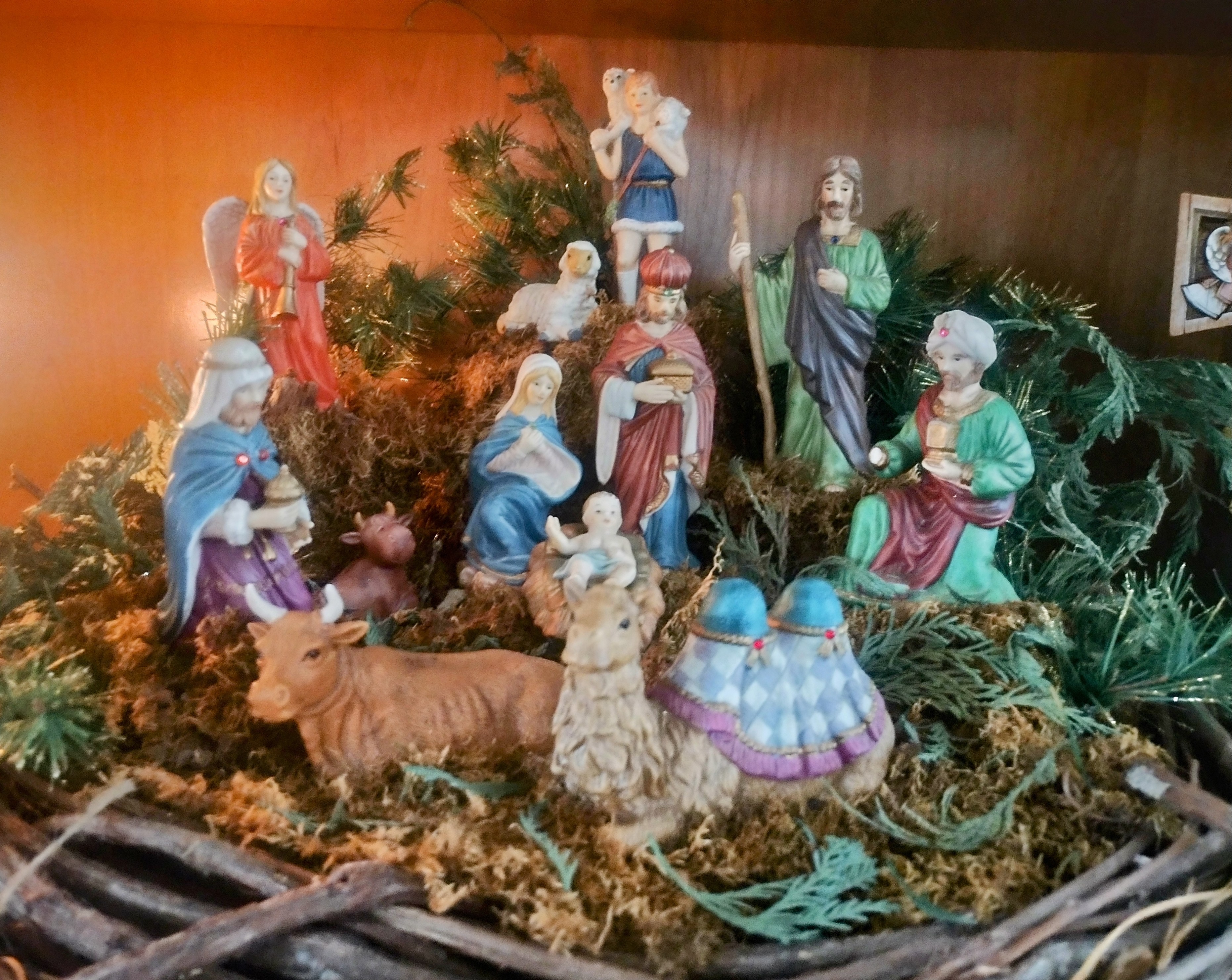
We treasure a ceramic nativity created by my wife’s mother, its colors warm and familiar, infused with the love and legacy of family.

And on our tree hangs a pewter ornament depicting the nativity scene—small, durable, and timeless.

Now, standing quietly on our bookshelf, the camel bone nativity from Egypt adds yet another voice to this beautiful chorus. Each piece comes from a different place and perspective, yet they all tell the same story: God choosing to enter our world in the most unexpected and humble way.

As they gather together, these nativities preach a quiet sermon. They remind us that the Christmas story is not confined to a single style, language, or land. It has traveled across borders and generations, finding expression in wood, glass, ceramic, metal—and now, camel bone.

This diverse collection testifies to the global reach of the gospel and the countless cultures shaped by the message of Emmanuel, “God with us.” It also invites us to see the manger with fresh eyes—eyes that recognize that the good news of great joy truly is for all people.

In a season when the world can feel divided, our nativities stand together as a small but powerful reminder: the Child born in Bethlehem still draws the nations to the greatest story ever told—one story, one culture, one family tradition at a time.
Reflecting on the Nativity: Finding Meaning in the Manger


One of the first Christmas songs I heard on the radio this year was Anne Wilson’s “The Manger.” Sung as a duet with Josh Turner, the song begins with a story:

They’re putting decorations up in front of my old church
The shepherds and the Wise Men and the hay
There’s Joseph and his Mary lookin’ down at Heaven’s birth
And the angel’s saying don’t you be afraid.

Right after Thanksgiving, my wife began putting up our decorations. A couple of days later, I rose early to savor my first cup of coffee and begin my morning reading, I experienced an unusual sensation: I felt as though I was being watched.

While the coffee brewed, I opened my laptop to check the news headlines. As my eyes scanned the screen, the feeling persisted—an awareness of other eyes observing my every move. After a few moments spent praying for guidance, expressing gratitude, and remembering the poor, the homeless, and those grieving during the holidays, I decided to investigate further. I surveyed the room more thoroughly, and then I saw them: Mary, Joseph, and the baby Jesus—everywhere I turned, they were watching me.

My wife, Amanda, is a Christmas enthusiast. She transforms our home into a holiday wonderland every year. Four themed Christmas trees light up our spaces, battalions of angels stand at attention, and a Dickens-style village invites us to step into another era. Two fluffy stockings, one red and the other green, hang from the mantle beneath wooden block letters that spell out J-O-Y and N-O-E-L. On the entertainment cabinet, other wooden blocks declare M-E-R-R-Y C-H-R-I-S-T-M-A-S!

The central theme of our holiday decor is the nativity. In the quiet of the morning, as I surveyed our home to uncover the source of that watching presence, I counted 24 manger sceneseach offering a unique perspective on the true meaning of Christmas. Among them are a delicate blown-glass nativity, a hand-carved wooden set gifted to us by a Jewish craftsman in Birmingham, a camel-bone nativity from Egypt, and a ceramic crèche lovingly crafted by Amanda’s mother and painted by Amanda’s sister, Michele.

Everywhere I look, I am reminded of the Christmas story—24 renditions of the babe-in-the-manger throughout our home.

Why are nativity scenes such an important part of our Christmas celebration?   What message do they convey to us?

As the holiday season unfolds, nativity scenes appear in homes, churches, and public spaces, offering a timeless reminder of the story of Christmas. These simple yet profound displays help center our focus on the birth of Christ, grounding us in the deeper meaning of the season as we navigate the hustle and bustle of holiday shopping and Christmas activities.

A nativity scene represents a story of humility and hope. A manger in Bethlehem becomes the setting for God’s love made flesh, reminding us that unrelenting grace often appears in the most unexpected places. Each figure—the holy family, shepherds, wise men, and even the animals—invites us to reflect on our role in this sacred narrative.

For families, nativity scenes can serve as a tangible way to teach children about the core message of Christmas. As young hands arrange the figures, they begin to understand that Christmas isn’t merely about gifts and festivities but about God’s greatest gift to humanity.

In a broader sense, nativity scenes inspire unity and peace. Regardless of cultural, political, or theological differences, the image of Christ’s birth resonates as a symbol of hope for all. The nativity narrative beckons us to pause, reflect, and rekindle the light of hope, peace, joy, and love.

The refrain to “The Manger” resounds with the good news of the season:

From the highest of the high to the lowest of the low
That stable tells a story of the distance you will go

For the lonely and the lost, there’s no sinner too far gone
To find a Savior lyin’ in the manger.

This Christmas, as you set up or encounter a display of the nativity, take a moment to ponder its message. Let it remind you of the simple, profound truth at the heart of the holiday: For there is born to you this day in the city of David a Savior, who is Christ the Lord. (Luke 2:11 NKJV)

(Barry Howard is a retired pastor who serves as a leadership coach and columnist with the Center for Healthy Churches. He and his wife live on Cove Lake in northeast Alabama.)