
When the Unseen Choir Sings

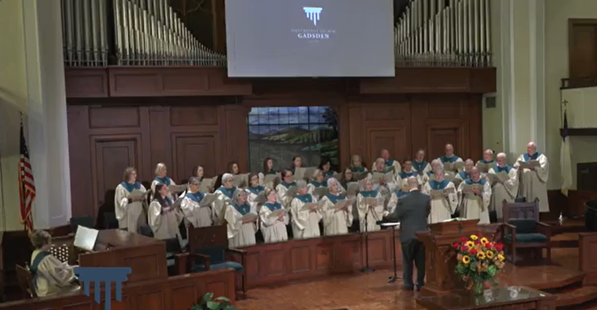
Last Sunday in church, the choir sang a beautiful rendition of one of my all-time favorite hymns, “Great Is Thy Faithfulness” arranged by Dan Forrest. The choir isn’t huge, but their sound is excellent and inspiring.

As I adjust to a more relaxed Sunday schedule following my recent retirement, my wife and I enjoy visiting our friends at the First Baptist Church in Gadsden for worship on the Sundays when we are not traveling. Nathan Edwards serves as Minister of Music and does a great job leading in worship and directing the choir.

As the choir began the anthem, I was reminded never to underestimate the power of a song, especially a song presented in multi-part harmony by a devoted and spirit-infused church choir. On the very first stanza, I noticed to my right a senior adult widow, who sits on the same row with the same friend each Sunday, as she mouthed the words “There is no shadow of turning with thee; Thou changest not, thy compassions they fail not, As thou hast been thou forever will be,” and there seemed to be a tear forming in her eye as though she was being reassured that the God of this universe was not intimidated by the problems in her life.

Just beyond her in the center section I saw a senior couple I assumed were husband and wife. He may have been nearly 90 years old and still had a farmer’s tan. She appeared to be a year or so younger than him yet weathered by the seasons of life. They were both nodding as though in agreement as the choir sang, “Summer and winter and noontime and harvest, Sun moon and stars in their courses above, Join with all nature in manifold witness To thy great faithfulness, mercy, and love.”

A couple of rows ahead of us was a dad seated beside his middle school son. Other than standing for the hymns and bowing his head for the prayers, the student had been completely still the entire service, somewhat tuned out, looking as though he was there because he had to be and not because he wanted to be. But during this choral anthem, I noticed that he began lightly tapping his foot and patting his knee, never taking his eyes off the choir as he kept perfect time with the beat of the song. I wonder if somehow the words of this powerful hymn were being planted in his subconscious and would one day sprout like a seed that would help him to become rooted and grounded in his faith.

Prior to the service I had noted a young adult as she was seated a few rows ahead of us in our section on the piano side. She sat alone and looked around as if she was in a new environment which made me think she might be a visitor, so I was glad to see several regulars greet her and sit near her. I don’t know her story but I was glad she was there. She sang the words to the congregational hymns without looking at the hymnal which indicated to me that this wasn’t her first church experience. As the choir sang, I caught her whispering along, “Strength for today and bright hope for tomorrow, Blessings all mine with ten thousand beside.”

These I’ve mentioned are only a few examples of the lips moving, heads nodding, and spirits being lifted across the congregation as the choir in the loft blended their voices melodiously. For some reason, more than listening to the robed choir, today I found myself looking and listening for the unseen choir. The choir in the loft was infusing the congregation with a song, thereby creating an antiphonal effect with the unseen choir silently singing, nodding, and toe-tapping the anthem in reflexive spiritual response.

Rich Mullins wrote a song popularized by Amy Grant titled “Sing Your Praise to the Lord.” The song was inspired by verse like Psalm 95:1 which says, “Oh come, let us sing to the Lord; Let us make a joyful noise to the rock of our salvation!”  It is certainly appropriate and biblical to sing to the Lord.

However, Ephesians 5:19 also encourages us to “Speak to one another with psalms, hymns, and spiritual songs.” There is something about congregational singing that creates a spiritual bond among people of faith as they sing to one another. Moreso there is something about a church choir singing with a disposition of worship that applies a balm to a wounded heart, that transmits energy to a weary soul, that conveys hope to those steeped in despair, and that plants seeds of faith in fertile minds.

The purpose of a choir is not to impress but to inspire. A church choir is not a show choir to entertain the congregation but rather a “flow” choir who, by immersing themselves in the spirit and message of worship, overflows onto the congregation with God-vibes and good news and contagious song.

Dietrich Bonhoeffer contended, “It is the voice of the Church that is heard in singing together. It is not you that sings, it is the Church singing, and you, as a member of the Church, may share in its song.”

Following the anthem, Pastor Mat Alexander’s well-prepared, well-delivered sermon from Matthew 12:1-21 encouraged us to “Love God, pursue righteousness, and find rest in the Lord.”

After the benediction, as we walked to our car, as the cart driver passed us as he transported a few folks to their cars I heard him humming the tune to “Great Is Thy Faithfulness.”

I wonder if Irving Berlin had the unseen choir in mind when he composed, “The song has ended, but the melody lingers on.”

Yes, it does! I’ve been humming that tune all week long.

(Barry Howard is a retired pastor who serves as a leadership coach and consultant with the Center for Healthy Churches.)
Love, Faith, and Simplicity: Remembering Our Visit in the Home of President and Mrs. Carter

What is it like to visit the home and the church of a former president?

In the spring of 2012, my wife and I were blessed to spend a week in Plains, Georgia, where I had been invited to lead in revival services at the Maranatha Baptist Church. Their most famous members, Jimmy and Rosalynn Carter, were present in every service.

I first met Governor Jimmy Carter in 1975 when I was a sophomore in high school and he was the featured speaker for the Alabama State FFA Convention in Montgomery. Interestingly the delegates at those conventions were seated in alphabetical order according to the school they represented, and since I served as a delegate from Alexandria High School, I had a front row seat.

Then in 2004, Amanda and I made the pilgrimage to Maranatha to attend President Carter’s Sunday School class and to stand in line with the other worshippers to have a photo taken with the 39th president. On that particular Sunday, Mrs. Carter was traveling internationally with an initiative related to the Carter Center.

Never would I have guessed in 1975 that I would become a pastor and someday preach in President Carter’s home church. After the first service in 2012, the worshippers formed a line to greet the guest preacher and his wife and welcome them to Maranatha. The Carters stood in line like every other member, and when they greeted us, Mrs. Carter welcomed us and commended the sermon, while President Carter shook my hand and kissed my wife on the cheek. She was so in awe of President Carter she quipped, “I may never wash my face again.”

The tradition at Maranatha is for the guest preacher to have lunch with the Carter’s during the revival week. We met the Carter’s at Dylan’s Diner on Wednesday, and then accompanied them to their home for dessert and conversation.

Before departing the restaurant, President Carter took me to every table in the restaurant, asked the patrons where they were from, introduced me as the guest evangelist for their revival, and invited every person in the diner to attend the final service that night. Then he added to his invitation, “If you come, you can sit with me and Rosalynn.” That night the attendance peaked, and the Carters were surrounded by the guests he invited from the restaurant.

The Carter’s home is modest and welcoming. President Carter built most of the furniture. We talked about his upbringing in Plains, his career in the Navy, his visits with world leaders, his work with Habitat for Humanity, his love for the Gulf Coast, and the well-being of several of our mutual friends. It was remarkable to hear stories of his recent conversations with Fidel Castro, and I was particularly interested in his recollections of Israeli Prime Minister Menachem Begin and Egyptian President Anwar Sadat.

Mrs. Carter, who insisted that we call her Rosalynn, had prepared sugar-free banana pudding for our dessert. She served it in a Corningware dish much like my grandmother’s. When I went to the kitchen to assist her with the coffee, I noted that she used a white older model Mr. Coffee coffeemaker, just like the one we use at home. Our visit was rich in simplicity and authenticity.

After we finished dessert, President Carter gave us a tour of his study, where he gave us an overview of some of his newest commentaries, followed by a tour of his workshop, where he showed us a few of his paintings and samples of his woodworks.

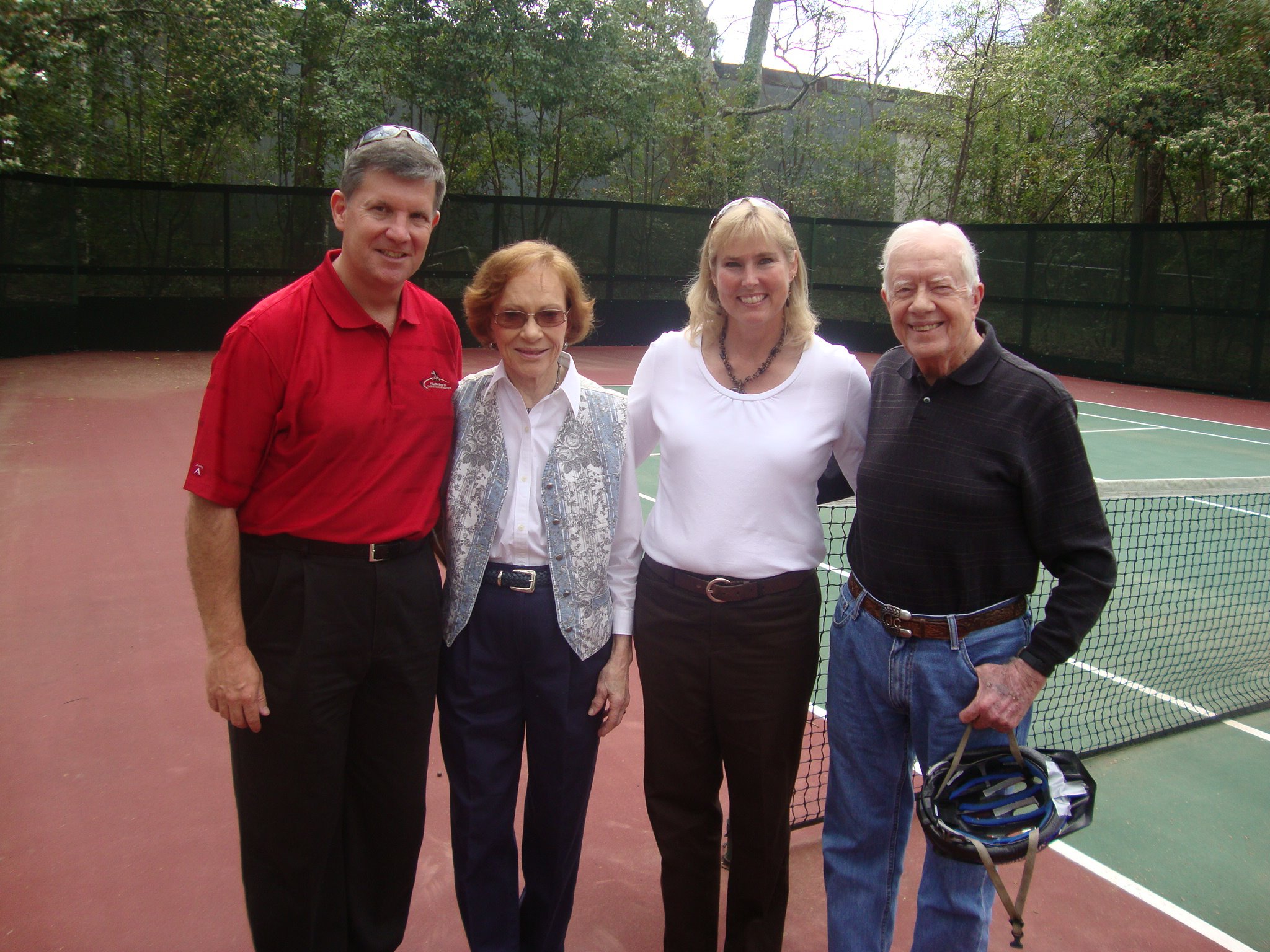
Then he said to Amanda, an avid tennis player, “Would you like to see our tennis court?” After he shared a few tennis stories, he said, “We normally take a photo of the guest minister on the front porch, but since Amanda loves tennis, we can take a photo of the four of us here on the tennis court.” Then he requested that one of the Secret Service Agents take the picture, a photo that we will continue to treasure for the remainder of our days.

After the photoshoot, we returned to the house to retrieve a few books he had signed for us, and then they walked us to our car, so we could return to the Plains Inn to freshen up before the evening service.

On the casual walk to our vehicle, as the two of them held hands, they shared with us that their home had been given to the National Park Service so that visitors could continue to visit Plains for years to come. Then Mrs. Carter pointed to a gardenesque area in the front yard and said, “And this is where we will be buried.” And President Carter squeezed her hand and said, “But not yet, Rosie. Not yet.”

In his book, A Full Life, President Carter confessed, “Earlier in my life I thought the things that mattered were the things that you could see, like your car, your house, your wealth, your property, your office. But as I’ve grown older I’ve become convinced that the things that matter most are the things that you can’t see — the love you share with others, your inner purpose, your comfort with who you are.”

Before our visit, we knew the Carters were faithful servants and influential advocates for the poor, the persecuted, and the underserved. During our visit, we learned they were gracious, down to earth, and comfortable in their own skin.

Nearly two years ago, the world learned President Carter was beginning hospice care at home, rather than continuing to go back and forth to the local hospital. And then, surprisingly, Rosalyn died before him.

This past week, as President Carter’s completed his journey, I can imagine that his beloved Rosie was there to squeeze his hand and say, “Welcome home, Jimmy! Welcome home!”.

(Barry Howard serves is a retired pastor who serves as a leadership coach and columnist with the Center for Healthy Churches. He and his wife, Amanda, currently reside on Cove Creek in northeast Alabama.)

7 Things We Enjoy About the Olympics

As the 2024 Olympics are set to begin in Paris this weekend, we find ourselves excited about the many upcoming moments that bring us joy and inspiration. The Olympics are not just about competition; they are a celebration of the human spirit, unity, and the diverse cultures that make up our world.

John Towner Williams emphasized, “The Olympics are a wonderful metaphor for world cooperation, the kind of international competition that’s wholesome and healthy, an interplay between countries that represents the best in all of us.”

Although I have not had the opportunity to attend the Olympics in person, my wife and I have been fortunate to visit multiple Olympic host cities just before or after the games, including Knoxville, Atlanta, Salt Lake City, Beijing, and Vancouver. And every two years I look forward to watching the games on TV.

Why are the Olympics so captivating? And why do we enjoy watching the ceremonies, the games, and the commercials? Here are seven things we particularly enjoy about the Olympics:

  1. Watching the opening and closing ceremonies. The Opening and Closing Ceremonies of the Olympics are spectacular displays of color, culture, and creativity. They set the tone for the entire event and provide a beautiful showcase of the host nation’s history, traditions, and aspirations. From the breathtaking choreography to the grand parade of nations, these ceremonies are a festive celebration of global unity, reminding us of the vast diversity of humankind.

  2. Observing the variety of different sports. The Olympics offer an incredible array of sports, some of which we may only get to see every four years. From the grace of gymnastics to the speed of track and field, the precision of archery to the endurance of marathon swimming, there’s something for everyone. This variety not only keeps us entertained but also broadens our appreciation for different disciplines and the dedication they require, mirroring the multitude of human gifts and talents.

  3. Seeing inspiring displays of sportsmanship. One of the most heartwarming aspects of the Olympics is witnessing the incredible sportsmanship between athletes. Whether it’s a helping hand after a fall, a congratulatory hug at the finish line, or a shared moment of respect and admiration, these acts remind us of the true spirit of the Games. Such gestures often transcend national and personal rivalries, inspiring us to be better in our everyday interactions, reflecting the love and respect that Jesus taught us.

  4. Rooting for the underdog. The Olympics are filled with stories of unlikely heroes and surprising victories. We love rooting for the underdog, those athletes who may not have the backing of powerhouse nations but possess an indomitable spirit and determination. Their triumphs against the odds remind us of the story of David and Goliath, and they show us that with faith and perseverance, anything is possible. These stories encourage us to pursue our dreams, no matter how big they are.

  5. Hearing the national anthems of many nations. There’s something profoundly moving about hearing the national anthems of different countries played as athletes stand on the podium. These moments symbolize the pride of nations and the culmination of years of hard work and sacrifice. Each anthem tells a story of cultural identity and national pride, creating a tapestry of global harmony. These anthems, played against the backdrop of the Olympic flag, remind us of our shared humanity and the beauty of our complex world.

  6. Hearing the biographies and behind-the-scenes stories of the athletes. Learning about the athletes’ backgrounds, their struggles, and their journeys to the Olympics is always inspiring. These biographical features provide insight into the dedication, perseverance, and faith that drive these individuals to achieve greatness. Their stories often remind us of our own personal journeys and the importance of resilience, faith, and community support in overcoming life’s challenges.

  7. Learning more about the host city. The Olympics also provide an opportunity to learn more about the host city and its culture. Through various features and news articles, we get to explore the history, landmarks, and traditions of the city, gaining a deeper appreciation for its unique contributions to the world. This cultural exchange enriches our understanding and fosters a sense of global fellowship, reflecting the civility and diversity that is central to peaceful and productive cooperation and collaboration.

Former Olympian Wilma Rudolph reminds us, “Never underestimate the power of dreams and the influence of the human spirit. We are all the same in this notion: The potential for greatness lives within each of us.”

As we gather to watch the Olympics, let us celebrate these moments that bring us joy, inspiration, and a sense of global community. May we recommit to live by the values of sportsmanship, perseverance, and unity that are embedded in the heart of the Olympics, in the soul of our nation, and at the core of our faith.

(Barry Howard serves as pastor of the Church at Wieuca in North Atlanta. He also serves as a leadership coach and columnist with the Center for Healthy Churches. You can follow him on social media at @BarrysNotes.)