On this twenty-fifth anniversary of the terrorist attacks of September 11, 2001, we come before you with hearts both grateful and heavy.
We remember an atrocious day, a day we wish we could forget. Yet even after twenty-five years, our grief still lingers, even as our faith still hopes.
We confess our ongoing need of your steadying and sustaining grace, for we are mindful that this date still grieves us, with emotions that are unsettling and memories that continue to elevate our anxiety.
Today, we lift up the families who lost husbands and wives, sons and daughters, mothers and fathers, friends and colleagues — in the collapse of the towers, in the field in Pennsylvania, and at the Pentagon. Comfort them still, O God, in the ongoing echo of that loss. May the years never erase the love they carry for those they lost.
We remember, too, the first responders and recovery workers who ran toward danger while others fled — firefighters, police officers, emergency medical workers, and ordinary citizens who became extraordinary in an instant. Bless them for their courage then, and be near to those among them who continue to serve.
And we pray especially today for those who are battling illness in their bodies now — illnesses set in motion by the toxic dust and hazards of that day and its aftermath, cancers and respiratory diseases and other conditions that continue to claim health and life a quarter-century later. Heal them, comfort them, and remind them that their sacrifice has not been forgotten.
We confess that our nation still struggles, twenty-five years later, with division, suspicion, and fear. Forgive us when disagreement hardens into contempt, and when our differences become excuses to separate rather than invitations to understand one another. Remind us that patriotism need not diminish compassion, and that strength need not silence mercy.
We pray for the leaders of our nation, and for leaders among the nations of the world — for wisdom and discernment, for the courage to seek peace rather than retaliation, and for a disposition that defuses conflict rather than inflaming it. Give them humility to lead with justice and grace to govern with integrity.
And we pray for peace in our world — not merely the absence of war, but the presence of justice, dignity, and understanding among all peoples and nations. Where there is conflict, bring reconciliation. Where there is fear, bring courage. Where there is hatred, let us, and all your people, be instruments of your love.
May the memory of September 11 never become simply a date on a calendar. May it call us to live with deeper gratitude, to serve with greater compassion, to forgive more freely, and to cherish the gift of each day we are given.
We offer this prayer in the strong name of the One who came to bring peace on earth and goodwill to all humankind. Amen.
Several years ago, I heard a pastor say, “God gave us two ears and one mouth so that we will listen twice as much as we speak.”
Wherever those words originated, the wisdom behind them is worth remembering. We live in a culture in which many have strong opinions, and increasingly, there is a tendency to believe that everyone else needs to hear that opinion immediately.
In many cases, it seems we have turned jumping to conclusions into an Olympic sport by leaping over facts, hurdling over context, and racing to judgment before we have even finished listening.
The Bible offers a radically different approach. James writes, “Let every person be quick to listen, slow to speak, slow to anger” (James 1:19). Notice the order: listen first, speak second, become angry last. That is good communication advice. More importantly, it is a spiritual discipline.
Listening is more than hearing. Hearing is a physical act. Listening is an intentional act.
We can hear someone’s words while simultaneously preparing our response. We can hear an opposing viewpoint while composing the rebuttal we intend to deliver. We can hear a story while deciding what we think about the person telling it.
True listening, however, requires us to temporarily put our conclusions on hold.
Proverbs says, “The one who gives an answer before listening—this is foolishness and disgrace” (Proverbs 18:13). Perhaps this verse needs to be posted beside every computer, smartphone, microphone, and social-media account.
How often do we respond to a headline without reading the article? React to a quotation without knowing its context? Judge a person based on a thirty-second video clip? Share something because it confirms what we already believe?
We have unprecedented access to information, yet access to information does not necessarily make us wise.
One of the great challenges of our age is confirmation bias—our tendency to notice, believe, and share information that reinforces what we already think while dismissing information that challenges us.
We can become so comfortable inside our ideological echo chambers that we rarely encounter an idea capable of changing our minds.
Our phones have become remarkably good at showing us what we like. Unfortunately, they can also become remarkably good at showing us only what we already believe.
Imagine having a GPS that refused to acknowledge that you might be on the wrong road. Instead of saying, “Recalculating,” it simply kept insisting, “You are absolutely correct.” That would not be helpful.
Neither is a worldview that is incapable of saying, “I may be wrong.” Wisdom requires humility.
Jesus was an avid listener. Jesus certainly spoke with authority for sure, but the Gospels also reveal someone who listened. He listened to Bartimaeus crying out beside the road. He listened to the desperate father whose daughter was dying. He listened to the woman at the well. He listened to people others ignored.
And sometimes Jesus’ questions were as important as his answers. He asked, “What do you want me to do for you?” (Mark 10:51).
What a powerful question. Before we assume we know what someone needs, perhaps we should ask. Before we explain, let’s listen first. Before we judge, perhaps we should understand. Before we respond, perhaps we should pause.
Because Jesus was an avid listener, followers of Jesus should also learn to be avid listeners. And an avid listener can listen across our differences.
Perhaps nowhere is this more important than in our increasingly divided culture. We don’t have to agree with everyone to listen to them. We don’t have to surrender our convictions to understand someone else’s convictions. We don’t have to abandon truth to practice kindness.
In fact, listening can strengthen our convictions because it forces us to examine whether they are based upon truth, Scripture, experience, evidence, or merely assumptions we inherited and never questioned.
Dietrich Bonhoeffer wrote, “The first service that one owes to others in the fellowship consists in listening to them.”
That is a profoundly Christian practice. Listening is an act of service. When we genuinely listen to another person, we communicate something powerful: You matter enough for me to hear you.
In navigating the different perspectives expressed within our social group or spiritual community, it is imperative that we learn to practice the pause.
There is tremendous wisdom in learning to pause. Before responding to an angry email, pause. Before reposting a provocative story, pause. Before assuming someone’s motives, pause. Before labeling someone because of one opinion, pause. Before saying something that cannot be unsaid, pause.
The pause gives wisdom an opportunity to catch up with emotion. The pause allows facts to catch up with assumptions. The pause gives compassion an opportunity to catch up with judgment. And sometimes the most spiritual thing we can say is not something profound at all. Sometimes it is simply, “Tell me more.”
Intentional listening doesn’t require us to be silent forever. Being slow to speak doesn’t mean we should never speak.
There are times when truth needs to be spoken, injustice needs to be challenged, and courage requires us to use our voices. But our words carry greater credibility when people know that we have first been willing to listen.
Perhaps that is why James connects being quick to listen and slow to speak with being slow to anger. Listening allows us to understand before we react. And understanding doesn’t always change our minds. But it can change the way we disagree.
Avoid becoming a gold medalist at jumping to conclusions. Instead of seeing who can respond the fastest, let’s see who can listen the longest. Instead of seeing who can deliver the sharpest comeback, let’s see who can ask the best question. Instead of seeing who can win the argument, let’s see who can preserve the relationship. Instead of trying to prove that everyone else is wrong, let’s become humble enough to ask whether there is something we might be missing.
“Perhaps it’s time to slow down, gather the facts, and listen more carefully with healthy discernment. Wisdom begins where assumptions and presuppositions end.”
In a noisy world, listening can be an act of courage. In a divided world, listening can be an act of grace. And in a world filled with instant opinions, listening can be an act of wisdom.
In this current climate, we are wise to follow the guidance of James:
Be quick to listen. Be slow to speak. Be slow to anger.
We have two ears and one mouth. Maybe God gave us that particular ratio for a reason, and for a season. Maybe even a time such as this.
The Jesuit poet Gerard Manley Hopkins observed, “The world is charged with the grandeur of God.”
Hopkins believed that God’s presence saturates the ordinary day-to-day world. If we have eyes to see and hearts to perceive, every sunrise, every act of kindness, every note of beautiful music, and every expression of genuine love can become a window through which we glimpse the sacred and the holy.
Perhaps that is why God so often chose ordinary places to reveal His extraordinary presence.
Moses was tending sheep when he encountered the burning bush. Jacob was sleeping on a stone when he dreamed of a ladder reaching into heaven. The disciples were mending nets, walking dusty roads, sharing meals, and sailing across the Sea of Galilee when they discovered that they were standing in the presence of the Son of God.
The sacred has always had a way of surprising us. Scripture tells us that when Moses approached the burning bush, God said, “Remove the sandals from your feet, for the place where you are standing is holy ground.” (Exodus 3:5)
Notice that the ground itself was not inherently holy. God’s presence made it holy.
The same is true today. Sometimes the holiest moments are not experienced in a sanctuary or viewed through the prism of stained glass. There are occasions when seemingly ordinary moments become sacred—a sunrise bursting over the horizon, a conversation with a friend, the breaking of bread, listening to music, telling a story, rekindling a cherished memory, or serving someone in need. In those moments, we sense the Divine Presence and become aware, if only for a fleeting instant, that we are standing on holy ground.
I tend to call that sacred space “Holy Terra Firma.”
I was in seminary when I first heard of Brother Lawrence, a seventeenth-century Carmelite monk who spent much of his life working in the monastery kitchen. Washing pots and preparing meals hardly seemed like sacred work, yet he discovered profound communion with God amid the clatter of dishes and the routine of daily chores. His classic work, The Practice of the Presence of God, reminds us that God’s presence is not confined to cathedrals. The kitchen can become a sanctuary when our hearts and minds are attentive.
The beloved poet Elizabeth Barrett Browning expressed a similar truth: “Earth’s crammed with heaven, and every common bush afire with God; but only he who sees takes off his shoes.”
Her imagery intentionally echoes Moses before the burning bush. The world is filled with holy moments, but too often we hurry past them without noticing.
Music has long helped us recognize these sacred encounters. Some of our most beloved hymns and songs remind us that holy ground is not merely a geographical location but a spiritual experience. Bill and Gloria Gaither’s beloved song “Holy Ground” declares, “We are standing on holy ground.” Likewise, “Surely the Presence of the Lord Is in This Place” by Lanny Wolfe has encouraged worshipers for generations to recognize God’s nearness. Even traditional hymns such as “Be Still, My Soul,” “Near to the Heart of God,” and “Open My Eyes, That I May See” invite us to become more aware of God’s presence in the ordinary rhythms of life.
Perhaps that is why certain songs move us so deeply. They awaken our awareness that heaven often touches earth in the most unexpected places.
Jesus certainly understood this. He transformed ordinary meals into sacred fellowship. He turned common fishing boats into floating classrooms. He made dusty roads into places of discipleship. He changed a rugged cross into the doorway of redemption and an empty tomb into the birthplace of hope.
Everywhere Jesus went, ordinary places became extraordinary because He was present.
The same invitation remains before us. The challenge is not that God has stopped speaking. The challenge is that we have become distracted by the clammoring noise around us. Our calendars are full. Our phones constantly demand our attention. Our schedules seldom allow us to linger long enough to notice the sacred that quietly surrounds us.
The psalmist offers to us a timeless invitation: “Be still, and know that I am God.” (Psalm 46:10)
Stillness creates space for wonder. Wonder awakens gratitude. And gratitude opens our eyes to God’s presence.
I’ve heard quite a few motivational speakers and inspirational preachers say, “Life is not measured by the number of breaths we take, but by the moments that take our breath away.” Many of those breathtaking moments are, in reality, holy moments.
Today, slow down. Watch the sunrise. Listen carefully to a child’s laughter. Share an unhurried meal with someone you love. Visit a friend. Offer encouragement to someone who is weary. Serve a neighbor in need. Pause long enough to hear the music that stirs your soul.
You may discover that what appeared to be an ordinary Tuesday was, in fact, a sacred appointment with God.
After all, holy ground is seldom marked by signs. It is recognized by hearts that have learned to notice the presence of the One who walks beside us every day.
So, watch your step! The ground you are standing on at any given moment could be Holy Terra Firma!
(This column is based on a sermon I preached at the First Baptist Church in Pensacola on July 12, 2009.)
During our nation’s quest for independence, George Washington cautioned, “Liberty, when it begins to take root, is a plant of rapid growth.”
Now, 250 years later, as we celebrate the blessings of our nation and reflect upon the freedoms we enjoy, it is worth remembering that liberty is both a priceless gift and a profound responsibility.
Freedom is not merely the absence of restraint; it is the opportunity to choose what is good, honorable, and life-giving. The Apostle Paul understood this distinction when he wrote: “For you were called to freedom, brothers and sisters; only don’t use this freedom as an opportunity for the flesh, but serve one another through love. For the whole law is fulfilled in one statement: Love your neighbor as yourself.” (Galatians 5:13-14)
Paul reminds us that Christian freedom is not self-centered; it is others-centered. We are set free not simply to do as we please but to become the people God created us to be and to bless those around us.
Our nation’s history beautifully illustrates this truth. On July 4, 1776, the members of the Continental Congress signed the Declaration of Independence, boldly affirming that all people “are endowed by their Creator with certain unalienable Rights.” Those words were revolutionary. Yet the founders also understood that liberty would endure only if citizens exercised virtue, accepted responsibility, and remained committed to the common good.
Freedom has never been free. It has been purchased by the sacrifices of soldiers on distant battlefields, preserved by courageous citizens willing to defend justice, and strengthened by generations who understood that rights and responsibilities always travel together.
President Ronald Reagan famously observed, “Freedom is never more than one generation away from extinction.”
His words remain as timely today as when they were first spoken. Every generation must decide whether it will cherish freedom enough to preserve it.
Yet as followers of Christ, we celebrate an even greater liberty. Before we were citizens of any nation, we were captives to sin. Through the death and resurrection of Jesus Christ, we have been set free from guilt, shame, and the fear of death. As Jesus declared, “So if the Son sets you free, you will be free indeed.” (John 8:36)
That freedom changes how we live. Christian liberty does not give us permission to ignore others. Rather, it compels us to love more deeply, forgive more readily, serve more generously, and live more faithfully.
William Wilberforce was the British parliamentarian whose Christian faith fueled his decades-long campaign to abolish the transatlantic slave trade. He understood that freedom was not something to be enjoyed selfishly while others remained in bondage. His faith inspired him to spend his life extending liberty to those who had none.
Wilberforce once wrote, “Our motto must continue to be perseverance. And ultimately I trust the Almighty will crown our efforts with success.” His perseverance reminds us that genuine freedom often requires sacrifice, courage, and unwavering conviction.
The same is true in our daily lives.
Freedom means choosing integrity when dishonesty would be easier.
Freedom means choosing forgiveness over bitterness.
Freedom means choosing generosity over selfishness.
Freedom means choosing service over self-interest.
That is exactly what Paul had in mind when he urged believers to “serve one another through love.”
Perhaps that is why the old spiritual “My Country, ‘Tis of Thee” includes the memorable phrase, “Sweet land of liberty.” Liberty is indeed sweet—but its sweetness is found not merely in what it allows us to do, but in what it enables us to become.
Someone wisely said, “Freedom reaches its highest purpose when it is used to glorify God and serve others.”
May we never take our freedoms for granted.
May we cherish the liberties secured by those who came before us.
May we faithfully preserve them for those who will follow us.
And above all, may we use the greatest freedom of all—the freedom we have in Christ—to love our neighbors, serve our communities, advocate for liberty and justice for all, and glorify the One who has truly set us free.
Graduation season is always emotional. Caps and gowns fill auditoriums. Proud parents wipe away tears. Grandparents beam with pride. Students celebrate years of hard work while simultaneously wondering what comes next.
High school graduation is both an ending and a beginning. One chapter closes while another unfolds. For many graduates, the future feels exciting, uncertain, intimidating, and hopeful all at the same time.
I think some of the best counsel for this season of life comes from from Proverbs 3:5-6: “Trust in the Lord with all your heart and lean not on your own understanding; in all your ways acknowledge Him, and He shall direct your paths.”
Those verses remind us that life is not navigated merely through intelligence, ambition, or talent. Life is best navigated through trust in God’s guidance.
With that in mind, here are twelve pieces of spiritual advice I would offer to every high school graduate.
1. Trust the Lord in all seasons.
Trust God not only during victories, but also during disappointments and uncertainty.
Life will not always unfold according to your plans. Dreams may shift. Doors may close. Unexpected detours will arise. But faith means believing that God still walks beside us even when the road becomes difficult.
As Corrie ten Boom wisely said, “Never be afraid to trust an unknown future to a known God.”
Sometimes God’s greatest work happens in seasons we never would have chosen for ourselves.
2. Ask honest questions.
Healthy faith is not afraid of honest questions.
Throughout Scripture, faithful people wrestled with uncertainty. Moses questioned God. David poured out doubts in the Psalms. Thomas asked for evidence after the resurrection.
Questions are not signs of weak faith; they are often pathways toward deeper faith.
James 1:5 reminds us: “If any of you lacks wisdom, let him ask of God.”
Never stop seeking truth, wisdom, and understanding.
3. Learn to be at home in your own skin.
One of the greatest challenges facing young adults today is comparison.
Social media constantly pressures people to measure themselves against curated versions of other people’s lives. But God did not create you to become a copy of someone else.
Psalm 139 says we are “fearfully and wonderfully made.”
Brené Brown advises, “Owning our story and loving ourselves through that process is the bravest thing that we’ll ever do.”
Learn to embrace the person God created you to be.
4. Never waste a mistake.
You are going to make mistakes. Everyone does. The important thing is not whether you fail, but whether you learn and grow from failure.
The Apostle Peter denied Jesus, yet grace restored him and transformed him into a leader of the early church.
Mistakes can become classrooms of wisdom if we allow them to teach us.
5. Invest wisely and focus on treasures that do not have an account number.
Learn financial responsibility early in life. Save wisely. Avoid unnecessary debt. Practice generosity.
But also remember that the greatest treasures in life are not material possessions.
Jesus taught in Matthew 6:20: “Store up for yourselves treasures in heaven.”
Some of the most valuable things in life cannot be purchased.
6. Don’t be afraid to venture outside your comfort zone.
Growth rarely happens in comfortable places.
Abraham had to leave home. Peter had to step out of the boat. Esther had to risk speaking up.
You may feel nervous about college, a new career, or unfamiliar opportunities. That’s normal. Courage is not the absence of fear; it is moving forward despite fear.
C. S. Lewis observed, “Hardships often prepare ordinary people for an extraordinary destiny.”
Do not let fear shrink your future.
7. Be proactive in caring for your physical and mental health.
Your physical and emotional well-being matter.
Get enough rest. Exercise regularly. Talk honestly about your struggles. Seek help when you need it.
There is strength—not weakness—in reaching out for support.
In a culture where many people feel exhausted, anxious, and isolated, self-care is not selfishness; it is stewardship.
8. Stay connected to a spiritual community.
Faith is not meant to be lived alone. Wherever life takes you, stay connected to a church family and surround yourself with spiritually healthy influences.
Hebrews 10:25 encourages believers not to neglect gathering together.
A coal separated from the fire eventually grows cold. Community helps sustain faith during difficult seasons.
9. Don’t let the labels others attach define you.
People may underestimate you, criticize you, or attempt to define you by your failures.
But labels do not determine identity.
David was labeled “just a shepherd.” Zacchaeus was labeled “a sinner.” Mary Magdalene was labeled by her past.
Never allow someone else’s opinion to limit what God can do through your life.
10. Cultivate and nurture friendships intentionally.
The people closest to you will influence your future more than you realize. But meaningful friendships don’t happen by default.
Proverbs 13:20 encourages us to “Walk with the wise and become wise.”
Some friendships inspire growth and wisdom. Others quietly pull people toward destructive choices.
Pay attention to who shapes your values, habits, and priorities.
11. Practice kindness in a harsh world.
We live in an age often marked by outrage and cruelty. Choose kindness anyway.
Be encouraging. Be compassionate. Be willing to listen.
Maya Angelou observed, “People will forget what you said… but people will never forget how you made them feel.”
Kindness leaves a lasting imprint on the world.
12. Navigate the turbulence of life with discernment and perseverance.
Life will not always be smooth skies and gentle winds. There will be unexpected storms, emotional turbulence, disappointments, and moments when the future feels uncertain.
In those moments, resist the temptation to panic or make impulsive decisions.
The Apostle Paul wrote in Galatians 6:9, “Let us not grow weary in doing good, for at the proper time we will reap a harvest if we do not give up.”
As author Max Lucado counsels, “You’ll get through this. It won’t be painless. It won’t be quick. But God will use this mess for good.”
There will be seasons when life feels turbulent. Hold steady. Pray carefully. Think wisely. Keep going.
Storms do not last forever, and perseverance often becomes the bridge between where you are and where God is leading you.
As you step into this next chapter of life, you will carry far more than diplomas and transcripts into the future. You will carry values, memories, relationships, faith, and the lessons that shape character.
The road ahead will include both breathtaking mountaintops and unexpected valleys, but do not walk it alone. The same God who guided you through childhood, classrooms, friendships, victories, and disappointments will continue directing your paths.
So dream boldly, love deeply, serve joyfully, and trust God completely.
(An Easter Sermon based on John 20:1-18 shared at the First Baptist Church of Pensacola on April 5, 2015)
Early on that first Easter morning, while it was still dark, Mary Magdalene made her way to the tomb. What she expected to find was death. What she discovered instead was life.
And everything changed.
That’s the power of what I want to call today “The Resurrection Factor.” It is the defining difference-maker of the Christian faith. It is not just something we believe happened—it is something that continues to happen in us and through us.
As Will Willimon once said, “We spend so much time trying to explain the resurrection, when in reality, the resurrection explains us.”
The Gospel of Johntells us it was still dark. That detail matters. Because resurrection often begins in the dark—when hope feels buried, when prayers seem unanswered, when life doesn’t make sense.
Mary came looking for a body, but she encountered a risen Savior.
And that is what the resurrection does—it interrupts our assumptions and replaces them with God’s reality.
What difference does Easter really make? Here are five ways the resurrection impacts us:
1. Forgiveness becomes our reality.
Jesus bore the weight of our sins and guilt on the cross.
“If we confess our sins, he is faithful and just and will forgive us our sins…” (1 John 1:9)
Some of us are still carrying guilt like extra baggage—dragging it from one season of life to another. But the resurrection declares: you don’t have to carry that anymore.
As Max Lucado said, “God loves you just the way you are, but He refuses to leave you that way.”
The resurrection lifts the weight of guilt and replaces it with grace.
2. Hope becomes our perspective.
Let’s be honest—the resurrection doesn’t eliminate every problem. It doesn’t promise that life will always be easy. But it does change how we see everything.
As Victor Hugo wrote, “Even the darkest night will end and the sun will rise.”
Because of Easter, we live with hope:
Hope for healing
Hope for restoration
Hope for second chances
Hope that God is still at work
We may not always feel optimistic—but we can always be hopeful.
3. Serving becomes our mission.
The resurrection is not just about life after death—it’s about life before death.
As N. T. Wright reminds us, God’s plan is not to snatch people out of earth, but to bring the life of heaven into it.
We are saved for something.
Resurrection people are called to:
Love boldly
Serve faithfully
Live purposefully
As Walter Brueggemann puts it, resurrection life is about aligning ourselves with God’s newness and purpose.
4. Heaven becomes our home.
Jesus said, “I go to prepare a place for you.”
The resurrection reminds us that death is not the end—it is a doorway.
It teaches us not only how to live, but how to face the end of life with faith instead of fear.
There is a quiet confidence that comes from Easter: A confidence that says, “This world is not all there is.”
Because of the resurrection, we can live under the governance of heaven here and now, and there and then.
5. Jesus becomes personal to us…not just me, but all of us.
Mary didn’t recognize Jesus at first. She thought He was the gardener.
But then He spoke her name: “Mary.”
And in that moment, everything changed.
The resurrection is not just theological—it is personal. Jesus still calls names. He still meets us in our grief. He still turns confusion into clarity.
The resurrection factor means this: the risen Christ knows you, sees you, and calls you by name.
Brennan Manning once said, “The most radical demand of Christian faith is to say yes to the present risenness of Jesus Christ.” I like that term “present risenness.” Not just in history—but in your life.
The resurrection transformed life on this planet more than any other event or experience in history.
It changes how we see our past (forgiven), our present (purposeful), and our future (secure).
So let me ask you: Why linger outside the tomb, looking for what used to be? What in this world could keep you from stepping into the resurrection life?
Because the stone has been rolled away. The tomb is empty. And Jesus is alive.
In his first epistle to the Corinthians (11:1), Paul urged the believers to, “Follow my example, as I follow the example of Christ
There is something transformative about walking where the apostle Paul once walked—standing in the shadows of ancient cities, tracing the roads of his missionary journeys, and imagining the courage it took to carry the gospel into unfamiliar and often hostile places.
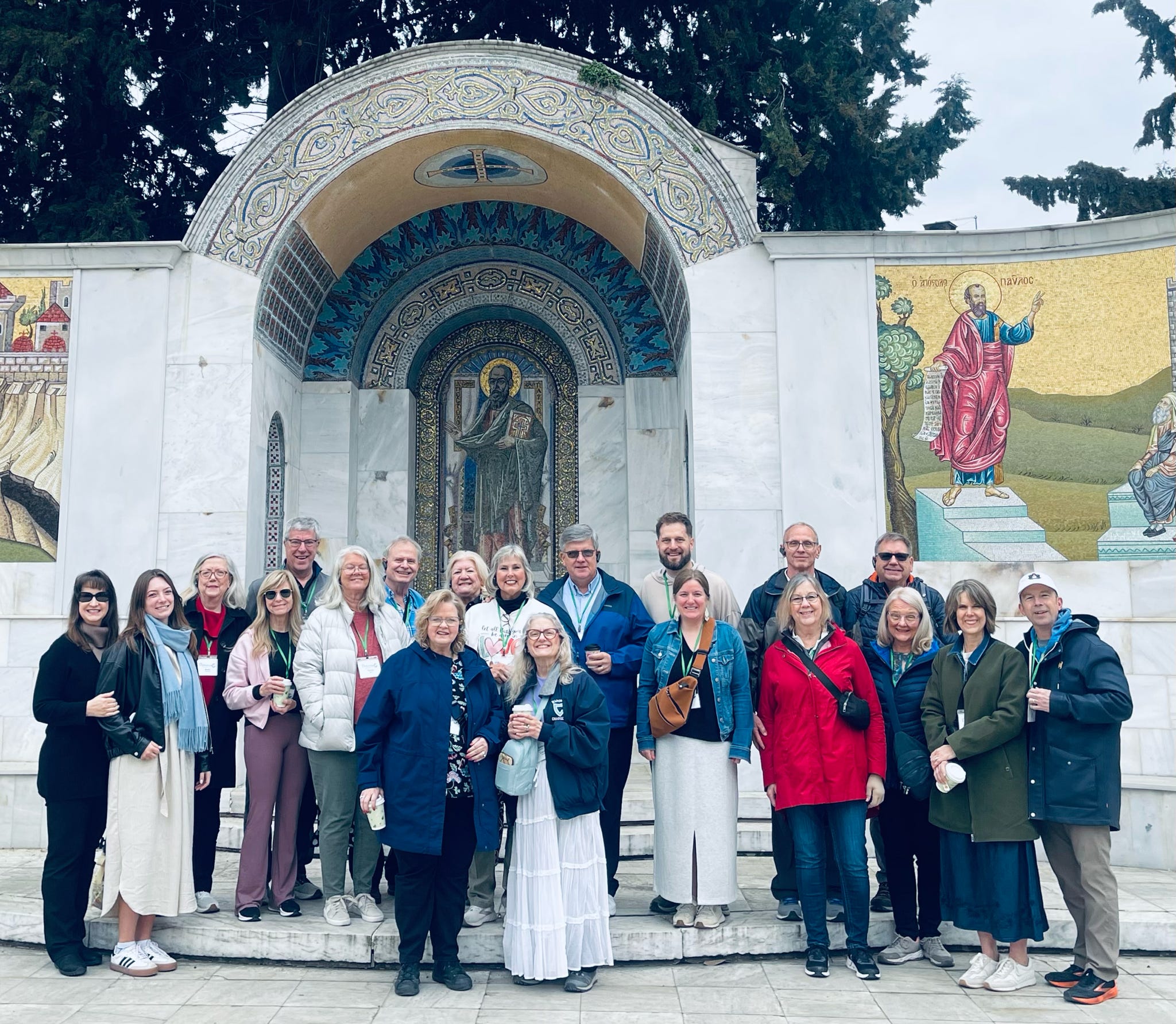
All the members of our travel group arrived home safely yesterday after our 12-day tour following the footsteps of Paul.
From Thessaloniki to Philippi, from Berea to Athens—and even reflecting on the missed opportunity to visit Ephesus and Patmos—this journey has deepened our understanding of Paul’s life, ministry, and message.
Here are ten things we learned about Paul while following in his footsteps:
1. Paul went where the people were. In every city, Paul positioned himself where conversations were already happening—synagogues, marketplaces, and gathering places. In Areopagus (Mars Hill), he engaged philosophers in thoughtful dialogue (Acts 17).
Paul practiced the words of Jesus from Mark 16:15: “Go into all the world and preach the gospel to all creation.”
Paul reminds us that mission begins where people already are.
2. Paul adapted his approach without compromising his message. In Jewish settings, Paul reasoned from Scripture. In Athens, he quoted Greek poets and connected with their worldview.
As John Stott once said, “We must be global Christians with a global vision because our God is a global God.”
Paul met people where they were—but always pointed them to Christ.
3. Paul faced opposition almost everywhere he went. In Thessaloniki and Philippi, he encountered resistance, imprisonment, and persecution (Acts 16–17).
Perhaps it was because of experiences like this that Paul wrote to young Timothy, “Everyone who wants to live a godly life in Christ Jesus will be persecuted.” (II Timothy 3:12)
Faithfulness does not guarantee ease, but it does produce endurance.
4. Paul invested in people, not just places. In Berea, he encountered believers who eagerly studied the Scriptures (Acts 17:11). His ministry was never about checking locations off a map—it was about nurturing lives.
The historian Will Durant once observed, “A great civilization is not conquered from without until it has destroyed itself from within.” Paul knew that transformed people shape transformed communities.
5. Paul trusted God in uncertain circumstances. Whether traveling dangerous roads or enduring imprisonment, Paul moved forward in faith.
Paul believed that God’s presence and purpose were persistent. “And we know that in all things God works for the good of those who love Him.” (Romans 8:28)
Even when plans change—like our missed stops in Ephesus, Patmos, and Santorini—God’s purposes are still at work.
6. Paul proclaimed a bold and relevant gospel. Standing in a culture filled with idols, Paul did not dilute the truth. But neither did he aim to offend. He dialogued with others at their point of need and their level of understanding. At Mars Hill, he proclaimed the one true God (Acts 17:24).
As C.S. Lewis wrote, “Christianity, if false, is of no importance, and if true, of infinite importance.”
Paul preached a gospel that invited deeper thought and an informed response.
7. Paul saw every city as a mission field. From bustling ports to intellectual centers, Paul viewed each location as an opportunity. Athens, with all its philosophy and culture, was no exception.
David Livingstone later wrote, “Here is a plain truth: God calls us to go where He is not known.”
No place was too complex, too pagan, or too resistant.
8. Paul built bridges through common ground. In Athens, Paul referenced an altar to an unknown god and used it as a starting point (Acts 17:23).
This approach reminds us that connection often precedes conversion.
9. Paul left a lasting legacy through his letters. Though we could not walk the streets of Ephesus, Paul’s letter to the Ephesians continues to shape the church today. Whether writing from his sojourn or a prison cell, Paul’s correspondence was practical, contextual, and encouraging.
Although Paul did not know his correspondence would end up in the New Testament, Paul believed, “All Scripture is God-breathed and is useful for teaching…” (II Timothy 3:16)
Paul’s influence extends far beyond geography.
10. Paul’s life pointed others to Christ, not to himself. Ultimately, Paul’s journey was never about Paul. It was about Jesus.
His daring perspective is summarized in his words, “For to me, to live is Christ and to die is gain.” (Philippians 1:21)
As Augustine of Hippo once said, “You have made us for yourself, O Lord, and our hearts are restless until they rest in you.”
Although we had a few delays and cancellations during our coming and going, this journey was more than a tour—it has been a pilgrimage.
We have stood in ancient cities, traced sacred stories, and reflected on a man whose life was wholly surrendered to God’s mission. Even in the places we could not visit, like Ephesus, the impact of Paul’s ministry remains undeniable.
And perhaps that is the greatest lesson of all: Faithfulness is not measured by where you go, but by how fully you follow.
As we return home, may we carry Paul’s example with us as we aim to live boldly, love deeply, and encourage generously.
Although our journey has ended, our mission continues.
Every spring, in addition to doing a more thorough cleaning of the house, my wife and engage in a “cleaning out” of our closet and personal items. This process involves sorting, discarding, and reorganizing.
The season of Lent arrives each year quietly inviting us to open the closet of our soul and take an inventory. Just as spring cleaning clears away the dust and clutter that accumulates unnoticed, Lent calls us to examine our inner lives and make space for God’s renewing grace. It is not about self-condemnation, but soul-restoration.
Scripture reminds us that God is deeply interested in this interior work. The psalmist prays, “Create in me a clean heart, O God, and put a new and right spirit within me” (Psalm 51:10). Lent is that season when we hold our inner self up to the light and ask what needs to be swept out. This may include things like the resentments we’ve nursed, the habits that dull our compassion, and distractions that throw us off track.
Spring cleaning is rarely glamorous. It involves getting into corners we’d rather ignore. Yet it is precisely there that grace does its best work. When we fast, pray, give generously, and practice repentance, we are not earning God’s love. Rather, we are clearing away the debris that keeps us from experiencing it fully.
C.S. Lewis suggested,“Relying on God has to begin all over again every day as if nothing had yet been done.” Lent gently reorients us in this daily reliance. Each act of surrender is like wiping down a dusty shelf. It is a small but intentional practice that is transformative over time.
In the early 16th century, Martin Luther described repentance not as a one-time event but as a lifelong posture. In a world focused on outward religious performance, Luther emphasized the ongoing need for inner renewal. This radical idea reframed faith as a continual turning of the heart toward God. His insight affirms that repentance is not about dwelling on guilt, but about returning to grace again and again.
As we journey through Lent, imagine God walking through the rooms of your soul with you, not as a harsh inspector, but as a loving companion. Some things will be kept, while others will be discarded.
Lent has a way of decluttering the chaos within so that our sense of peace is restored. Many years ago, Billy Graham advised, “Like a spring of pure water, God’s peace in our hearts brings cleansing and refreshment to our minds and bodies.”
This year, when Easter arrives, may it find our hearts lighter, cleaner, and more spacious, and ready to welcome the risen Christ with joy.
“Have mercy on me, O God, according to your steadfast love; according to your abundant mercy blot out my transgressions.” -Psalm 51:1
In my growing-up years, I remember the elderly in our community and in my family saying, “Lawsy mercy!” whenever they heard about an accident or an illness or some sort of tragedy. In Southern Appalachia, “Lawsy mercy” was a common expression of concern or sympathy to surprising or troubling news. The saying was a derivative of the biblical phrase, “Lord, have mercy.”
The biblical version, however, packs a more powerful punch. It is one of the most ancient and enduring prayers of the Church and yet also one of the simplest: “Lord, have mercy” is a cry that rises from deep within the human heart, a prayer offered not from a place of strength, but from a place of need. During Lent, we are invited to slow down long enough to hear ourselves praying these words honestly, without defensiveness or disguise.
Historically, the prayer Kyrie eleison (“Lord, have mercy”) was spoken not only in worship but also in moments of desperation. During the Black Death of the 14th century, entire communities processed through the streets chanting this plea, not as a magical formula, but as an act of trust when answers were few and suffering was overwhelming. The prayer acknowledged a hard truth: human effort has limits, but God’s mercy does not.
Lent helps us rediscover that truth. It reminds us that mercy is not something we earn through self-denial or religious effort. Mercy is something we receive when we finally stop pretending we don’t need it. To ask for mercy is not only to confess our shortcomings, but to practice humility. It is to recognize that grace, not perfection, is the foundation of our relationship with God.
The reformer Martin Luther once wrote, Those words were found scribbled on a scrap of paper after his death. They capture the spirit of Lent beautifully. No matter how accomplished, faithful, or disciplined we may be, we remain people in need of daily, ongoing, and undeserved mercy.
Echoing this posture of trust, Thomas Merton proposed, “Mercy is the kindness that makes sense of our failures.” Lent does not deny our brokenness. It places it gently in the hands of a merciful God who knows us fully and loves us completely.
To pray “Lord, have mercy” is a way to open ourselves to transformation. Mercy does not merely forgive the past; it reshapes the future. As we receive mercy, we are invited to extend mercy to ourselves, to our neighbors, and even to those we struggle to love.
This Lent, let that simple prayer rest on your lips and in your heart. Not as a sign of defeat, but as an act of hope. For the God who meets us in mercy is already at work, healing what is wounded and restoring what feels lost.
So today, as we pray for ourselves and for our world, may we begin “Lord, have mercy!”
17 Be good to your servant while I live, that I may obey your word. 18 Open my eyes that I may see wonderful things in your law. 19 I am a stranger on earth; do not hide your commands from me. 20 My soul is consumed with longing for your laws at all times. 21 You rebuke the arrogant, who are accursed, those who stray from your commands. 22 Remove from me their scorn and contempt, for I keep your statutes. 23 Though rulers sit together and slander me, your servant will meditate on your decrees. 24 Your statutes are my delight; they are my counselors. Psalm 119:17-24 (NIV)
When I visited my optometrist for my annual eye exam, he said, “Your vision has changed a little. We need to update your prescription for your glasses.” I knew it would happen one day. I’ve had the same prescription for almost 7 years.
Sight is extremely important. Maybe that is why the psalmist prayed, “Open my eyes that I may see wonderful things in your law” (v.18). However, I don’t think the psalmist was referring to the ability to see the smallest letters on the vision test chart.
Just as eyesight gives us the capacity to see the physical world around us, things like hindsight, foresight, and insight give us the capacity to better understand God’s word, to shape our faith perspectives, to formulate our worldview, and to exercise wisdom and discernment in our decision-making.
Helen Keller contended, “The only thing worse than being blind is having sight but no vision.”
Lent is an eye-opening season where the Spirit helps us better understand our purpose in life as we revisit the story of Jesus, who fully embodied God’s universal mission.
The psalmist wanted the eyes and minds of worshippers to be wide open as they pursue a deeper understanding of God’s vision for the world. The petitioner prayed, “Cause me to understand the way of your precepts, that I may meditate on your wonderful deeds.”
After the eye exam, my optometrist gave me my new prescription and advised me to upgrade to progressive lenses. For years, I had worn bifocals, mostly for reading. He cautioned that the change from bifocals to progressive lenses would require a period of adjustment. “You need to be especially careful when walking because your depth perception will be a little different.”
I have discovered that every new flicker of insight or morsel of wisdom requires a period of adjustment as I apply it to life. May our understanding of God’s word encourage and equip us to follow God’s ways.
Reflection:
How does God communicate new insights to you? Do you welcome new points of view or are you inclined to resist changes in your understanding? How easily can you move from stale presuppositions and open your mind to fresh insights from God’s word?
Prayer:
Be Thou my Vision, O Lord of my heart; Naught be all else to me, save that Thou art; Thou my best Thought, by day or by night; Waking or sleeping, Thy presence my light. (Eleanor H. Hull, Mary E. Byrne)







 Cove Creek Reflections