
Most of us learned the bedtime prayer long before we understood its meaning:
“Now I lay me down to sleep,
I pray the Lord my soul to keep.
If I should die before I wake,
I pray the Lord my soul to take.”
As children, we prayed those words without fear. As adults, they sound a little more sobering. That simple prayer confronts a reality we spend much of our lives trying to avoid — the fact that life is fragile, and death is certain.
The anonymous writer of Hebrews put it bluntly: “Just as people are destined to die once, and after that to face judgment” (Hebrews 9:27).
Facing our mortality is not morbid; it’s clarifying. As the philosopher Socrates once said, “The unexamined life is not worth living.” Facing death honestly helps us live more intentionally, more gratefully, and more faithfully.
Here are 10 reflections on mortality to help us live with hope and die with peace.
1. Life is a gift that should never be taken for granted. James 4:14 reminds us that life is “a vapor that appears for a little while and then vanishes.” Every sunrise is a gift, every breath a miracle.
Holocaust survivor Viktor Frankl observed that the difference between those who survived the concentration camps and those who didn’t was often the ability to find meaning, even in suffering. “When we are no longer able to change a situation,” he wrote, “we are challenged to change ourselves.”
Gratitude transforms survival into living. Don’t take the ordinary for granted; it’s where the extraordinary hides.
2. Death Is a certainty we should not fear. Emily Dickinson penned, “Because I could not stop for Death — He kindly stopped for me.” Her calm acceptance captures a truth many of us resist: death is inevitable, but not necessarily tragic.
The older I get, the less I fear death itself, and yet the more I want to avoid a prolonged dying process. While we don’t get to choose the way we depart this world, I often tell my wife, “If I don’t wake up tomorrow morning, I’ve had a good life. And you can say, ‘Thank you, Lord. That’s the way he wanted to go.’”
For followers of Christ, death is not the end of the story. As Paul wrote, “To live is Christ and to die is gain” (Philippians 1:21). Our hope isn’t in escaping death, but in trusting the One who conquered it.
3. The ultimate mortality rate Is 100%. Every generation learns the same lesson: no one gets out of this life alive. But that doesn’t have to sound grim. It can actually sharpen our focus.
Benjamin Franklin once quipped, “In this world nothing can be said to be certain, except death and taxes.” But even Franklin understood that certainty can bring clarity. Living with the end in mind helps us prioritize what truly matters.
4. You write your own eulogy each day that you live. Every decision, every conversation, every act of kindness or cruelty writes another line in your story. The question is — what will your story say?
The tombstone’s “dash” between birth and death represents your life. What fills that dash? Maya Angelou wrote, “People will forget what you said, people will forget what you did, but they will never forget how you made them feel.”
When you reach the end of your days, may people remember that your words healed, your presence mattered, and your faith endured.
5. Focus on things of eternal significance. Buford Green, a wise friend of mine, once said, “I’ve never seen a hearse pulling a U-Haul.” You can’t take it with you. But you can leave something behind—faith, love, integrity, and kindness.
Jesus taught us not to store up treasures on earth, but in heaven. Eternal investments look like compassion for the poor, forgiveness for the wounded, and service for the overlooked. The things that outlive us are usually the things we did for others.
6. The best way to prepare for death is to live every day to the maximum. The Latin phrase carpe diem—“seize the day”—was first written by the poet Horace more than 2,000 years ago. It still holds wisdom.
In our era of constant distraction, we can spend hours scrolling, comparing, and worrying. But as author Annie Dillard observed, “How we spend our days is, of course, how we spend our lives.”
Live fully present. Watch a sunrise. Call your mother. Forgive someone. Laugh often. Reggie McNeal once said, “The enemy of your soul whispers fear and worry all the time, and if you listen to that roar, you’ll never hear the Spirit speak.” Tune out the noise and tune in to the sacred.
7. Prepare for death spiritually and logistically. As Jesus said, “Love the Lord with all your heart, mind, and soul, and love your neighbor as your self.” Confess your sins regularly and receive God’s gift of forgiveness. But also make the practical plans. Writing a will, organizing your affairs, or discussing end-of-life wishes with family members isn’t pessimism—it’s love in practical form.
Years ago, a parishioner told me, “I don’t want my kids to have to guess about my funeral. I want them to be free to grieve, not to argue.” Her preparation became one of the greatest gifts she left beh
8. Live with a sense of mission and purpose. In other words, serve God by serving others, especially the disadvantaged and underserved. And live so that there’s no doubt about what you believe or who you follow. Dietrich Bonhoeffer, who faced death in a Nazi prison, said before his execution, “This is the end—for me, the beginning of life.”
Build your life around Christ’s teachings and compassion. The best way to prepare to die is to live each day as a gift to God and to others
9. Wake up before you die. The late preacher Tony Campolo told of a Buddhist monk who once said, “You Christians teach your children to pray all wrong. You teach them to say, ‘If I should die before I wake.’ It would be better if you taught them to pray, ‘If I should wake before I die.’”
Campolo explained that many people go through life half-awake—distracted, numb, and unaware of the sacred all around them. The tragedy isn’t dying before you wake up—it’s never waking up while you’re alive.
Take time to wake up to God’s love, to beauty, to laughter, to grace.
10. Let death catch you from behind, living generously and faithfully. You can’t control the timing of your death, but you can control the quality of your life. Live so that death finds you authentic in faith, generous in spirit, and awake to God’s presence.
Don’t sit around dreading death, or awaiting its arrival drearily. Whatever your limitations, live with a grateful heart and a positive spirit.
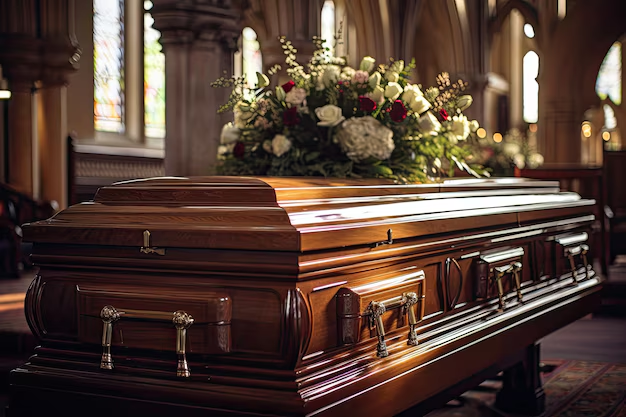
When I was a teenager, I once spent the night in a casket. A friend invited me to go camping behind his house. However, a storm rolled in unexpectedly. His stepfather worked in a funeral home and had shipping caskets in the storage barn. So when the rain began, we moved our campout to the barn and converted two of the shipping containers to beds. It was eerie but unforgettable. I agreed to this arrangement under one condition: That we leave the lids open.
There will come a day when the casket lid will close on my life. But until then, I want to make every day count. As the writer of Romans reminds us, “Whether we live or die, we belong to the Lord” (Romans 14:8).
Someone once asked, “How do you know if God’s purpose with your life is complete?” The answer is, “If you have breath, God is not finished with you.”
We prayed the old bedtime prayer as children, but maybe, just maybe, we should also pray this prayer as adults:
“If I should die before I wake,
I pray the Lord my soul to take.
But if I should wake before I die,
I pray the Lord to teach me how to live.”
Life is short. Death is certain. As long as we have a pulse, may God give us the grace to be fully alive.
 Cove Creek Reflections