On this twenty-fifth anniversary of the terrorist attacks of September 11, 2001, we come before you with hearts both grateful and heavy.
We remember an atrocious day, a day we wish we could forget. Yet even after twenty-five years, our grief still lingers, even as our faith still hopes.
We confess our ongoing need of your steadying and sustaining grace, for we are mindful that this date still grieves us, with emotions that are unsettling and memories that continue to elevate our anxiety.
Today, we lift up the families who lost husbands and wives, sons and daughters, mothers and fathers, friends and colleagues — in the collapse of the towers, in the field in Pennsylvania, and at the Pentagon. Comfort them still, O God, in the ongoing echo of that loss. May the years never erase the love they carry for those they lost.
We remember, too, the first responders and recovery workers who ran toward danger while others fled — firefighters, police officers, emergency medical workers, and ordinary citizens who became extraordinary in an instant. Bless them for their courage then, and be near to those among them who continue to serve.
And we pray especially today for those who are battling illness in their bodies now — illnesses set in motion by the toxic dust and hazards of that day and its aftermath, cancers and respiratory diseases and other conditions that continue to claim health and life a quarter-century later. Heal them, comfort them, and remind them that their sacrifice has not been forgotten.
We confess that our nation still struggles, twenty-five years later, with division, suspicion, and fear. Forgive us when disagreement hardens into contempt, and when our differences become excuses to separate rather than invitations to understand one another. Remind us that patriotism need not diminish compassion, and that strength need not silence mercy.
We pray for the leaders of our nation, and for leaders among the nations of the world — for wisdom and discernment, for the courage to seek peace rather than retaliation, and for a disposition that defuses conflict rather than inflaming it. Give them humility to lead with justice and grace to govern with integrity.
And we pray for peace in our world — not merely the absence of war, but the presence of justice, dignity, and understanding among all peoples and nations. Where there is conflict, bring reconciliation. Where there is fear, bring courage. Where there is hatred, let us, and all your people, be instruments of your love.
May the memory of September 11 never become simply a date on a calendar. May it call us to live with deeper gratitude, to serve with greater compassion, to forgive more freely, and to cherish the gift of each day we are given.
We offer this prayer in the strong name of the One who came to bring peace on earth and goodwill to all humankind. Amen.
Early that Sunday morning, we discovered the quietest spot in what must be our nation’s loudest city.
In 2017, just after I retired as pastor of the First Baptist Church of Pensacola, we visited New York City to attend the U.S. Open.
Since our visit was on the weekend of the anniversary of September 11, Amanda and I made our way to Ground Zero. It was my first visit to the memorial. It was her second. Typically, on a Sunday morning, we are in church. But on our final day in New York, we found ourselves in a different kind of sanctuary, one built not of stained glass and pews, but of granite, water, and names.
We read the names, like so many others there, looking for the name of the one from our hometown, and we thought about his mother and his family. And we remembered how life changed on that fateful day for families from large cities and small towns all around our country.
In the news footage of September 11, 2001, alongside the horrifying images of collapsing towers, I vividly remember the masses of people moving away from that site, desperate to escape. On this quiet Sunday morning, sixteen years later, I watched masses of people moving toward that same site — not to escape anything, but to remember and reflect.
Where the Twin Towers once stood, One World Trade Center now rises, crowned with an observatory that seems to keep watch over the city below. At its base rests a reflective pool, water descending endlessly into what feels like the basement of memory itself. Standing there, in the solemnness of that unexpectedly quiet corner of Manhattan, I found myself observing several things I haven’t been able to shake since.
A Congregation of Every Kind of American
The crowd that had gathered represented the vast diversity of our country. Multiple races and ethnicities filled that plaza. I’m sure some were international visitors, taking in the memorial as part of a holiday itinerary. But the vast majority, it seemed, were Americans — Americans of different backgrounds, different religious traditions, and undoubtedly different political convictions. And yet, on that morning, in that place, we were simply Americans. No hyphens. No labels. Just people standing shoulder to shoulder in shared grief and shared gratitude.
Dr. Martin Luther King Jr. preached, “Darkness cannot drive out darkness; only light can do that.”
Whatever darkness gathered over that site on September 11, what we witnessed on this Sunday morning was light — the light of ordinary people extending quiet dignity to one another as they remembered, reflected, prayed, and commemorated together.
Every Name, Equally Important
Every life lost that day was memorialized as equally important. From the firefighter, to the business executive, to the custodian, to the mother and child — the names inscribed around the reflective pools appear in the same font, the same size, with no suggested hierarchy of importance or privilege. No title before a name. No epitaph elevating one story above another.
There is something profoundly spiritual about that. It reminded me that in the eyes of God, every life bears equal worth — not measured by title, income, or accomplishment, but by the simple fact of being made in God’s image. Ground Zero, without necessarily intending to, underscores that truth in granite.
A Living Memorial
At the reflective pools, memories seemed to move in two directions at once — water descending into the depths, and grief, somehow, rising back up to meet the light. It’s an odd sensation to describe, but standing there, I felt as though the memorial itself understood something about grief that we often miss: that mourning is never a one-way street. What descends into sorrow can still rise again into hope.
I was struck, too, by how many families had brought young children with them — children born well after 2001, hearing this story perhaps for the very first time from a parent’s own lips. I watched mothers and fathers kneel beside sons and daughters, pointing to a name on the wall, offering a brief and tender history lesson right there on sacred ground. It gave new perspective to a phrase we often hear associated with 9/11: “Remember, and never, ever forget.”
But standing there, I realized that remembering is not meant to be a motif for vengeance. It is meant to be a motivating force for building a better world. Elie Wiesel, who knew more about memory and atrocity than perhaps anyone of his generation, put it this way: “To forget the dead would be akin to killing them a second time.”
Every parent kneeling beside a child at that wall was passing along not just a historical fact, but a sacred responsibility — to remember well, so that memory might do some good in the world.
Hope Rising Out of Rubble
Perhaps what moved me most was simply looking up. Where wreckage and ash once filled the skyline, a tower now stands — not identical to what was lost, but new, resilient, and unmistakably reaching toward the sky. The construction of that tower, and the entire redevelopment around it, testifies to something stubborn and beautiful in the human spirit: our capacity to hope for the future even in the shadow of unimaginable loss.
I couldn’t help but think of Fred Rogers, who famously recalled his mother’s advice for facing frightening news: look for the helpers. On this ground, I didn’t have to look far. I saw them in the volunteers guiding visitors. I saw them in the security personnel greeting people with quiet patience. I saw them in the parents becoming, for a moment, historians and pastors to their own children.
And I thought of President George W. Bush’s words spoken in the rubble of that very site, not long after the towers fell: “I can hear you. The rest of the world hears you. And the people who knocked these buildings down will hear all of us soon.”
Sixteen years later, what I heard on that plaza wasn’t defiance. It was something quieter and, in some ways, more powerful: resolve. The resolve to remember rightly. The resolve to grieve honestly. And the resolve to keep building — towers, yes, but also communities, families, and a nation still capable of standing shoulder to shoulder as one people.
Chimes in the Silence
Our time at Ground Zero passed far too quickly. As we made our way to catch the bus back to our hotel, the silence of the morning was broken by the resonating chimes of a nearby church. It felt like a benediction — as if that quietest spot in the loudest city was being gently released back into the noise and rhythm of ordinary life, but not without first leaving something behind in us.
I have preached in a lot of sanctuaries over the years. But that memorial plaza in lower Manhattan is uniquely inspiring — a sanctuary built out of tragedy, sustained by memory, and quietly insistent that even our deepest grief can become fertile soil for hope.
As the poet and civil rights icon Maya Angelou wrote: “History, despite its wrenching pain, cannot be unlived, but if faced with courage, need not be lived again.”
May we keep facing it with courage. May we keep remembering well. And may we keep building — towers, friendships, communities, and a world — worthy of the names etched in that granite.
(Barry Howard is a retired pastor who now serves as leadership coach and consultant with the Center for Healthy Churches. He and his wife, Amanda, live on Cove Lake in Northeast Alabama.)
Several years ago, I heard a pastor say, “God gave us two ears and one mouth so that we will listen twice as much as we speak.”
Wherever those words originated, the wisdom behind them is worth remembering. We live in a culture in which many have strong opinions, and increasingly, there is a tendency to believe that everyone else needs to hear that opinion immediately.
In many cases, it seems we have turned jumping to conclusions into an Olympic sport by leaping over facts, hurdling over context, and racing to judgment before we have even finished listening.
The Bible offers a radically different approach. James writes, “Let every person be quick to listen, slow to speak, slow to anger” (James 1:19). Notice the order: listen first, speak second, become angry last. That is good communication advice. More importantly, it is a spiritual discipline.
Listening is more than hearing. Hearing is a physical act. Listening is an intentional act.
We can hear someone’s words while simultaneously preparing our response. We can hear an opposing viewpoint while composing the rebuttal we intend to deliver. We can hear a story while deciding what we think about the person telling it.
True listening, however, requires us to temporarily put our conclusions on hold.
Proverbs says, “The one who gives an answer before listening—this is foolishness and disgrace” (Proverbs 18:13). Perhaps this verse needs to be posted beside every computer, smartphone, microphone, and social-media account.
How often do we respond to a headline without reading the article? React to a quotation without knowing its context? Judge a person based on a thirty-second video clip? Share something because it confirms what we already believe?
We have unprecedented access to information, yet access to information does not necessarily make us wise.
One of the great challenges of our age is confirmation bias—our tendency to notice, believe, and share information that reinforces what we already think while dismissing information that challenges us.
We can become so comfortable inside our ideological echo chambers that we rarely encounter an idea capable of changing our minds.
Our phones have become remarkably good at showing us what we like. Unfortunately, they can also become remarkably good at showing us only what we already believe.
Imagine having a GPS that refused to acknowledge that you might be on the wrong road. Instead of saying, “Recalculating,” it simply kept insisting, “You are absolutely correct.” That would not be helpful.
Neither is a worldview that is incapable of saying, “I may be wrong.” Wisdom requires humility.
Jesus was an avid listener. Jesus certainly spoke with authority for sure, but the Gospels also reveal someone who listened. He listened to Bartimaeus crying out beside the road. He listened to the desperate father whose daughter was dying. He listened to the woman at the well. He listened to people others ignored.
And sometimes Jesus’ questions were as important as his answers. He asked, “What do you want me to do for you?” (Mark 10:51).
What a powerful question. Before we assume we know what someone needs, perhaps we should ask. Before we explain, let’s listen first. Before we judge, perhaps we should understand. Before we respond, perhaps we should pause.
Because Jesus was an avid listener, followers of Jesus should also learn to be avid listeners. And an avid listener can listen across our differences.
Perhaps nowhere is this more important than in our increasingly divided culture. We don’t have to agree with everyone to listen to them. We don’t have to surrender our convictions to understand someone else’s convictions. We don’t have to abandon truth to practice kindness.
In fact, listening can strengthen our convictions because it forces us to examine whether they are based upon truth, Scripture, experience, evidence, or merely assumptions we inherited and never questioned.
Dietrich Bonhoeffer wrote, “The first service that one owes to others in the fellowship consists in listening to them.”
That is a profoundly Christian practice. Listening is an act of service. When we genuinely listen to another person, we communicate something powerful: You matter enough for me to hear you.
In navigating the different perspectives expressed within our social group or spiritual community, it is imperative that we learn to practice the pause.
There is tremendous wisdom in learning to pause. Before responding to an angry email, pause. Before reposting a provocative story, pause. Before assuming someone’s motives, pause. Before labeling someone because of one opinion, pause. Before saying something that cannot be unsaid, pause.
The pause gives wisdom an opportunity to catch up with emotion. The pause allows facts to catch up with assumptions. The pause gives compassion an opportunity to catch up with judgment. And sometimes the most spiritual thing we can say is not something profound at all. Sometimes it is simply, “Tell me more.”
Intentional listening doesn’t require us to be silent forever. Being slow to speak doesn’t mean we should never speak.
There are times when truth needs to be spoken, injustice needs to be challenged, and courage requires us to use our voices. But our words carry greater credibility when people know that we have first been willing to listen.
Perhaps that is why James connects being quick to listen and slow to speak with being slow to anger. Listening allows us to understand before we react. And understanding doesn’t always change our minds. But it can change the way we disagree.
Avoid becoming a gold medalist at jumping to conclusions. Instead of seeing who can respond the fastest, let’s see who can listen the longest. Instead of seeing who can deliver the sharpest comeback, let’s see who can ask the best question. Instead of seeing who can win the argument, let’s see who can preserve the relationship. Instead of trying to prove that everyone else is wrong, let’s become humble enough to ask whether there is something we might be missing.
“Perhaps it’s time to slow down, gather the facts, and listen more carefully with healthy discernment. Wisdom begins where assumptions and presuppositions end.”
In a noisy world, listening can be an act of courage. In a divided world, listening can be an act of grace. And in a world filled with instant opinions, listening can be an act of wisdom.
In this current climate, we are wise to follow the guidance of James:
Be quick to listen. Be slow to speak. Be slow to anger.
We have two ears and one mouth. Maybe God gave us that particular ratio for a reason, and for a season. Maybe even a time such as this.
Every life is a book still being written. Some chapters are page-turners. Others we’d rather skip, or tear out entirely, or pretend were written by someone else. But here’s the truth every good editor knows: you don’t get a great book by deleting the hard chapters. You get a great book by letting each chapter speak into the story, and then turning the page.
We are each writing our own life story. And we each make a few mistakes along the way. The question is, how will you deal with those mistakes? Will you wallow in guilt and regret? Or will you rise up and wise up as you make the most of the next day and the next opportunity?
Yesterday’s mistakes may explain part of your story, but they do not define your identity or determine your future. Learn from them, seek forgiveness where needed, extend grace to yourself, and keep moving forward. Your greatest chapters are not written by your failures but by your willingness to rise after you fall.
Here are five things worth remembering as you keep living into your story.
1. Never waste a mistake.
John Harris, a retired pastor and respected counselor in Birmingham who became one of my primary mentors and encouragers, advised me more than once as I navigated the challenges of being a pastor, “Never waste a mistake!”
In 1968, a scientist at 3M named Spencer Silver set out to invent a super-strong adhesive. What he actually invented was the opposite. His efforts resulted in a weak, pressure-sensitive glue that barely stuck to anything and could be peeled right back off. By every measure of the original assignment, it was a failure. It sat on a shelf for years, unwanted, until a colleague named Art Fry realized that a glue which didn’t quite stick was exactly what he needed to keep bookmarks from falling out of his hymnal. That “failed” adhesive became the Post-it Note, which has become one of the best-selling office products in the world.
Silver didn’t waste his mistake. He kept talking about it, kept believing it was useful for something, even when he didn’t yet know what. Thomas Edison famously took the same posture toward his own long string of failed experiments: “I have not failed. I’ve just found 10,000 ways that won’t work.” Notice, he didn’t call them failures. He treated them as lessons.
Every mistake you’ve made is carrying information and potential you haven’t fully processed yet. A wasted mistake is one you feel bad about and then set down without asking what it came to teach you. A redeemed mistake is one you turn over in your hands until you find the thing it was hiding.
2. Although you cannot re-write the previous chapters of your biography, your next chapter can be the best part of your story.
Just as no author achieves perfection on their first attempt at writing, so no human being lives an error-free life. When you make mistakes, you cannot go back and unwrite the chapters already behind you. But you are not required to let yesterday’s chapter set the tone for the next segment of your story.
Maya Angelou put it simply: “I did then what I knew how to do. Now that I know better, I do better.” That’s not an excuse for the past. It’s a hinge for the future. The chapters behind you are locked, but they’re not the whole book. As is often said, though its precise origin is debated: you can’t go back and change the beginning, but you can start where you are and change the ending.
Some of the most compelling stories in history are compelling precisely because of the turn partway through, the chapter where everything changes. J.K. Rowling was rejected by twelve publishers before Harry Potter found a home. Walt Disney was fired from a newspaper for “lacking imagination.” Neither of them got to revise those rejections. But neither of those rejections got to write the next chapter either. You get to decide what this one says.
3. When extending grace to others, do not neglect to extend grace to yourself.
We tend to be far more patient editors of other people’s stories than our own. A friend confesses a mistake, and we say, “That doesn’t change how I see you.” We say it, and mean it, and yet turn around and refuse ourselves the very same grace.
There’s a striking scene near the end of John’s Gospel. Peter had denied even knowing Jesus three times, on the worst night of his life, in the exact moment loyalty mattered most. It would have been reasonable for that failure to define the rest of Peter’s story. Instead, Jesus finds him on a beach and asks him, three times, “Do you love me?” — one gentle question for every denial, not to rub his face in the failure, but to write over it. Peter didn’t get a different past. He got a next chapter, and it turned out to be the chapter where he became the rock the church was built on.
If you’re the kind of person who extends grace freely to everyone except yourself, it’s past time for your to make more space for grace to do its work in your life. Extend yourself the same sentence you’d offer a friend: that doesn’t change how I see you.
4. Live so that your mistakes don’t define you. Let them refine you instead.
There’s a meaningful difference between a mistake that defines you and one that refines you. A defining mistake becomes your whole identity, the thing people whisper about, the thing you introduce yourself with in your own head before anyone else says a word. A refining mistake becomes raw material, something the heat was turned up on, but that came out of the fire more useful than it went in.
Before Abraham Lincoln became one of the most consequential presidents in American history, his résumé read like a catalog of setbacks: a failed business, a nervous breakdown, defeat after defeat in elections for state legislature, Congress, and the Senate. His later success erased none of that. All of it refined the patience and depth of character that later success required. Author and speaker John Maxwell has a phrase for this that’s worth internalizing: fail forward. Not fail and stay down. Fail forward!
The question is never really whether you’ll make mistakes. You will. The only real question is whether you’ll let them harden into an identity or soften into wisdom.
5. In the age of AI and virtual reality, be sure your life story is biography and not fantasy or fiction.
We live in a strange new season of history, where it has never been easier to construct a version of your life that isn’t quite true. A filtered photo. A curated feed. An AI-generated image of a vacation you didn’t take, a body you don’t have, a highlight reel with all the ordinary, unglamorous, mistake-filled chapters edited out. Virtual worlds let us build avatars who never fail, never age, never have an awkward year. It is entirely possible, now, to spend more energy authoring a fictional version of yourself than living an honest one.
But here’s the thing about a fictional chapter: it can look impressive, and it can still be empty, because nobody grows from a chapter they didn’t actually live. Growth requires friction, and friction requires reality. The mistakes you’re tempted to edit out of your story are often exactly the chapters doing the most work in you.
Theodore Roosevelt is credited with the observation that “comparison is the thief of joy.” And in an age when everyone else’s highlight reel is a thumb-scroll away, that theft happens faster than ever. Write your actual story. Let it include the parts that don’t photograph well. A true biography, mistakes and all, will always be worth more than a polished fiction because only the true story is actually yours, and only the real story can actually be redeemed.
Winston Churchill once said that success is not final, failure is not fatal — it is the courage to continue that counts. Life is about authenticity. Not the absence of mistakes. Not a life edited down to only its best moments. Just the courage to keep writing, one honest page at a time, one day at a time.
Your greatest chapters are not focused on your failures, yet mistakes are a part of the narrative. The best chapters are written by your willingness to rise after you fall, and to continue the journey, believing that the best part of the story is yet to come.
(Barry Howard is a retired pastor who now serves as a leadership coach and consultant with the Center for Healthy Churches. He and his wife, Amanda, live on Cove Lake in northeast Alabama.)
If you hear voices in your head, you are not alone.
In her poem, “The Voices Within,” Emily Dickinson described her internal dialogue like this:
The voices that live in my head, Whispering secrets, softly they tread. They murmur and sigh, never at rest, Filling my mind with their constant quest.
Most of us, if not all of us, are perpetually engaged in a conversation with the collaborative and competitive voices within. Perhaps there are voices that taunt you or haunt you, and those contenders need to be disciplined, silenced, or converted. But there can also be voices that help you to find direction, make decisions, and affirm your sacred worth.
Learning to dialogue with these voices is one of our most important life skills.
Regardless of the wisdom around the table, a successful board meeting is rarely unanimous. Whether in a corporation, a church, or a city council, thoughtful decisions usually emerge after vigorous discussion. Different perspectives are expressed. Risks are identified. Opportunities are explored. Questions are asked. Ideally, the participants do not seek perfect unanimity but sufficient consensus to move confidently toward a common goal.
Perhaps our inner lives function in much the same way. We often speak of “following our heart” or “listening to our inner voice,” or even being attentive to the “still small voice,” but I suspect we do not possess a single inner voice. Rather, each of us hosts an internal committee, composed of voices shaped by our experiences, emotions, memories, hopes, fears, convictions, and faith. Every significant decision becomes something of an internal board meeting.
Years ago, while serving in Kentucky, my dear friend, Bob Lockhart, who was a wise and beloved, yet crotchety, retired pastor, told me that from his perspective, each of us has multiple constituents within who are arguing their case, and that those constituent voices lobby until a majority comes to an agreement, and that is when we make a decision.
That explanation helped me understand that we do not have an inner voice, but a cacophony of inner voices. When we make decisions, the goal is for those inner voices to reach a consensus, which leads to action, although the voices are seldom, if ever, unanimous.
Some members of that internal committee are extraordinarily helpful. One voice urges caution. Another inspires courage. One reminds us of our responsibilities. Another dreams of new possibilities. One values stability. Another longs for adventure.
These voices are not our enemies. In fact, they often protect us from impulsive decisions. Problems arise, however, when one of the haunting or taunting voices dominates the conversation while silencing all the others.
For example, when anxiety takes control, it convenes an emergency meeting where every agenda item becomes a potential disaster.
When anger chairs the meeting, every discussion becomes a debate about fairness.
When guilt presides, every decision is filtered through past failures.
When pride occupies the chair, every proposal must somehow enhance our reputation.
None of these voices should be allowed to dominate our decision-making process. The Apostle Paul understood this internal struggle. “I do not understand my own actions. For I do not do what I want, but I do the very thing I hate” (Romans 7:15). Paul recognized that the Christian life involves an ongoing conversation between competing desires. Spiritual maturity is learning which voices deserve influence and which must yield to Christ.
The psychologist Viktor Frankl observed, “Between stimulus and response there is a space. In that space is our power to choose our response.” Wisdom grows in that space. Rather than reacting to the loudest emotion of the moment, we learn to pause, reflect, pray, and discern.
I am convinced that although the voice of faith, which could also be called the voice of the Spirit, is not the only voice we hear, it should be designated as the voice that presides over all the other voices.
Nehemiah modeled this beautifully. When King Artaxerxes noticed his sadness and asked what troubled him, Nehemiah tells us, “I prayed to the God of heaven, and I answered the king” (Nehemiah 2:4–5). It was only a brief prayer, but it reveals a disciplined heart. Before speaking outwardly, Nehemiah listened inwardly for God’s direction. He allowed the voice of faith to moderate the voices of fear, uncertainty, and opportunity.
Decision-making improves when we refuse to let the most emotional voice cast the deciding vote. Instead, we invite every perspective to be heard while making sure to keep faith at the head of the table to preside over the meeting.
Dallas Willard wisely wrote, “The first and most basic thing we can and must do is to keep God before our minds.” When Christ occupies the chairperson’s seat, fear becomes prudence instead of panic. Ambition becomes stewardship instead of self-promotion. Grief becomes love remembering. Anger becomes righteous conviction rather than destructive resentment.
The goal is not to eliminate the many voices within us. God has given us emotions, memories, imagination, reason, and intuition as valuable gifts. The challenge is to bring them into proper relationship under the lordship of Christ.
Healthy decision-making is less about achieving unanimity among our internal constituents than it is about building enough consensus to move forward faithfully. There will almost always be lingering questions, unresolved tensions, and minority opinions. That is part of being human.
But when Scripture informs our minds, the Holy Spirit shapes our thinking, and prayer quiets our souls, the internal conversation becomes healthier. The competing voices gradually become contributing voices, and what once sounded like confusion begins to resemble harmony.
The next time you face an important decision, imagine convening a meeting of your internal constituents. Let fear speak but not dominate. Let wisdom ask its questions. Let experience offer its counsel. Let hope imagine possibilities.
Then, before the vote is taken, invite faith to present the closing argument.
The internal voices will not go away. So, learn to hear and discern those voices wisely.
Emily Dickinson concluded her poem with these words:
So, I listen, I ponder, I try to make sense, Of the myriad voices, their presence immense. They shape my thoughts, they shape my art, The voices within, an inseparable part.
The Jesuit poet Gerard Manley Hopkins observed, “The world is charged with the grandeur of God.”
Hopkins believed that God’s presence saturates the ordinary day-to-day world. If we have eyes to see and hearts to perceive, every sunrise, every act of kindness, every note of beautiful music, and every expression of genuine love can become a window through which we glimpse the sacred and the holy.
Perhaps that is why God so often chose ordinary places to reveal His extraordinary presence.
Moses was tending sheep when he encountered the burning bush. Jacob was sleeping on a stone when he dreamed of a ladder reaching into heaven. The disciples were mending nets, walking dusty roads, sharing meals, and sailing across the Sea of Galilee when they discovered that they were standing in the presence of the Son of God.
The sacred has always had a way of surprising us. Scripture tells us that when Moses approached the burning bush, God said, “Remove the sandals from your feet, for the place where you are standing is holy ground.” (Exodus 3:5)
Notice that the ground itself was not inherently holy. God’s presence made it holy.
The same is true today. Sometimes the holiest moments are not experienced in a sanctuary or viewed through the prism of stained glass. There are occasions when seemingly ordinary moments become sacred—a sunrise bursting over the horizon, a conversation with a friend, the breaking of bread, listening to music, telling a story, rekindling a cherished memory, or serving someone in need. In those moments, we sense the Divine Presence and become aware, if only for a fleeting instant, that we are standing on holy ground.
I tend to call that sacred space “Holy Terra Firma.”
I was in seminary when I first heard of Brother Lawrence, a seventeenth-century Carmelite monk who spent much of his life working in the monastery kitchen. Washing pots and preparing meals hardly seemed like sacred work, yet he discovered profound communion with God amid the clatter of dishes and the routine of daily chores. His classic work, The Practice of the Presence of God, reminds us that God’s presence is not confined to cathedrals. The kitchen can become a sanctuary when our hearts and minds are attentive.
The beloved poet Elizabeth Barrett Browning expressed a similar truth: “Earth’s crammed with heaven, and every common bush afire with God; but only he who sees takes off his shoes.”
Her imagery intentionally echoes Moses before the burning bush. The world is filled with holy moments, but too often we hurry past them without noticing.
Music has long helped us recognize these sacred encounters. Some of our most beloved hymns and songs remind us that holy ground is not merely a geographical location but a spiritual experience. Bill and Gloria Gaither’s beloved song “Holy Ground” declares, “We are standing on holy ground.” Likewise, “Surely the Presence of the Lord Is in This Place” by Lanny Wolfe has encouraged worshipers for generations to recognize God’s nearness. Even traditional hymns such as “Be Still, My Soul,” “Near to the Heart of God,” and “Open My Eyes, That I May See” invite us to become more aware of God’s presence in the ordinary rhythms of life.
Perhaps that is why certain songs move us so deeply. They awaken our awareness that heaven often touches earth in the most unexpected places.
Jesus certainly understood this. He transformed ordinary meals into sacred fellowship. He turned common fishing boats into floating classrooms. He made dusty roads into places of discipleship. He changed a rugged cross into the doorway of redemption and an empty tomb into the birthplace of hope.
Everywhere Jesus went, ordinary places became extraordinary because He was present.
The same invitation remains before us. The challenge is not that God has stopped speaking. The challenge is that we have become distracted by the clammoring noise around us. Our calendars are full. Our phones constantly demand our attention. Our schedules seldom allow us to linger long enough to notice the sacred that quietly surrounds us.
The psalmist offers to us a timeless invitation: “Be still, and know that I am God.” (Psalm 46:10)
Stillness creates space for wonder. Wonder awakens gratitude. And gratitude opens our eyes to God’s presence.
I’ve heard quite a few motivational speakers and inspirational preachers say, “Life is not measured by the number of breaths we take, but by the moments that take our breath away.” Many of those breathtaking moments are, in reality, holy moments.
Today, slow down. Watch the sunrise. Listen carefully to a child’s laughter. Share an unhurried meal with someone you love. Visit a friend. Offer encouragement to someone who is weary. Serve a neighbor in need. Pause long enough to hear the music that stirs your soul.
You may discover that what appeared to be an ordinary Tuesday was, in fact, a sacred appointment with God.
After all, holy ground is seldom marked by signs. It is recognized by hearts that have learned to notice the presence of the One who walks beside us every day.
So, watch your step! The ground you are standing on at any given moment could be Holy Terra Firma!
(This column is based on a sermon I preached at the First Baptist Church in Pensacola on July 12, 2009.)
Gracious God, author of liberty and giver of every good gift, we come before you this Independence Day with a spirit of gratitude and celebration. Two hundred fifty years ago, a fledgling nation dared to declare that all people are created in your image, endowed with rights no earthly power can rightly take away. From the mountains to the prairies, thank you for holding our nation together through all the seasons of this quarter-millennium.
Yet even as we celebrate, we come humbly, for we know that gratitude without honesty is hollow. We confess our sins, both as a nation and against one another. Forgive us for the times we have wielded freedom as a weapon instead of a gift to be shared. Forgive us for the walls we have built where you call us to build bridges — walls of suspicion, contempt, and pride that separate neighbor from neighbor, family member from family member. Forgive us for the harsh words spoken too quickly and the listening ear withheld too long. As your Word promises, “If my people, who are called by my name, will humble themselves and pray and seek my face and turn from their wicked ways, then will I hear from heaven and will forgive their sin and will heal their land” (II Chronicles 7:14). Hear us now, Lord, and heal our land.
We pray for those who lead us — in this nation, our states, and our communities. Strip away, we ask, every hint of selfish ambition and self-interest that so easily takes root in seats of power. Clothe our leaders instead with moral integrity and political wisdom, that they might govern not for personal gain or party advantage, but for the true good of all people, especially the most vulnerable among us.
We pray for the great gulf that divides so many of your children — by politics, by race, by class, by conviction. Heal it, Lord, and create among us a spirit of unity. Where we have made enemies of those who simply see differently, restore us to one another. Teach us, we pray, that working with one another and truly listening to each other accomplishes so much more than working against each other. Give us the humility to hear before we speak, and the grace to disagree without being disparaging.
And in this season of loud allegiances, remind us that our first and highest loyalty belongs to you alone. From sea to shining sea, may our allegiance to you, O God, rise above our loyalty to any other alliance, affiliation, party, or platform. Let our citizenship in your beloved commonwealth shape our citizenship in our beloved nation, and not the other way around.
Finally, in the Spirit of Jesus Christ, who identified himself with the hungry, the stranger, the imprisoned, and the forgotten, we pray for the least of these among us — the poor, the sick, the lonely, the overlooked. Give us eyes to see them as you see them, and hands willing to serve them as we would serve you.
As we mark two hundred fifty years of this nation’s story, make us responsible stewards of the freedom we have inherited and faithful servants of the One who makes us free indeed. Forge in us the faith and courage to become a more perfect union, a nation that truly pursues liberty and justice for all.
We pray in the name of the One who teaches us to “be kind and compassionate to one another, forgiving each other, just as in Christ God forgives you.” (Ephesians 4:32) Amen.
As we celebrate the 250th anniversary of the United States of America, we stand at a remarkable moment in our nation’s history. Two and a half centuries of freedom, sacrifice, innovation, and growth have shaped who we are as a people. Independence Day 2026 invites us to pause, reflect, and celebrate not just with fireworks and parades, but with intention and gratitude. Whether you are a history enthusiast, a proud patriot, or simply someone who loves this country, here are ten meaningful ways to make this milestone birthday unforgettable.
1. Read the Declaration of Independence. Take an hour this week to sit down and actually read the Declaration of Independence in full. Too often, we know only the famous opening: “We hold these truths to be self-evident, that all men are created equal, that they are endowed by their Creator with certain unalienable Rights, that among these are Life, Liberty, and the pursuit of Happiness.” But reading the entire document reveals the grievances, the reasoning, and the courage of the founding generation. You will find it moving and instructive. Let the words of 1776 speak to your heart in 2026.
2, Revisit the Great Speeches of Previous Presidents. Listen to or read great speeches from American presidents throughout our history. From Lincoln’s Gettysburg Address to FDR’s Four Freedoms, from JFK’s inaugural address to Reagan’s challenge at the Brandenburg Gate, these speeches capture defining moments and illuminate American ideals. Spend an evening listening to one or two of these speeches. Notice how the language differs from today. Reflect on the challenges faced and the courage required. You might discover a phrase or a principle that speaks directly to your life today.
3. Visit a Historical Site, Museum, or National Park. Plan a trip to one of the great historical sites, museums, or national parks near you. Whether it is a presidential birthplace, a museum of American history, a battlefield, or a national park that showcases the natural beauty of our land, immerse yourself in the physical places that tell America’s story. Walk where patriots walked. See the documents. Stand in the spaces where history happened. Bring your family. Make it an adventure that teaches and inspires all ages. 4. Teach Your Children About American Heroes. Use this anniversary as an opportunity to teach your children or grandchildren about American heroes and their stories. Go beyond what they learn in school. Share stories of ordinary people who did extraordinary things. Talk about the suffragists who fought for women’s voting rights. Discuss the civil rights leaders who sacrificed for justice. Explain the contributions of inventors, artists, and activists. Help the next generation understand that America is built on the contributions of people from many backgrounds and walks of life, all working toward a more perfect union.
5. Volunteer in Your Community. Celebrate America by serving your community. Volunteer at a local food bank, mentor a young person, clean up a park, or serve in an organization that helps those in need. The true greatness of America is not just about freedom; it is about people who care enough about their neighbors to serve them. By volunteering, you embody the spirit of civic responsibility that the founding generation called us to. You put love into action. You make your community stronger.
6. Attend a Naturalization Ceremony. One of the most profoundly American experiences is to witness a naturalization ceremony where immigrants become United States citizens. These ceremonies remind us of the immigrant dream that has always been central to our nation’s identity. Watching people from dozens of different countries stand and pledge allegiance to the United States, tears streaming down their faces, will stir your heart and remind you why this country is worth celebrating. Many courts hold public naturalization ceremonies. Check your local federal courthouse for dates and times. 7. Host a Meaningful Conversation with Neighbors. Invite neighbors over for a picnic, a barbecue, or an ice cream party. Instead of letting the conversation drift to complaints and grievances, intentionally steer it toward meaningful discussion. Ask: “What does America mean to you?” or “What are you most grateful for about living in this country?” or “When have you witnessed the best of American values?” These conversations can deepen friendships and create connections across differences. In a divided time, simply gathering and talking with people is a form of patriotism. 8. Support Local and Small Businesses. Celebrate American entrepreneurship by intentionally shopping at local and small businesses in your community during this season. Every small business owner is part of America’s story. They are dreamers and risk-takers. They create jobs. They invest in their communities. By supporting them, you are celebrating the entrepreneurial spirit that has always been at the heart of American success. Visit that local bookstore, patronize the family restaurant, shop at the farmer’s market. Make your dollars count for local impact.
9. Exercise Your Freedom to Worship. One of the great freedoms we enjoy is the freedom to worship at the church of our choice, or not to worship at all. Regarding religion, there is neither compulsion nor prohibition. One excellent way to celebrate this monumental anniversary is to attend church and join with others to worship God. Unfortunately, there are countless others around the world for whom religious freedom is still a dream and not yet a reality.
10. Reflect on Freedoms and Express Gratitude. Set aside time for personal reflection. Find a quiet place—a park, a church, your backyard—and simply think about the freedoms you enjoy and often take for granted. Freedom of speech. Freedom of religion. Freedom of assembly. Freedom to pursue your dreams. Freedom to live without fear of persecution. Not everyone in the world has these freedoms. Millions of people throughout history have died defending them. Let that reality sink in. Express gratitude to God for these gifts. If you are a person of faith, pray for our nation. If you are not, simply carry a sense of gratitude and wonder in your heart.As we celebrate America’s 250th birthday, let us do so with intention and depth. Yes, enjoy the fireworks and the parades. rill the hot dogs and make the homemade ice cream. But also take time to honor the profound significance of this moment. We are celebrating a nation founded on ideals of freedom, justice, and human dignity. We are celebrating the sacrifices of those who came before us. We are celebrating the diverse people who make up the American story.
Our nation is not perfect. And these days, some of those imperfections are more glaring than at other times. Mark Twain wittily reminded us that “Patriotism is supporting your country all the time, and your government when it deserves it.” And so, we are celebrating the hope that, despite our imperfections, we can continue to form a more perfect union.
These ten suggestions offer ways to make your celebration of America’s 250th birthday memorable, meaningful, and transformative. In doing so, you honor not just a date on the calendar, but the ideals and people that make this great nation what it is.
During our nation’s quest for independence, George Washington cautioned, “Liberty, when it begins to take root, is a plant of rapid growth.”
Now, 250 years later, as we celebrate the blessings of our nation and reflect upon the freedoms we enjoy, it is worth remembering that liberty is both a priceless gift and a profound responsibility.
Freedom is not merely the absence of restraint; it is the opportunity to choose what is good, honorable, and life-giving. The Apostle Paul understood this distinction when he wrote: “For you were called to freedom, brothers and sisters; only don’t use this freedom as an opportunity for the flesh, but serve one another through love. For the whole law is fulfilled in one statement: Love your neighbor as yourself.” (Galatians 5:13-14)
Paul reminds us that Christian freedom is not self-centered; it is others-centered. We are set free not simply to do as we please but to become the people God created us to be and to bless those around us.
Our nation’s history beautifully illustrates this truth. On July 4, 1776, the members of the Continental Congress signed the Declaration of Independence, boldly affirming that all people “are endowed by their Creator with certain unalienable Rights.” Those words were revolutionary. Yet the founders also understood that liberty would endure only if citizens exercised virtue, accepted responsibility, and remained committed to the common good.
Freedom has never been free. It has been purchased by the sacrifices of soldiers on distant battlefields, preserved by courageous citizens willing to defend justice, and strengthened by generations who understood that rights and responsibilities always travel together.
President Ronald Reagan famously observed, “Freedom is never more than one generation away from extinction.”
His words remain as timely today as when they were first spoken. Every generation must decide whether it will cherish freedom enough to preserve it.
Yet as followers of Christ, we celebrate an even greater liberty. Before we were citizens of any nation, we were captives to sin. Through the death and resurrection of Jesus Christ, we have been set free from guilt, shame, and the fear of death. As Jesus declared, “So if the Son sets you free, you will be free indeed.” (John 8:36)
That freedom changes how we live. Christian liberty does not give us permission to ignore others. Rather, it compels us to love more deeply, forgive more readily, serve more generously, and live more faithfully.
William Wilberforce was the British parliamentarian whose Christian faith fueled his decades-long campaign to abolish the transatlantic slave trade. He understood that freedom was not something to be enjoyed selfishly while others remained in bondage. His faith inspired him to spend his life extending liberty to those who had none.
Wilberforce once wrote, “Our motto must continue to be perseverance. And ultimately I trust the Almighty will crown our efforts with success.” His perseverance reminds us that genuine freedom often requires sacrifice, courage, and unwavering conviction.
The same is true in our daily lives.
Freedom means choosing integrity when dishonesty would be easier.
Freedom means choosing forgiveness over bitterness.
Freedom means choosing generosity over selfishness.
Freedom means choosing service over self-interest.
That is exactly what Paul had in mind when he urged believers to “serve one another through love.”
Perhaps that is why the old spiritual “My Country, ‘Tis of Thee” includes the memorable phrase, “Sweet land of liberty.” Liberty is indeed sweet—but its sweetness is found not merely in what it allows us to do, but in what it enables us to become.
Someone wisely said, “Freedom reaches its highest purpose when it is used to glorify God and serve others.”
May we never take our freedoms for granted.
May we cherish the liberties secured by those who came before us.
May we faithfully preserve them for those who will follow us.
And above all, may we use the greatest freedom of all—the freedom we have in Christ—to love our neighbors, serve our communities, advocate for liberty and justice for all, and glorify the One who has truly set us free.
George Bernard Shaw insisted, “Liberty is the breath of life to nations.”
As our nation celebrates the 250th Anniversary of the Declaration of Independence this year, those words remind us that freedom is much more than a political ideal. It is a precious gift that must be cherished, practiced, protected, and preserved. Freedom has inspired countless acts of courage, sacrifice, and service throughout our nation’s history, and it has also inspired some of our most moving music.
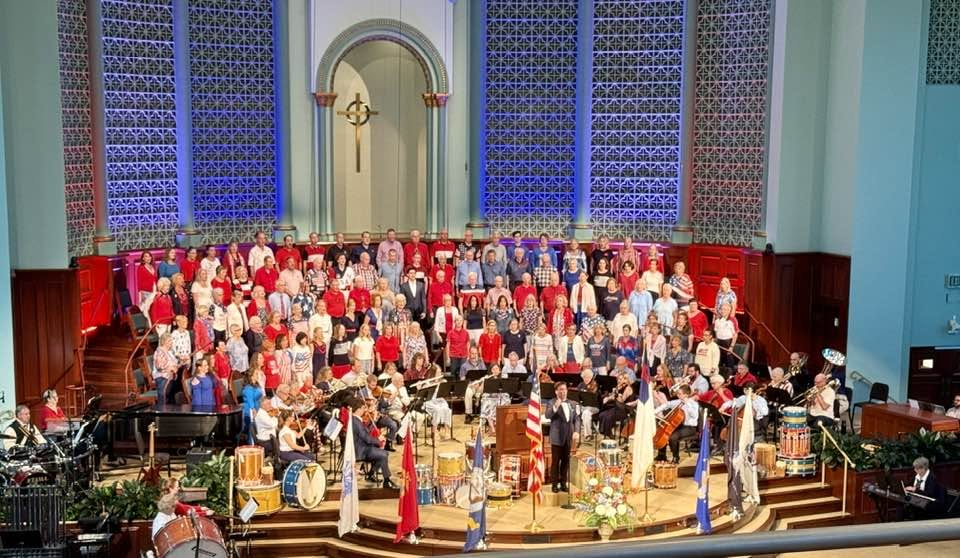
Amanda and I had the joy of spending this past weekend in Pensacola, Florida, where I had the privilege of returning to preach at the First Baptist Church of Pensacola, a congregation I was honored to serve as pastor from 2005 until 2017. Returning always feels a bit like coming home. We were blessed to reconnect with dear friends and worship alongside people who continue to hold a special place in our hearts.
The weekend concluded on a particularly meaningful note as Amanda joined the Festival Chorus and Orchestra for the annual Pensacola Patriotic Celebration on Sunday afternoon. Under the gifted direction of Scot Cameron, the choir and orchestra presented “The Four Freedoms,” a stirring musical by renowned composer Joseph M. Martin. The cantata was beautifully framed by several beloved hymns and patriotic anthems celebrating America’s heritage, creating an afternoon filled with gratitude, inspiration, and worship.
Martin’s work draws its inspiration from one of the most significant speeches in American history. On January 6, 1941, nearly a year before the United States entered World War II, President Franklin Delano Roosevelt addressed Congress and articulated a vision for a world founded upon four essential human freedoms that should belong to every person, everywhere.
Those freedoms continue to speak powerfully to our generation.
Freedom of Speech reminds us that truth flourishes where people are free to express their convictions respectfully and without fear.
Freedom of Worship affirms the priceless privilege of worshiping God according to the dictates of one’s conscience. As followers of Christ, we understand how extraordinary that freedom truly is and how many believers around the world continue to worship amid great hardship in regions hostile to religious expression.
Freedom from Want expresses the hope that every individual can enjoy life’s necessities and the opportunity to live with dignity.
Freedom from Fear envisions a world where peace replaces violence and where families can live without constant anxiety over oppression and war.
Through soaring melodies and inspiring lyrics, Joseph Martin transformed Roosevelt’s timeless vision into a compelling musical testimony. The presentation celebrated America’s past, but it also challenged us to consider our responsibility for America’s future.
As I listened Sunday afternoon, I was reminded that music has an extraordinary ability to unite hearts. Long after a speech has been forgotten, a song often continues to echo in our memories. Music not only entertains; it teaches, inspires, and preserves the values that shape a nation.
The timing of this presentation could not have been more fitting. During this week, as we celebrate the 250th Anniversary of our great nation, The Four Freedoms gave voice to our celebration. Yet it also reminded us that freedom is never something to be taken for granted. Every generation must choose to practice these freedoms responsibly, protect them courageously, and preserve them faithfully for those who follow.
President Ronald Reagan wisely observed, “Freedom is never more than one generation away from extinction.”
His words remain as relevant today as when they were first spoken. Liberty survives not by accident but because ordinary citizens exercise it with wisdom, gratitude, and responsibility.
As Christians, however, we celebrate an even greater freedom. Jesus declared, “So if the Son sets you free, you will be free indeed.” (John 8:36)
Political freedom is one of God’s greatest blessings, but spiritual freedom is God’s greatest gift. Through Christ we are set free from the power of sin, the burden of guilt, and the fear of death.
Perhaps that is why this concert was so meaningful. It reminded us that the greatest songs not only celebrate our country’s freedoms—they point us toward the One who is the source of all true freedom.
May we celebrate this historic anniversary with gratitude, renewed patriotism, and an unwavering commitment to use our freedoms not merely for ourselves, but for the good of others.
And may we leverage our freedoms to align with and advocate for those for whom freedom is still a dream yet to come true.









 Cove Creek Reflections