Holy Week: A Time for Deeper Reflection

Holy-Week

Holy Week is a season for reflection and soul-searching, a week to re-trace the steps of Jesus toward the cross and to contemplate the depth of God’s love. During this week, Christ followers and spiritual inquirers from all around the globe will be focused once again on the events that led to the death, burial, and resurrection of Jesus of Nazareth.

The word “holy” is a healthy and meaningful word, though one of the most misunderstood terms in the English language. It does not nearly suggest “spiritual superiority” or “moral perfection.” The word “holy” refers to people or things set apart for specific, and usually religious, purpose. In the New Testament the Greek word for holy is “hagios” which means “different,” and it is most often used to underscore practices and lifestyles that correlate to a standard different than the cultural norm.

Why is observing Holy Week important to our preparation for Easter? Here’s a bit of history: The traditional observance of Holy Week seems to have originated in the Christian East, emerging out of the practice of pilgrimages to Jerusalem. Each day of Holy Week is important but at least five days call for specific reflection. Palm Sunday is a day to revisit the royal welcome extended to Jesus by the curious crowd as he entered Jerusalem. On Maundy Thursday believers recall the occasion when Jesus washed the feet of the disciples as he gave them a new mandate to love and serve. Good Friday is a day to review the passion and suffering of Christ on the cross. Holy Saturday (or Easter Even) commemorates the day that Jesus lay in the tomb. And Resurrection Sunday, or Easter, is a festive day to celebrate and proclaim that “Christ is risen; He is risen indeed.”

Dr. C. Welton Gaddy, retired senior minister at Northminster Church in Monroe, Louisiana describes the progressive steps in a meaningful pre-Easter journey: “Holy Week services bring into focus dimensions of discipleship that are missed completely by a simple leap from Palm Sunday to Easter. Worship services which take seriously the truths of Maundy Thursday and Good Friday please God because they challenge a greater commitment and a more comprehensive ministry of compassion among the people of God.”

This year as we navigate through each episode of Holy Week, here are few suggestions for honest and healthy soul-searching:
• Read the gospel account in John 12-20.
• Listen to the conflicting voices in the crowd
• Meditate on the cruel injustice of the cross.
• Imagine the passion of Christ’s suffering.
• Think on the hopelessness felt by his disciples.
• Celebrate the hope of the resurrection.
• Renew your commitment to faithfully follow Jesus.

The introspective prayer recorded in Psalm 139:23-24 is extremely relevant and probing during Holy Week:

Search me, God, and know my heart;
test me and know my anxious thoughts.
See if there is any offensive way in me,
and lead me in the way everlasting.

This year, as we read the biblical account with fresh eyes, and listen to the passion of Christ with fresh ears, it may seem as though we are encountering the story for the very first time. An intentional and focused journey through Holy Week may deepen our faith and inspire us to follow Jesus with unrelenting resolve

(Barry Howard serves as leadership coach/consultant with the Center for Healthy Churches. He resides in Pensacola, Florida. You can follow him on Twitter @BarrysNotes.)

Nineteen Books I Plan to Read in 2019

readinglist2019

I love to read. For me, reading is relaxing, educational, and often inspirational.

However, I haven’t always enjoyed digesting a good book. My affinity for reading was slow to develop.  But when it emerged, it flourished. During my teenage years, I perceived reading to be a nuisance and somewhat of a necessary evil to get decent grades. At some point during my college years, however, I learned to enjoy reading, not just for assignments or entertainment, but for personal growth.

As a minister, writer, and pastoral counselor, I need to read widely to stay current and relevant. More importantly, in my current stage of life, I need books like I need food, to satisfy cognitive hunger and to probe intellectual curiosity. Books stimulate my thinking, exercise my memory muscles, and challenge my presuppositions.

Typically, I read a variety of genres including fiction, spirituality, theology, history, and biography. I concur with Diane Duane who surmised that, “Reading one book is like eating one potato chip.”  Therefore, I usually keep from three to five books going at the same time, a discipline that was recommended by Opal Lovett, one of the most influential faculty members from my college years. This practice involves a variety of authors as conversation partners in my internal dialogue.

And I am careful to read books that I disagree with. One of Tony Campolo’s most underrated books contended, They Are the Enemy and They Are Partly Right.  Reading an opposing viewpoint challenges me to test my own assumptions and it acquaints me with a variety of perspectives, equipping me to dialogue and debate intelligibly, and not just emotively.

For the past several years, around the first of January, I make a list of books that I plan to read during the coming year. While I hope to read 40-50 books this year, I have already compiled a list of nineteen of the books I want to be sure to read in 2019:

  1. Sacred Rhythms: Arranging Our Lives for Spiritual Transformation by Ruth Haley Barton.
  2. Eternity Is Now in Session by John Ortberg.
  3. A Glad Obedience: Why and What We Sing by Walter Brueggemann.
  4. Were You There: Lenten Reflections on the Spirituals by Luke Powery.
  5. The Power of Love by Bishop Michael Curry.
  6. Crazy Christians: A Call to Follow Jesus by Bishop Michael Curry
  7. The Reckoning by John Grisham.
  8. The Civil War as a Theological Crisis by Mark Noll.
  9. Letters to the Church by Frances Chan.
  10. The CEO Next Door by Elena Botelho and Kim Powell
  11. Farsighted by Stephen Johnson.
  12. The Great Alone by Kristin Hannah.
  13. A Crazy, Holy Grace: The Healing of Pain and Memory by Frederick Buechner
  14. The Emotionally Healthy Church: A Strategy for Discipleship That Actually Changes Lives by Peter Scazzero
  15. An Unhurried Leader: The Lasting Fruit of Daily Influence by Alan Fadling.
  16. Irresistible: Reclaiming the News That Jesus Unleashed for the World by Andy Stanley.
  17. Dare to Lead: Brave Work. Tough Conversations. Whole Heart. by Brene’ Brown
  18. Grief Day by Day: Simple Practices and Daily Guidance for Living with Loss by Jan Warner and Amanda Bearse.
  19. The Waiting Room: 60 Meditations for Finding Peace and Hope in a Health Crisis by Elizabeth Turnage.

I find that it is healthy and helpful to read “outside the box” of my personal ideology. In other words, don’t just read the kind of stuff that reinforces what you think you know with certainty. Dare to read something that challenges you to think about life and faith from a different point of view.

Whether you are a fast reader or a slow reader, a hard print reader or a e-book reader, read for quality, not quantity. Mortimer Adler said it best: “In the case of good books, the point is not to see how many of them you can get through, but rather how many can get through to you.”

Enjoy a great year of reading in 2019!


A New Trend Emerging in Pastoral Calls

pastor pic

In the Baptist world, an ecclesial culture that treasures local church autonomy and operates in a “free call” method for pastoral assignments, there seems to be a new trend emerging. More and more pastor search committees are considering associate ministers with no senior pastor experience for senior pastor roles.

Throughout much of my ministry, I have observed pastor search committees limit their pool of candidates to ministers with solo or senior pastor experience. In the past, it has not been uncommon for search committees to limit their search with demographic parameters that are surprisingly narrow, such as seeking candidates “who are 35-55 years of age, who have graduated from a Baptist seminary, and who have 5 or more years of senior pastor experience.”

During a Center for Healthy Churches consultants’ retreat last fall, when asked to provide an update on the church from which I had retired, I shared that the church had called a 36-year-old associate pastor who had no senior pastor experience. And then I added affirmatively, “And he seems to be off to a great start.”

This led to our group recounting and listing the growing number of churches in our circles of acquaintance who have also recently called an associate pastor or a ministry resident to the position of senior pastor. Our team named 16 such churches immediately and continued to add to the list in follow up conversations. We were all surprised at the large number of churches (even those churches some call “big steeple churches,” “flagship churches,” or “legacy churches”) who have called new senior pastors whose only previous experience is as an associate.

One of our team members mentioned that when he started out, it was expected that a pastor would begin serving as a solo pastor in a small church, perhaps even while attending college or seminary, and then move to a larger pastorate soon after graduation. Several of my veteran colleagues recalled that when our generation of ministers moved from a smaller church to a larger church, the biggest challenge was adjusting to a multi-staff culture and providing guidance over a much larger budget.

Then we began to itemize the advantages that associates, who already have experience on a medium or large church staff, bring to a senior pastor role:
• They are familiar and comfortable with how a medium-to-large church operates.
• They are already comfortable and familiar with a multi-staff environment.
• They are acquainted with budgetary designations, parameters, and objectives.
• They bring fresh eyes and ideas to the mission of the church and the role of the senior pastor.
• They usually fall in an age range that makes a long tenure possible.
But there are also challenges for an associate who moves directly to the pastorate of a medium-to-large congregation:
• As an associate, they may have preached periodically, but now they must prepare sermons for 40-46 Sundays per year in addition to midweek services and other special events, a responsibility which requires a relentless discipline of preparation.
• Depending on a candidate’s age, they must overcome the stereotype of “youthfulness.”
• They must adjust to senior leadership. Even though an associate has experience leading large groups of people, senior pastoral leadership can often be more like herding cats than shepherding sheep.
• A senior pastor must show fairness and balance to all the ministries of the church and not be preferential. For example, an associate who has served for years in student ministry cannot give preferential treatment to student ministry.
• An associate who becomes a senior pastor must be patient with the learning curve and not expect to have the wisdom of a veteran pastor overnight.

Dave Snyder recently transitioned from an associate’s role to serve as the new senior pastor at First Baptist Church of Pensacola, a church with 2,600 members. When asked about some of the biggest challenges he has faced, Snyder immediately mentions the learning curve: “My lack of experience as a senior pastor presents some unique challenges. For example, there is no history in my soul when it comes to dealing with major church issues, unexpected tragedies, and overall staff leadership. Each month of my first year tends to be a classroom full of lessons learned. When leading staff meetings, prayer gatherings, ordinances, counseling, and preaching, I don’t have years of experience or expertise to draw on. Although my excitement is there, the lack of history in the role can produce an uneasiness in me if I allow it to.”

Then Snyder adds, “But after 17 years in student ministry, I have discovered new life and excitement in ministry. A senior pastor carries different types of work and labor. I have been excited about my first Christmas Eve service, my first Lord’s Supper, and my first deacon ordination. For veteran senior pastors, these come as normal parts of the call. In my first year, they are all brand new. On top of these, meeting, shepherding, and teaching the people of God creates deeper joy in my call. Multi-generations of people are now under my care. Although this is a huge undertaking, I am being strengthened by God’s grace.”

Pastor search committees who are looking for the best possible senior pastor for their church are discovering that experienced associate pastors and ministry residents are prime candidates for their committee’s consideration.  Associate ministers have a wealth of experience which enables them to adapt to a senior pastor role in a short period of time.  And much like participants in a medical residency program, ministry residents who have served two or more years in a local church residency program usually complete a full rotation in multiple areas of specialization, which gives them more diverse experience than many pastors who have not had the privilege of getting hands-on experience in multiple staff areas.

A healthy church is a community of Jesus followers with shared vision, thriving ministry, and trusted leadership. The team of consultants at the Center for Healthy Churches are available to assist your congregation in facilitating healthy pastoral transition. For more information about our services please contact us.

(Dr. Barry Howard retired in 2017 after spending 39 years in pastoral ministry, the last 12 years as the Senior Pastor at First Baptist Church Pensacola. He completed his coach training at the Pastoral Institute in Columbus, Georgia. He has a passion for the local church and a natural talent for fostering healthy practices among clergy and congregations. He serves as a coach for CHC.)

Don’t Let the Darkness of Grief Eclipse the Light of Christmas

winter-solstice-2015-777x437

Yesterday when my wife and I went for our afternoon walk, it seemed to be getting dark a little earlier than the day before.  And today will be even darker.  And it should be, because today is the darkest day of the year.

For those of us who live in the northern hemisphere, the shortest day of the year, the Winter Solstice, usually occurs on Dec. 21. The solstice, which literally means, “sun stood still,” officially marks the beginning of winter.

More notably, with the shortest day also comes the longest period of darkness. The Earth’s axial tilt is at its furthest point from the sun, allowing the least amount of daylight to reach the earth.

While it may be merely coincidental that the darkest day arrives just prior to our customary celebration of Christmas, from my experience as a pastor, I am aware that holidays can be dark days emotionally for many of us.

While there are a variety of events, experiences and emotions that cast dark shadows over our lives, some even bleak enough to obscure the joy of Christmas, a prominent culprit is grief.

Grief comes in many shapes and sizes.  We grieve over the death of friends and loved ones. We grieve over disintegration of a marriage. We grieve over an unexpected diagnosis. We grieve over friction within the family. We grieve over the loss of a job. We grieve over tragic events around the globe. At times, we may even grieve over our diminishing health, the loss of our dreams or the fading of opportunities.

Let me be quick to affirm that grieving is healthy as long as we are progressing through the grief process as opposed to becoming stuck in our grief.

The Bible never tells us not to grieve, but it does counsel us not to grieve “as those who have no hope” (1 Thessalonians 4:13).

Be aware that the empty chair at the Christmas dinner table, the Christmas card labeled “return to sender” or the empty pillow on the other side of the bed can all trigger a seemingly overwhelming sense of darkness, loneliness or grief.  Grief is a naturally part of life.  However, unprocessed grief is unhealthy and can lead to anger, depression or even physical illness.

During the holidays, rather than being overwhelmed by the darkness of grief, look your grief in the eye and call it by name. Dialogue with your grief. Don’t deny it or ignore it. But just because grief is present, it doesn’t have to be dominant.  Don’t let grief dictate or dominate the mood or conversation of your holiday celebration.

I am convinced that because we are “fearfully and wonderfully made” (Psalm 139:14), our faith gives us the capacity to experience the pangs of grief and “the peace of God, that transcends all understanding” (Philippians 4:7) simultaneously.

Our faith does not exempt us from the darkness, but our faith does equip us to deal with our grief with deep-seated hope.

Hinting at what life will be like when the promised Messiah comes, Isaiah 9:2 envisions that, “The people walking in darkness have seen a great light; on those living in the land of deep darkness a light has dawned.”

Walk through the darkness with courage. Just don’t take up residence in the shadows. Grief does not have the final word.

Today is the darkest day of the year.  But tomorrow, the days start getting longer, bringing a little more light.  The psalmist reminds us that “Weeping may endure for the night, but joy comes in the morning.” (30:5b)

After the long night of darkness, then comes the light, gradually, but certainly.

Be careful not to let the darkness of grief eclipse the Light of Christmas.

(Barry Howard serves as a pastoral counselor who leads Healthy Grief Groups in Pensacola, Florida.)

When God Moved into the Neighborhood

bethlehem

One of my favorite passages to reflect on at Christmas is found in the first chapter of the gospel of John. In The Message, Eugene Peterson translates verse 14 like this: The Word became flesh and blood, and moved into the neighborhood (John 1:14a MSG).  This earthy translation traces the incarnation to our front door.

Often overlooked as one of the biblical Christmas stories, the first chapter of John’s gospel describes the incarnation in philosophical prose. In contrast,  Matthew and Luke composed nativity narratives which chronicle the birth story of Jesus.  John, however, portrays Jesus as the Word who came to bring life and light to all who are willing to receive it (1:4).  And now, over 2000 years later, this Light still guides our steps and this Life continues to infuse our existence with a sense of purpose and direction.

The gospel accounts are compiled from different vantage points. Just as Matthew’s gospel appeals to the historian and genealogist in us, and Luke’s gospel sings to the poet and musician inside of us, perhaps John’s gospel dialogues with the inquirer and logician within us.

John asserts that in the beginning of all things, the Word co-existed with God. Before order was brought out of chaos, the Word was with God. Before light emerged out of darkness, the Word was with God. Before the first breath exhaled through human nostrils, the Word was with God. The Word was, is, and always will be in sync with God.

The Greek term translated and personified as the Word is logos. Logos is a philosophical concept which can be translated as “ultimate meaning” or “reason for being.” During Christmas we may see or hear the familiar slogan that says, “Jesus is the reason for the season.” I think John is actually proposing this Word incarnate informs our reason for being.

According to John, the Word took on human form and moved into the neighborhood. In other words, God not only entered the world as a human being on our behalf, but God has strategically chosen to be near and accessible to us.  In the incarnation, the God of the universe, who transcends our capacity to comprehend or control, has freely and lovingly chosen to relate to us in a personal way and to communicate with us in a language we can understand…an exemplary human life.

Remarkably, God not only invites us to receive light and life; God also calls us to be life and light wherever we live and wherever we go. As we follow the teachings of Jesus and emulate the example of Jesus, we become light and life in our community. As we serve God by serving others, especially the “least among us,” we too, mysteriously, become God’s flesh and blood, God’s hands and feet in our neighborhood.

In all seasons, may we share the Light and the Life with others in the way that we live and serve.

Simple Blessings I Never Want to Take for Granted

simple pleasures 1

I first saw this folk proverb on a sign hanging in one of our favorite Smokey Mountain restaurants: “Simple pleasures are life’s treasures.”  It reminded me of an old tv commercial that proclaimed, “Life’s simple pleasures are the best.” Whatever one’s station or mission in life, little blessings should never be taken for granted.

During this week designated to remind us to count our blessings, I will certainly be giving thanks for faith, family, friends, and freedom. But there are a few things that popped up in my gratitude inventory that some folks might label as minor blessings. For me, however, they are a big deal. Some are simple pleasures, others are personal preferences, and a few are stress relievers.

These twelve represent a longer list of blessings that add richness and meaning to life, simple gifts that I never want to take for granted:

  • A hot cup of coffee on a cool October morning.
  • A multi-colored sunrise over the bay or an autumn sunset over the Gulf.
  • Sticky hugs from nieces and nephews.
  • A timely phone conversation with a friend.
  • Artwork given to me by a child.
  • Immersing myself in a good book…a novel, a biography, or a little theology.
  • Home-made cards or written notes of encouragement.
  • A song emanating from my soul.
  • A refreshing midafternoon nap.
  • A weekly walk between 18 holes.
  • The freedom to gather with others to worship.
  • The privilege of dedicating, encouraging, baptizing, marrying, and even eulogizing others…walking alongside others through all of the seasons of life.

This week, as we give thanks for the big things, let’s also take time to give thanks for the little things that bring joy, fulfillment, and affirmation to our lives.

What would you include on your list of simple blessings?

Pastor: A Unique and Contextual Calling

eugene peterson

Earlier this week Eugene Peterson departed this life for his eternal home. But his influence will live on for years to come.  Throughout my ministry, I have been blessed with a few trusted and treasured mentors who shaped and molded my approach to pastoral work. Eugene Peterson is the only one I never met in person.

I think I have a copy of every one of Peterson’s books in my library. But his books about the pastoral vocation stand a little taller than the others. The Pastor: A Memoir by Eugene Peterson is an inspiring autobiographical account of what it means to be called to pastoral ministry and to live out that vocation in a unique community. On more than one occasion, this book inspired me to reaffirm my calling with fresh perspective.

While Peterson is known to many primarily for his popular Bible translation called The Message, his most significant contribution to my world has been his writings about pastoral work. Years ago I read three of Peterson’s books about pastoral ministry: Five Smooth Stones of Pastoral Work, The Contemplative Pastor, and Under the Unpredictable Plant. In a church world that looks to the pastor to be the CEO, a chaplain-on-demand, or an ecclesial entrepreneur, Peterson reminds ministers and churches that a pastor is more like a spiritual director, a “soul friend” who walks alongside others pointing out what God is doing in their life.

In a fast-paced world, where a competitive consumerist culture has invaded the church, pastors are often expected to be an idealistic combination of captivating motivational speaker, savvy executive/administrator, and extraordinary counselor. But the call to be a pastor is unique. There is no other vocation like it.

Veteran pastor Hardy Clemons reminds us that the church is to be “more family than corporation.” Clemons reminds pastors and churches of their peculiar mission:

Our goal is to minister: it is not to show a profit, amass a larger financial corpus or grow bigger for our own security. The ultimate goals are to accept God’s grace, share the good news, invite and equip disciples, and foster liberty and justice for all.

For Peterson, the call to be a pastor is a call to spiritual discernment and caring within a unique local congregation and community. It is not a “one size fits all” occupation that functions uniformly in cookie cutter churches. The “pastoral intelligence” you glean from ministering to your people becomes a primary tool of the Spirit which informs and inspires how you lead and preach to your people.

In Peterson’s Memoir, he summarizes his understanding of the biblical role of a pastor:

The pastor is “not someone who ‘gets things done’ but rather the person placed in the community to pay attention and call attention to ‘what is going on right now’ between men and women, with one another and with God—this kingdom of God that is primarily local, relentlessly personal, and prayerful ‘without ceasing.’

Each of us is responsible to God for fulfilling our calling. Forty-two years ago I confirmed my calling to be a pastor. Now I have retired from the active pastorate and have entered new season of coaching and encouraging pastors and congregations. And I am still reflecting, learning, and growing in my understanding of what it means to be an effective pastor, even in this new stage of life.

(Barry Howard is a retired minister, writer, and leadership coach who lives in Pensacola, Florida.)

Trusted Places to Make Your Donation for Hurricane Michael Relief

disaster relief.png

Whether the destruction is caused by a hurricane, tornado, or flood, the process of cleaning up, repairing, and rebuilding is long and tedious.  And even when a dwelling or business is fully insured,  during the chaotic time immediately following a natural disaster, those affected may experience limited communication, inadequate supplies,  a need for temporary accommodations, and suspended employment.

Even as individuals are applying for FEMA funds or completing tedious insurance paperwork, there is a immediate need for resources and assistance. I am grateful for churches, community groups, businesses, non-profits, and individuals who give generously of their time and resources to assist those in the zone of destruction.

After a disaster strikes, one of the welcomed blessings is seeing neighbor helping neighbor, and seeing diverse groups and individuals put aside their political, theological, or personal differences and join forces to serve those afflicted by the disaster.

In the aftermath of Hurricane Michael I have been asked numerous times, “Where is the best place to send my donation?” After all, no one wants to be scammed.  As a pastor who has been on ground zero where tornadoes and hurricanes have hit, I have partnered with numerous organizations that I have found to be dependable and trustworthy accountable managers of disaster relief resources.

The following is a list of organizations that I have donated to or  worked with on the ground and found to be reliable and accountable:

  • Your local church
  • Volunteers of America
  • Christian Ministries of Pensacola
  • Florida Baptist Disaster Relief
  • Pensacola Bay Baptist Association
  • Cooperative Baptist Fellowship Disaster Relief
  • Baptists on Mission (NC)
  • The United Methodist Committee on Relief (UMCOR)
  • Catholic Charities
  • Campers on Mission
  • Mennonite Disaster Services
  • LDS Charities
  • Samaritan’s Purse
  • The Salvation Army

This list is exemplary and not exhaustive.  I am sure that there are many other outstanding organizations that could be on this list.

When disaster strikes, it takes all kinds of groups working together cooperatively to meet the needs of those in distress.  By all accounts, rebuilding after Hurricane Michael will be ongoing for the next few years.  However, during these first few weeks after the storm, our generous gifts can make a life-sustain, life-changing impact.

Join me in giving a generous gift to Disaster Relief/Hurricane Michael.


Life After the Storm

Hurricane is approaching at the beach

Today has been a sad and anxiety-riddled day on the Panhandle of Florida. One of the most powerful storms in history sprinted across the Gulf of Mexico and then blitzed ashore between Panama City Beach and Port Saint Joe, wreaking havoc from Navarre Beach to the Big Bend.

Photos and videos on tv and social media are all too familiar. Signs down, roofs blown away, beaches eroded, and homes under water.

Although I grew up in Alabama’s tornado alley, I escaped exposure to catastrophic storms until 1994. I was serving as pastor at the First Baptist Church of Williams near Jacksonville, Alabama when a tornado touched down on Palm Sunday near Ragland, Alabama and cut a trail to Rome, Georgia, demolishing hundreds of homes, destroying five church campuses, and taking 29 lives before leaving that area.

Later, in 2005, when I began serving at FBC Pensacola, we dealt with a series of destructive storms including Hurricanes Ivan, Cindy, Dennis, and Katrina. To date, during our 13 years in Pensacola, we have weathered 16 named storms that have affected the Panhandle.

As a category 4 storm, Hurricane Michael will likely be remembered as the strongest hurricane to hit the gulf coast, and one of the most powerful to hit United States in our lifetime.

Once a storm passes, residents are faced with a haunting reality. Life will never be the same. For many, friends have been injured, businesses have been damaged, homes have been destroyed, and irreplaceable family heirlooms lost. A sense of despair prevails. But for most, at least, life will continue. In fact, today’s storm bulldozed on shore with winds near 155 mph, and yet at this point, there no reported fatalities and only minimal injuries.

Following previous tornadoes and hurricanes, the communities I served learned a lot about patience and perseverance. We learned a lot about the grace and hope that emerges in the middle of chaos. We learned the importance of looking forward and not backward. We learned to focus on our dreams for the future rather than the nightmare of the storm. We learned a lot of valuable lessons at the congested intersection of life and faith, lessons that have helped us to heal and move forward, slowly and progressively.

In the days ahead, as we help others put life back together, let us employ the lessons learned from storms past as we help our neighbors rebuild after the storm:

1. Life goes on after the storm. Once the initial shock of the devastation has been absorbed, it’s time to channel all of your energy to re-building and moving forward. Despite the grief over things lost, there is a unique kind of joy that arises when you begin dreaming of the new things you can build…together. And interestingly, the challenge of re-building has a healing effect and can be a healthy way to process the grief of storm-associated losses.

2. When a storm hits, no one is exempt. Storms result from a chaotic weather pattern and they tend to strike indiscriminately. Regardless of what you hear from those with quirky religious superstitions, storms are not typically God’s way of punishing the “worst of sinners.” Storms affect everyone in their path, whether you are rich or poor, young or old, faithful or faithless. As Grady Nutt used to remind us, “It rains on the just and the unjust, and not always just on the ‘just’.”

3. When the going gets tough, people of good will mobilize and work together cooperatively. After each of the aforementioned storms, a variety of church groups, missional agencies, and community organizations rolled up their sleeves, and went to work. To assist in the cleanup and the re-building process, many volunteers will be needed. After previous storms, I have been privileged to work alongside faith-based groups, work release inmates, utility cooperatives, Campers on Mission, student groups, biking clubs, medical groups, and other community volunteers.

4. All kinds of talents and skill levels are needed for clean-up and re-building. We were fortunate to have a huge corps of skilled personnel who managed chain saws, dozers, cranes, and front-end loaders. However, we also needed folks to cook food, drive trucks, pick up debris, run errands, care for children, visit the elderly, sweep the floor, manage communications, and do household cleaning. In disaster relief, every job is important and every volunteer has something to offer. Never underestimate the importance of doing all the good you can, where you can, when you can.

If you want to volunteer, always connect with an organization such as your church or denominational mission agency, Volunteers of America, the Salvation Army, the Red Cross, or BRACE. Don’t just strike out on your own. Each of these organizations will be engaged in relief work following Hurricane Michael.

5. Relief work fosters a unique sense of community. We learned that remarkable bonding occurs in the field. The sense of community born among those who work together following a storm forges a spiritual kinship that lasts for a lifetime… or longer.

6. Refuse to live in fear of the next storm. Those affected by storms may be inclined to experience storm phobia, a fear of storms. Many begin to live in such a heightened state of anxiety, that every cloud invokes a near panic attack. One alternative to living in fear is to be better prepared for the next storm. Perhaps that means creating a storm preparation checklist. Or possibly that means better implementation of a storm safety plan. Time and energy spent worrying about something as unpredictable as a future storm is wasted energy. It is best to find creative ways to transform that energy into constructive preparation.

7. A storm experience can deepen your spiritual faith.  For some of us, simply having a “close call” invokes a profound sense of one’s mortality.  Others may emerge from a storm with a “new lease on life” that translates into a commitment to live in a deeper and more meaningful sort of way. For still others, during the rebuilding process they discover a community of friends who inspire them toward a more authentic and honest understanding of faith, a faith they want and often claim for themselves.

Today many of us are praying for those in the path of a storm that has wreaked havoc in local neighborhoods. Many of these affected residents are feeling shock, anger, and a nearly overwhelming sense of despair.

The people of Florida, Alabama, and Georgia are resilient. And the residents of the Panhandle where I live deeply love the Emerald Coast. In the next few days, relief agencies and churches will mobilize labor pools and resource centers. And residents will be drying their tears, rolling up their sleeves, and getting ready to repair and rebuild, because there are some things deep inside that the strongest storm cannot destroy.

(Barry Howard is a retired minister who lives on the beautiful Emerald Coast of Florida.)

Ode to Steve: My Recollections of Our Journey with Steven Mamer

barry and steve mamer 1

Soon after Amanda and I moved to Pensacola, I saw a guy wearing an army green jacket, apparently homeless, pushing a wheelchair down the sidewalk on 9th Avenue. The wheelchair was occupied by an older woman who was holding a large bag. For the next few months, I would see this same duo on Palafox, near Cordova Mall, or strolling along Cervantes.

Later in December, when our church at First Baptist hosted our annual Homeless Luncheon, I noticed the guy, the wheelchair, the woman, and the bag, as they entered Chipley Hall. It was my chance to meet them, finally. When I greeted the guy, he looked confused and anxious, as though he thought I was going to ask him to leave. He reluctantly told me his name was Steve, and that was about it. The woman did not give me her name, but we made sure that she and Steve received a hot meal, and they left shortly thereafter. Although we offered backpacks, clothing, jackets, and blankets at no charge, I don’t remember that Steve took anything.

For the next few months, when I would see Steve here and there on the street, I wondered about his background, and was curious as to whether the woman was a friend or relative. I’m not sure where they stayed at night, but I assumed that they slept under the interstate bridge. The homeless population in Pensacola skyrocketed after Hurricane Katrina, so keeping up with Steve or any of our homeless friends became more challenging, and street life in Pensacola became more competitive.

I made it a point to learn the names of many of our homeless friends, often listening to their stories, guiding them toward resources, or just sharing a word of prayer or encouragement with them. The following spring, I stopped seeing Steve or his friend on the street. I feared the worst, supposing he could have suffered a dismal fate, or become lost in the turbulent sea of transient life.

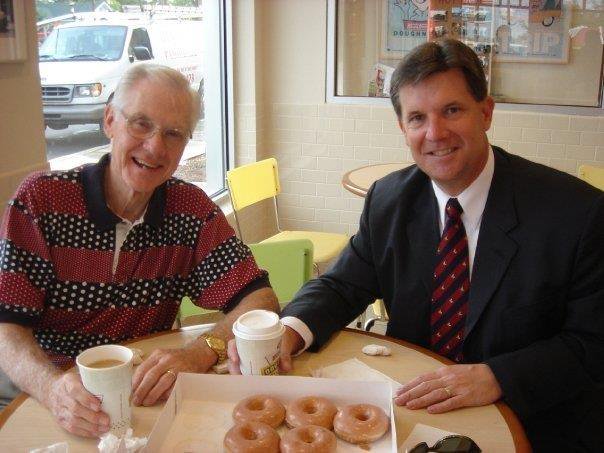
Six-to-eight-months later, as I was driving back to the office via 9th Avenue after making visits at Sacred Heart hospital, I saw a wheelchair and a familiar green army jacket. It was Steve pushing the wheelchair down the sidewalk, but this time the chair was occupied only by the large black garbage bag that contained all of Steve’s earthly possessions. The woman was not there. Elated to see that Steve was safe, I whipped into the Krispy Kreme parking lot and approached him as he was traveling his usual route into town. When I called his name he looked up, seemed to remember that I was from the church, but he didn’t remember my name and was still reluctant to talk. When I asked about “the woman,” he said, “What woman? I don’t know a woman.” When I asked where he had been, he only said, “Hospital” and walked away. I encouraged him to come by the church for coffee on Sunday morning, but I got no response. We never heard a word about the female amputee or her whereabouts again, and even later, when Steve gained much greater clarity, he did not recall the woman who once occupied the wheelchair.

A couple of weeks later, I was surprised but pleased when Steve showed up for coffee around 8 a.m. on Sunday morning. He had pushed his wheelchair with the bulky bag containing all his belongings indoors as though it was his trusted companion. He finally but reluctantly agreed to leave the wheelchair just outside the door, as one of our greeters promised to watch it for him. And that was the first of many Sundays that Steve came to church.

Steve usually attended the Early Service, sat in the Atrium during Sunday School, and attended the Mid-morning Service as well. Since First Baptist is an extraordinarily caring and friendly community, and a church better skilled than most to welcome and minister to the homeless, many folks were speaking to Steve, but he would only nod and occasionally tell someone his name was Steve, careful to keep his distance. I feared he would be overwhelmed and not come back.

When I say “attended,” I use the word loosely. Steve would find a seat, move to another seat about five minutes later, go the restroom, return to his seat, and move again. Simply because his constant movement was a distraction to many in the congregation, a couple of us kindly encouraged Steve to go to the restroom before the service, and we tried to explain the importance of finding a seat and staying there so that he could take in all the service. It wasn’t a demand from us, as much as it was a gentle orientation to church life, intended to enrich Steve’s social and spiritual awareness. However, once again, after our huddle I feared he would not come back.

But come back he did. Every time the doors were opened. Steve started coming on Wednesday nights. Someone would usually offer to buy his meal, but Steve often had money and insisted on paying for his own plate. He was still distant, slow to speak, and at times disoriented, but he seemed to know that church was a safe place, so he began conversing a little more around the dinner table. On Wednesday nights, he began learning a few names of other church members, and almost everyone in the church knew Steve’s name. Many wanted to help but getting information from Steve was like prying a fish from an osprey’s talons.

One Wednesday, shortly after winter arrived, a heavy freeze was in the forecast and the temperature was already in the 30’s at church time. Yet, here came Steve, from under the bridge, up the sidewalk with his trusty bag and wheelchair, and into Chipley Hall. Since the temperatures were expected to drop into the teens overnight, with the possibility of a light snow and ice, we knew we couldn’t let Steve sleep in the cold. But even my suggestion that we take him to a shelter or safe place was met with suspicion and high anxiety. After arguing with him for a few minutes, our associate minister, Ross Lankford, and I, convinced Steve that he might not survive the night in the cold, and he reluctantly agreed to let us transport him to Waterfront Mission.

The next dilemma was getting his wheelchair and bag into my car. When Ross and I tried to extract the large bag from the wheelchair, we discovered that it had been there so long, it had almost “grown attached.” Second, the moment we touched the bag, Steve almost attacked us, reacting much like a mother bear when someone approached her cub. Once again, Ross and I had a serious conversation with Steve, in the cold parking lot, about how his safety was our priority. I think he finally understood our intentions and allowed us to put the bag in the back seat, the chair in the trunk, and Steve in the front seat.

Later I would learn from Steve’s mother that, when Steve was a young man, his father dropped Steve off at a hotel with a bag of clothes and said, “You are on your own.” Shortly thereafter, Steve’s father took his own life. With no place to call home, and disconnected from his mother, Steve had begun lugging this bag, containing his meager possessions and his mixed memories, with him everywhere and didn’t want to let the bag out of his sight.

On this cold evening, as we were en route to Waterfront Mission, for some reason, Steve talked to me more than he had spoken since I had first met him. He told me that his mother lived in Colorado, that he hadn’t seen her in years but talked to her on the phone occasionally, and that he had a sister but didn’t know for sure where she was. He told me that he was not afraid to live on the street and that most of the homeless looked out for each other, except for the bullies, which he avoided. He assured me that he wasn’t currently “drinking or on drugs,” although I had not asked. For a few brief moments, a different personality shined through. When I dropped Steve off at the shelter, he thanked me, but there was no touching. Steve bristled when anyone tried to touch him or shake his hand. However, I sensed that a slow and gradual transformation was taking place.

Al Smith, one of our many servant-hearted members, recalls seeing Steve for the first time in 2010. Later in 2013, Al met Steve at a 5th Sunday cookout. Soon after that, Al began trying to encourage and assist Steve. After getting to know a little more about Steve’s circumstances, Al wanted to talk with me about Steve. Al had been visiting with Steve at our mission center, Samaritan Hands, and Al had the crazy idea that he might be able to get Steve a place to live and a job. Even though I was highly concerned for Steve and our homeless friends, I suppose I had grown a little crusty and less optimistic. I cautioned Al not to get his hopes up and even said to Al that Steve might be one whose potential was being maximized by our trying to keep him safe and well-fed. Not to be discouraged, Al pursued assistance for Steve proactively and aggressively. And I am so glad he did.

Al took Steve to 90 Works, an organization that assists our transient friends by evaluating vocational skills, observing their potential, and assessing benefits and resources available to them. Over the next few weeks, we discovered in a medical evaluation that Steve has been diagnosed a paranoid-schizophrenic, and that he had not been taking his medicine appropriately. We also discovered that Steve was entitled to benefits that he had not yet accessed. To summarize, after a brief hospital stay where Steve’s medicine was evaluated and administered correctly, Steve had a new lease on life. Al, with the help of 90 Works, found Steve a place to live. Steve had a new wardrobe, and when Steve returned to church, he had a new disposition, a cheerful countenance, and demonstrated a higher intellect and remarkably upgraded social skills.

After giving myself an internal reprimand, “Oh, ye of little faith,” I joined the congregation in celebrating Steve’s extreme makeover. He learned names quickly. He wanted to find a place to serve, and he chose Samaritan Hands, the ministry that had helped him. A short time later he got involved in Kairos, a ministry to inmates.  Steve was also invited by 90 Works to share his story at one of their major events, and this homeless guy who wouldn’t say much other than his name when we first met, stood in front of dozens of people and spoke articulately about his journey.

In 2015, between our worship services, the church hosted a surprise reception in the Atrium for me and my wife for our 10th anniversary. Steve was the last one in the receiving line. When I put out my hand to shake his hand, he put down his cake, and gave me a bear hug as he said, “I just want to thank you for being my pastor.” As Steve walked away, I stood there wiping away tears of gratitude for Steve (even as I am doing as I write these words), for his new lease on life, and for the privilege of serving the kind of congregation that notices, cares, and goes the extra mile for the Steves of the world. And for servant-hearted folks like Al and Martha Smith, Bill Farris, Tim Milstead, Quoc Vuong, Barbara Shows, my wife Amanda, and others who saw potential in Steve despite his transient dilemma. I continue to be grateful for Samaritan Hands, Waterfront Mission, 90 Works, and Lakeview Center for the encouragement, care, and resources they provided to Steve. And I am thankful for the seeds of grace that are planted when the church is busy being the church.

A few weeks later, Steve asked to join the church. He thought he had been baptized earlier in life but couldn’t clearly remember much other than “I believed then and I still do.” He officially joined in November of 2015, although we claimed him as one of our own long before that. The next year he approached Ross and said I want to be baptized so that “I have a baptism to remember, and so that others will know what I believe.” Steve was baptized in September of 2016.

Over the past few years, Steve continued to come to church almost every time the doors are opened. Almost everybody knew Steve. He became sort of a fixture at First Baptist, the “poster child” for caring ministry, one who reminded us to care even when we don’t see the immediate fruit of our caring.

We were all stunned and saddened to learn that Steve did not wake up on Thursday morning. He likely died in his sleep in his apartment due to complications with diabetes. After hearing of Steve’s unexpected passing, it occurred to me that many of the folks around First Baptist these days don’t remember the wheelchair. They never saw the big black bag. They never met the forgotten woman who occupied that wheelchair 13 years ago. And they would never believe that Steve was once quiet, anxious, and “untouchable.” They will only remember the new Steve: 30 pounds heavier, friendly and outgoing, often wearing a Crimson Tide shirt, and being among the first to welcome new members to First Baptist, even as others generously and proactively welcomed him a few years ago.

Now, as I think about our journey with Steve, I am processing the things we learned. When Steve first came to church, I remember thinking ever so naively that there are some things Steve can learn from us. And I do think Steve learned several things and his life was enriched by being a beloved member of our church family. But more importantly, I think we as a congregation learned much more from Steve than he learned from us.

Among the many lessons Steve taught us, let me highlight a few that are already influencing and shaping the way we do ministry:
Effective Christian ministry requires the engagement of the head and the heart. Our faith is at its best when we are caring for the least of these. But effective ministry for the least of these requires compassion and accountability. When dealing with the homeless, be “wise as serpents and gentle as doves.” Unconditional love and tough love are tenacious teammates.
Everyone has a story that shapes their lives, and we are not privy to all the details of that story. Be careful not to judge or stereotype others. Be slow to criticize those in whose shoes you have not walked, or in this case, those whose wheelchair you have not pushed.
There are many reasons for homelessness, and we can’t fix them all. But we can offer grace, opportunity, and resources to as many as possible.
Life is messy but grace in not intimidated by the messiness of life. Progress in ministry comes in baby steps, not by leaps and bounds.
The source of our joy comes not from wealth, fame or accomplishment. Our joy comes from being accepted unconditionally into God’s family, a family that is extraordinarily welcoming and redemptive.

I am not sure whether our church was a band of angels sent to Steve in his time of need, or whether Steve came to us as an “angel unaware” who brought out the best in us. But I am sure, and thankful, that both happened.

Farewell, my friend. Until we meet again.

(Barry Howard is the retired senior minister at First Baptist Church of Pensacola. He currently serves as a Leadership Coach with the Center for Healthy Churches and is a board member of The Baptist Center for Ethics.)