When we are traveling, we enjoy seeing the scenery and the wildlife, including both the large and small animals.
We have seen a couple of roadrunners this week, although both were at a distance. They were there and then they were gone, only making a brief appearance.
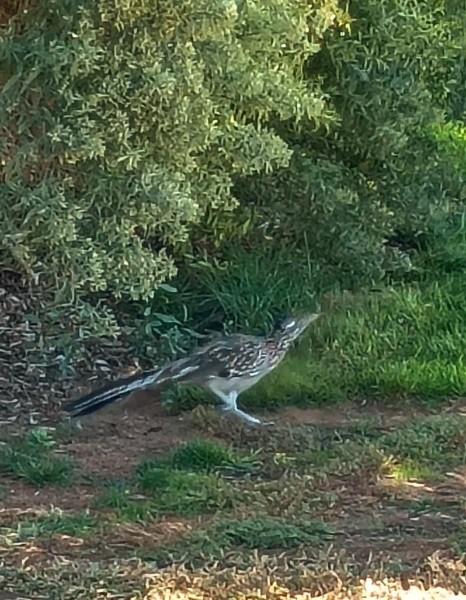
However, on Thursday while playing a round of golf at Lake Powell National Golf Course in Page, Arizona, we spotted a roadrunner between holes 12 and 13. This time, instead of keeping his distance, he posed for us.
For a few moments, this normally elusive desert bird seemed perfectly content to stand there while we admired him and took pictures.
And, of course, seeing a real roadrunner immediately took me back to childhood.
Beep, beep!
I loved the old Wile E. Coyote and Road Runner cartoons. The formula was simple: Wile E. Coyote was always scheming, plotting and ordering some elaborate Acme contraption in an attempt to catch the Road Runner. And the Road Runner was always one step ahead. Usually, the coyote’s plan ended badly.
I’m not sure the real roadrunners are quite as savvy when dealing with their adversaries as their cartoon counterpart. I doubt they spend much time contemplating elaborate strategies for outsmarting coyotes.
But one thing the cartoon got right: Roadrunners are fast!
The greater roadrunner is a real bird of the American Southwest. Its scientific name is Geococcyx californianus, and Arizona lists it among the state’s native bird species.
Unlike many birds, roadrunners spend much of their time on the ground. They have long legs, a long tail and a distinctive crest, and they are wonderfully adapted to life in the desert. They can run at impressive speeds when necessary, which makes the cartoon’s famous “beep, beep” escape scenes at least somewhat grounded in reality.
They also eat a remarkably varied diet, including insects, lizards, snakes, small mammals and other prey. In other words, the real roadrunner isn’t simply a cute desert bird. He is a pretty capable little predator himself.
A roadrunner in red-rock country
The Page area is an especially appropriate place to encounter one. Here in northern Arizona, the landscape seems almost inhospitable at first glance. There are miles of red sandstone, rugged mesas, deep canyons, sparse vegetation and seemingly endless sunshine. Yet the desert is anything but lifeless.
The National Park Service describes Glen Canyon National Recreation Area as home to a rich diversity of wildlife adapted to the arid conditions of the Colorado Plateau. More than 300 species of birds live in or migrate through the area, along with numerous mammals, reptiles, amphibians and fish.
That makes a roadrunner more than an interesting roadside sighting. He is one small part of a remarkable ecosystem.
More than roadrunners
During our time around Page and Lake Powell, we have been reminded repeatedly that wildlife is all around us, even when we don’t always see it.
The area is home to coyotes, bobcats, mountain lions, mule deer, kangaroo rats and desert bighorn sheep, among other mammals. The National Park Service notes that coyotes, bobcats and mountain lions inhabit Glen Canyon, although these predators generally avoid people.
And then there are the birds. In addition to roadrunners, the region provides habitat for eagles, hawks, falcons, owls, ravens, herons and many other species. Glen Canyon’s waters and shoreline also attract a variety of waterbirds and shorebirds.
Perhaps the most spectacular animal we could encounter would be the desert bighorn sheep. These remarkable animals are perfectly designed for the rocky desert. Their ability to negotiate steep, rugged terrain is extraordinary, and their coloring allows them to blend surprisingly well into the canyon walls and surrounding rocks.
Even the animals we don’t see leave evidence that they are here. Tracks, scat, bird calls, movement in the brush and an occasional flash of wings all remind us that the desert is alive.
Keeping eyes wide open
Perhaps that’s one of the lessons of traveling through the desert and to places like Page. You have to slow down enough to see the wildlife.
We can become so focused on the spectacular scenery—the towering cliffs, Lake Powell, Horseshoe Bend, Antelope Canyon and Glen Canyon Dam—that we sometimes overlook the smaller wonders.
A roadrunner standing beside a golf cart isn’t as dramatic as a red-rock canyon. But it is memorable.
On Thursday, between the 12th and 13th holes, we had our own little encounter with one of the Southwest’s most recognizable residents. He stood there long enough for us to appreciate him, photograph him and remember a cartoon character who entertained us when we were children.
Then, eventually, he went on his way. No Acme contraption. No Wile E. Coyote. No “Beep, beep!” Just a real roadrunner doing what real roadrunners do.
Sometimes you just have to keep your eyes open.
And when you see one, don’t blink.
He might be gone before you get the picture.

