“Wow” Moments: 7 Benefits of Experiencing Awe and Wonder

When was the last time you were genuinely amazed? Not mildly impressed. Not entertained. Amazed.

Maybe it was your first glimpse of the Grand Canyon, a sky crowded with stars, a newborn grandchild or a stranger’s unexpected kindness. There are moments when life stops us in our tracks and we whisper, “Wow!”

That feeling is called awe. It’s what we experience when something is so beautiful, vast or meaningful that it stretches our ability to comprehend it.

The trouble is that we can get used to almost anything, even astonishing things. G. K. Chesterton put it well: “The world will never starve for want of wonders; but only for want of wonder.” We don’t lack wonders. We only lack the practice of slowing down long enough to notice them.

I shared a message at church last Sunday about “Discovering Awe and Wonder” from Psalm 19. Since then, I’ve been thinking about how awe enriches our lives.

Here are seven benefits of recovering our capacity for awe.

1. Awe gets us outside ourselves.

Our culture is remarkably good at keeping us focused on ourselves. Phones invite us to take selfies, social media asks us to curate our experiences, and our schedules remind us of everything we must accomplish. Even our problems can make the whole world revolve around us.

Awe interrupts that cycle. Beneath a star-filled sky, our thoughts shift from me to something bigger than me. The psalmist knew the feeling: “When I consider your heavens, the work of your fingers, the moon and the stars that you have set in place, what is mankind that you are mindful of them?” (Psalm 8:3–4). Sometimes the best way to get over ourselves is simply to look up.

2. Awe puts our problems in perspective.

Awe doesn’t make problems disappear. The mortgage is still due. The diagnosis is still real. But awe changes the size of the frame.

Have you ever stared at the ocean after a day of worrying and realized that the problem consuming your morning is only one small part of a much larger world? A problem can be real without being ultimate. Sometimes we don’t need a smaller problem. We need a larger perspective.

3. Awe makes us more grateful.

Wonder and gratitude are close relatives. Think of the sunrise. We’ve seen thousands, yet no two are alike. The same is true of a child’s laughter, an embrace from someone we love, a conversation with an old friend or the simple gift of waking up to another day.

Familiarity makes extraordinary things seem ordinary, and one challenge of adulthood is that we grow so accustomed to blessings that we stop recognizing them as blessings. Awe teaches us to notice again. It changes the question from “What else do I need?” to “How much have I already been given?”

4. Awe keeps us curious.

A child can spend ten minutes watching an ant carry a crumb across the sidewalk. An adult is more likely to step over it while checking email. As we age, we become certain we’ve seen it all.

Awe challenges that certainty. It gives us permission to say, “I don’t know—but I’d like to know more.” That matters in our faith, too. Faith doesn’t eliminate mystery; it teaches us to live faithfully within it. Science can explain how something happens without exhausting why it matters.

Maybe that’s why Albert Einstein advised, “Never lose a holy curiosity.”

5. Awe connects us with other people.

When we see something beautiful, our instinct is to share it. “Look at that!” “Did you see that?” “You’ve got to come see this!” We don’t want to experience wonder alone, which is one reason concerts, worship services, and family gatherings can be so powerful.

Sometimes the greatest awe isn’t inspired by a mountain or a sunset. It’s inspired by another human being: someone courageous, generous, or forgiving, someone who sacrifices or quietly serves without recognition. Some lives make us say, “That’s the kind of person I want to become.” Or, “I want others to see that trait in me.”

6. Awe inspires us to live differently.

Awe doesn’t always leave us standing still. We see the beauty of creation and want to protect it. We witness generosity and become more generous. We experience God’s grace and want to extend it to someone else.

Awe lifts our eyes, but it can also move our feet. It asks a pointed question: “Now that you’ve seen this, what are you going to do about it?”

7. Awe opens our hearts and minds to God.

For people of faith, awe ultimately points beyond creation to the Creator. A night sky can become a sanctuary. A child’s face can remind us of the miracle of life. An act of forgiveness can become a glimpse of grace.

One of the greatest spiritual dangers isn’t atheism. Sometimes it’s familiarity. We can know the Bible so well that we stop being amazed by its message, pray so often that we stop listening, and attend worship so regularly that we forget what we’re doing. As I commented in that recent sermon, we can become so familiar with Jesus that we lose our sense of wonder.

The people of Nazareth made that mistake. They saw the carpenter’s son and missed the Savior standing in their midst. The problem isn’t that God has stopped doing wonderful things. It’s that we may have stopped noticing.

How do we recover our sense of wonder?

Maybe what we need most is to notice. Notice the sunrise. The stars. The laughter of someone you love. The kindness of a stranger. The miracle of another day. And notice the fingerprint of God.

The older we get, the more tempting it is to trade wonder for familiarity. But there are still sunsets we’ve never seen, songs we’ve never heard, prayers we’ve never prayed and mysteries we haven’t begun to understand. And there is still a God who is full of mystery and revelation.

So slow down. Look closer. Let yourself be amazed.

The rabbi Abraham Joshua Heschel insisted, “Our goal should be to live life in radical amazement… get up in the morning and look at the world in a way that takes nothing for granted. Everything is phenomenal; everything is incredible, never treat life casually. To be spiritual is to be amazed.”

Living in “radical amazement” doesn’t require you to travel across the country or around the world. Perhaps the best place to start is by noticing the awe and wonder that is already all around you.
Off to See the Wizard: Our First Visit to The Sphere

Sunday September 27

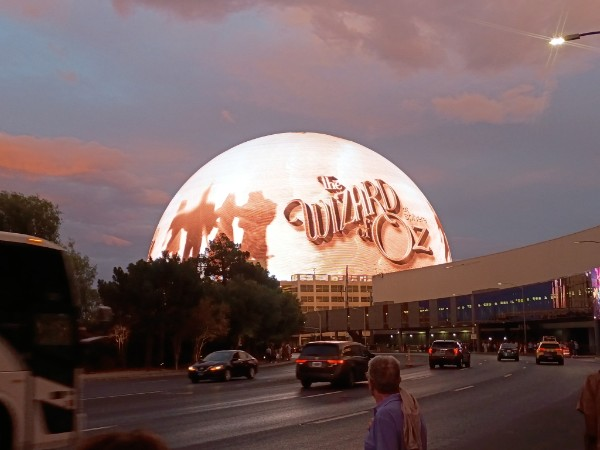
The Eagles were here a few nights ago. And Metallica will begin a tour here on Wednesday. But today, the featured event at The Sphere is “The Wizard of Oz.”

For our final two nights in Las Vegas, we are staying at Treasure Island, which has turned out to be an ideal location for the last stop on our journey. The Sphere is only about seven-tenths of a mile from our hotel, so we had a very short walk ahead of us as we prepared to “follow the yellow brick road.”

There weren’t any concerts scheduled at the Sphere during our stay, so we decided to purchase upper-level tickets to see The Wizard of Oz. Before we left home, a customer service representative at the T-Mobile store in Gadsden had encouraged us to see it. His assessment was, “It’s well worth the price of the ticket.”

After experiencing it for ourselves, we understand what he meant.

A Giant Globe on the Las Vegas Skyline

Like the Space Needle in Seattle and the High Roller (the largest observation wheel in the US), the Sphere has become a unique and prominent structure on the Las Vegas skyline.

You don’t have to know exactly where you are on the Las Vegas Strip to know you’re getting close. Just look up and you’ll eventually see that enormous glowing sphere.

And enormous is the right word. The Sphere is a technological and architectural marvel. It is a massive entertainment venue designed to make the audience feel as though they aren’t simply watching an event but are actually inside the experience.

The exterior itself is a spectacle. Its enormous LED display can transform the building into virtually anything, from a giant eyeball to a smiling face to an enormous moon or a glowing representation of the Earth.

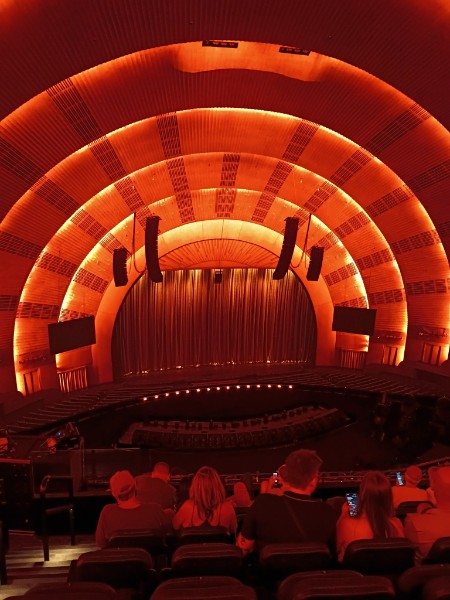
But what happens inside is even more impressive. The venue was designed around immersive entertainment, with a gigantic wraparound screen that extends far beyond the normal field of vision. The enormous display, combined with sophisticated sound, special effects and sensory technology, creates an experience that traditional movie theaters simply cannot duplicate.

The Sphere isn’t just a place where you watch something. It is a place where the environment becomes part of what you’re watching.

There’s No Place Like Oz

Although we haven’t watched the movie in several years, The Wizard of Oz was a perfect choice for The Sphere.

Most of us know the story. Dorothy is swept away from Kansas and transported to a strange and wonderful world filled with colorful characters, talking animals, flying monkeys, a Wicked Witch and, of course, a yellow brick road leading to the Emerald City.

But seeing that story inside the Sphere is something altogether different. The immersive 4-D experience makes you feel as though you are actually traveling with Dorothy. The screen surrounds you. The images extend beyond the traditional boundaries of a movie screen. The sound comes from everywhere. The effects engage your senses in ways that make you forget, at least for a while, that you’re sitting in a theater in Las Vegas.

The Woman Behind Us

But I’m not sure what was more entertaining—the movie or the woman sitting two rows behind us.

I saw her, rather I heard her, as she stood at the bottom of the stairs looking up in anxious disbelief. She was obviously afraid of heights. She barked loud enough for our entire section to hear, “That woman at the ticket booth lied to me. She lied to me! She told me that my seats were not that high up. Oh, Jesus. I’m not sure I can do this.”

That might have been a minor inconvenience at an ordinary movie theater. It was a considerably bigger issue when her seat was in Row 10 of Section 405. From the moment she began climbing the stairs, her commentary became louder and more salty. And she kept it coming.

As she made her way higher and higher, she expressed her concern about the height, the stairs, the distance from the floor and, apparently, the wisdom of whoever had decided that seats should be placed that far above the ground. Smiles turned to laughter as her running commentary became an unexpected part of our entertainment.

And then, as the movie progressed, the Sphere itself began doing what it was designed to do. The experience made the height seem even more dramatic. I’m not sure the woman ever completely overcame her fear of heights, but she persevered.

And she was still there at the end. And when Dorothy threw the water and the Wicked Witch melted, she said, “Now, I know a few people I would like to do that to.”

By then, we had almost become as interested in her comic comments as we were in Dorothy’s journey.

An Experience Worth Having

One thing became clear during our evening at the Sphere: Almost any event would be great in this building. A concert would be spectacular. A sporting event could be incredible to watch. A documentary about the natural world could be breathtaking.

And a movie like The Wizard of Oz takes on an entirely different dimension. The Sphere’s immersive technology isn’t simply a gimmick. It changes the dynamic between the audience and the story.

At a conventional theater, you watch Dorothy enter Oz. At the Sphere, you feel as though you’ve entered Oz with her.

Navigating the Sphere

The facility itself is enormous, and at first glance, it might seem a little intimidating. There are multiple escalators, entrances, exits and levels. With thousands of people moving in and out, it would be easy to imagine the whole operation becoming confusing.

But the staff did an excellent job. There were people everywhere to point us in the right direction and help visitors navigate the building. Despite its size, the process was remarkably organized.

A Walk Through Venice

After the movie, we walked back toward our hotel, taking advantage of another uniquely Las Vegas experience along the way. We crossed the Rialto Bridge and walked through the Grand Canal Shoppes at The Venetian, which is just across the street from Treasure Island.

It was a fitting way to end the evening. Having visited Venice multiple times, it was enjoyable to walk through this re-creation of Venice without ever leaving Las Vegas.

Eventually, we made our way to Malena’s Yogurt Plus for our traditional evening “snack” before heading back to the room. Then we settled in and watched Bo Nix lead Denver on a great comeback against the Rams.

The Last Day

Tomorrow will be our final day on this western adventure.

It will be a leisure day, a chance to slow down, do a little relaxing, repack our luggage and prepare for our early flight home Tuesday morning.

It’s hard to believe the trip is almost over. We’ve traveled through some remarkable country. We’ve seen the Hoover Dam, Lake Powell, Glen Canyon, Zion, the Grand Canyon and the spectacular landscapes of the Southwest. And we’ve collected enough stories to keep us talking about this trip for a long time.

Tomorrow we’ll enjoy one last leisurely day in Las Vegas. Then we’ll pack our bags, head to the airport and begin the journey home.

And as Dorothy said, “There’s no place like home.”

The View from the South Rim: Highlights from Our Day at the Grand Canyon

Saturday September 26

David Brown observed, “Standing at the edge of the Grand Canyon is like standing at the edge of time, where nature’s artistry tells stories of eternity.” 

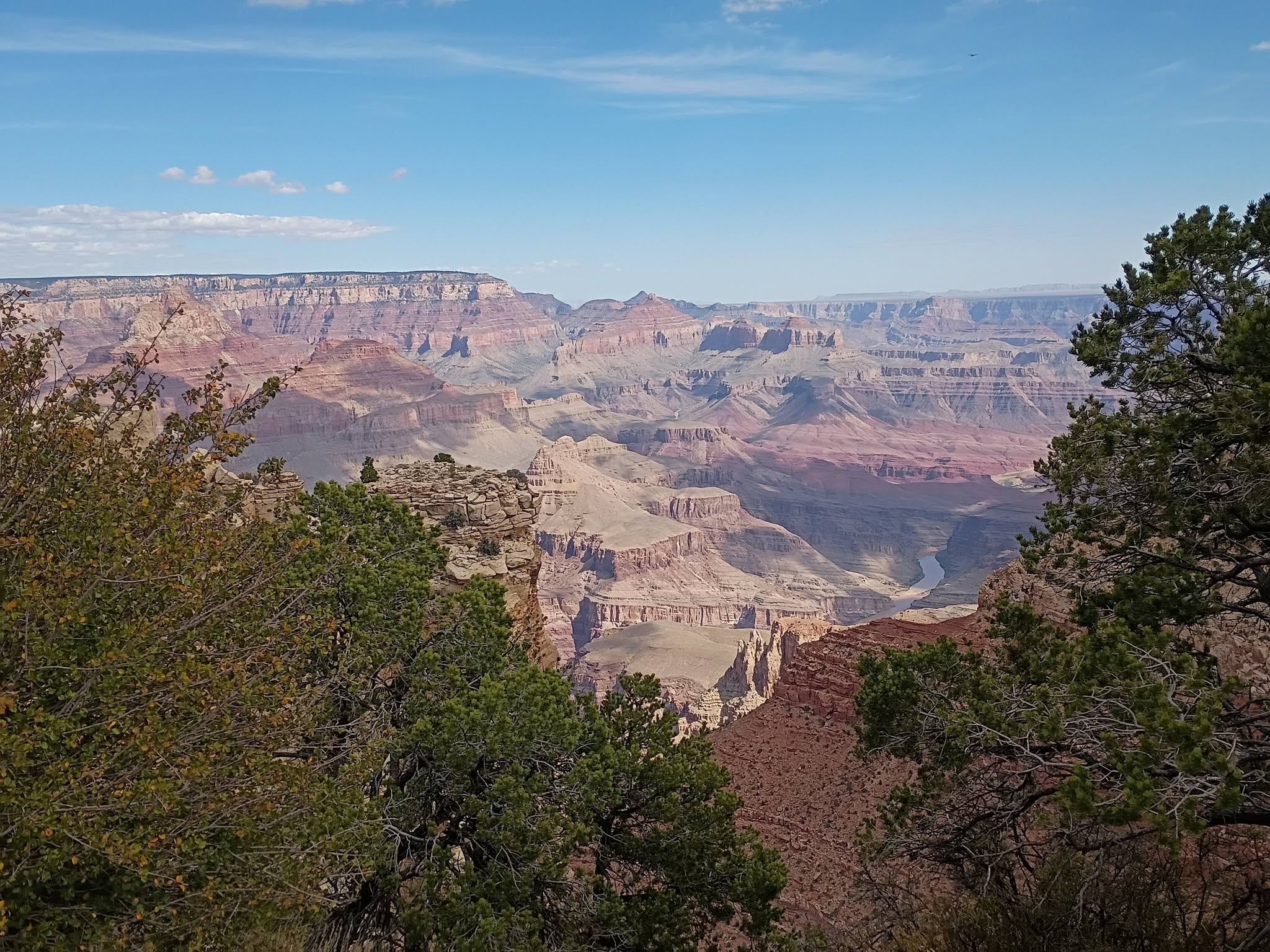
The Grand Canyon is one of those places where photographs, words, and memories seem inadequate to describe the experience of gazing across the gorge, admiring the colors, listening to the whistling wind, and inhaling the moment.

I have been to the Grand Canyon multiple times over the years, and one thing that continues to amaze me is that the view never gets old.

No matter how many times I stand at the rim, there is something about looking into that immense canyon that makes me pause, reflect, and simply take it in.

Our most recent visit was 25 years ago, when we visited the North Rim. It has been over 30 years since we visited the South Rim.. So today’s return to the Grand Canyon was not a new experience but it was a new adventure.

A Scenic Prelude to the Canyon

This morning we left Page, Arizona, and headed toward the Grand Canyon, entering the park through the East Entrance.

The drive itself was a wonderful primer on the formation of the canyon. For much of the way, we followed the Colorado River Gorge through a landscape of colorful cliffs, mesas and rugged desert terrain. The changing colors of the rocks seemed to provide a kind of primer for the Grand Canyon.

By the time we reached the park, we were already surrounded by the geological artistry that makes this part of Arizona so extraordinary. But the best was yet to come.

Desert View: Our Favorite Stop

Our first stop was Desert View, and it turned out to be our favorite of all the overlooks we visited.

The view was spectacular, but the setting was made even more memorable by the Desert View Watchtower, the distinctive stone tower built in the 1930s. The tower rises dramatically above the rim and looks as though it belongs there—as though someone simply found a way to make the architecture grow naturally out of the canyon landscape.

Standing there and looking across the canyon toward the distant horizon was breathtaking.

John Muir once described the Grand Canyon as “a vast wilderness of rocks in a sea of light, colored and glowing like oak and maple woods in autumn.” That description seemed particularly appropriate today.

The canyon isn’t simply one big hole in the ground. It is a vast landscape of color, depth, shadows, light and seemingly endless layers of geological history. Even after multiple visits to the park, the sight still invokes awe and wonder.

We stopped briefly at several other overlooks as we made our way along the rim, but eventually we spent considerable time at Grandview Point. The name is certainly appropriate.

The View That Never Gets Old

One of the interesting things about returning to a place you’ve visited before is discovering that the place may not have changed nearly as much as you have.

Twenty-five years ago, we stood on the North Rim and looked across this same magnificent canyon. Today we stood on the South Rim and saw it from an entirely different perspective. The Colorado River was still winding its way through the depths. The layers of rock were still telling a story that began millions of years before any of us arrived. And yet the view still seemed fresh and inspiring.

There is something humbling about standing before a landscape that makes our own lifetimes seem so small.

Keeping the Canyon Clean

Eventually, we made our way to the Grand Canyon Visitor Center, parked the car and walked a portion of the South Rim Trail. We stopped at Mather Point, where the views were, once again, astonishing. But something else caught our attention.

We noticed a team of people wearing blue shirts who appeared to be preparing to rappel down the canyon. At first, we couldn’t figure out exactly what they were doing. It looked like some kind of adventurous expedition. Then we discovered they were a work crew whose job was to clean garbage and debris from the steep sides of the canyon.

Later, we saw another team doing similar work along the canyon wall behind Thunderbird Lodge. They are brave and appreciated souls indeed.

It was a good reminder that preserving places as magnificent as the Grand Canyon requires more than creating a national park and putting up a few signs.

Perhaps that’s part of the responsibility that comes with enjoying beautiful places: We should do what we can to preserve them for the generations who will come after us.

The Mystery of the Tonka Truck

As we were leaving Mather Point, we noticed something rather unusual. On the ground, over the fence and near the canyon’s edge, was a child’s Tonka truck. We wondered how it got there and imagined a child tossing it, not realizing it could not be safely retrieved.

Then, ironically, at the very next overlook, we encountered the answer. A young boy was crying because he had lost his truck. We overheard his dad explaining to him, rather matter-of-factly: “You threw it over the fence. There’s no getting it back. That’s just the way it is.”

We couldn’t help but smile at the irony. Of course, there may be a little life lesson in there for all of us. And sometimes, no matter how much we want something back, there’s no getting it back. Whether it’s a dilemma of our own making, or just the unfairness of life. That’s just the way it is.

Finding a Bite to Eat

After another restroom break and a brief stop in the Park Store, we drove on to the Village Market, where we purchased a turkey sandwich and Pringles to share.

It wasn’t exactly a leisurely Grand Canyon lunch, but it did the job.

And given the circumstances at the South Rim, we were fortunate to find something to eat. The lodges and restaurants at the South Rim are currently closed because of a flash flood in August that damaged the park’s water system. Officials are hoping to have things reopened sometime in November or December.

As a result, many of the regular restrooms are also closed, and portable toilets have been brought in for visitors.

It was an unusual sight at one of America’s most visited national parks. The Grand Canyon is still very much open to visitors, but the infrastructure that normally supports those visitors is undergoing repairs.

Bright Angel and the Crowds

After our stop at the market, we continued to Bright Angel, where we walked a little more of the South Rim Trail.

The crowds were noticeably larger here, which was interesting because the hotels are currently closed. There were several bus groups, and we suspect many of them were either getting ready to board the Grand Canyon Railway or had just arrived from the train.

Throughout our visit, we noticed that many of the visitors who appeared to be on day trips or overnight trips out of Las Vegas or Phoenix.  Others were staying in the area camp grounds which we still open. And others, like us, were driving the canyon loop as a part of a larger trip.

On to Williams

After our visit to Bright Angel, we departed the National Park and headed south. We drove on to Williams, where we stopped at the Pine Country Restaurant for a late lunch/early dinner. After a full day of driving, walking, and taking in one spectacular view after another, we were ready for a good meal.

Then we checked into the Ellsworth Hotel, arriving just in time to watch a little football. Both of our teams, Jax State and Alabama, pulled out big wins.

It was a fitting way to end an extraordinary day.

Another Day, Another Adventure

Tomorrow we will leave Williams and make our way back toward Las Vegas, with a brief stop at Hoover Dam along the way.

In the morning, we plan to participate in worship via livestream.

Tomorrow evening, we have tickets to see The Wizard of Oz at the Sphere.

After a good night’s sleep, we plan to make the most of our last couple of days out west.

Don’t Blink: Encountering the Greater Roadrunner

When we are traveling, we enjoy seeing the scenery and the wildlife, including both the large and small animals.

We have seen a couple of roadrunners this week, although both were at a distance. They were there and then they were gone, only making a brief appearance.

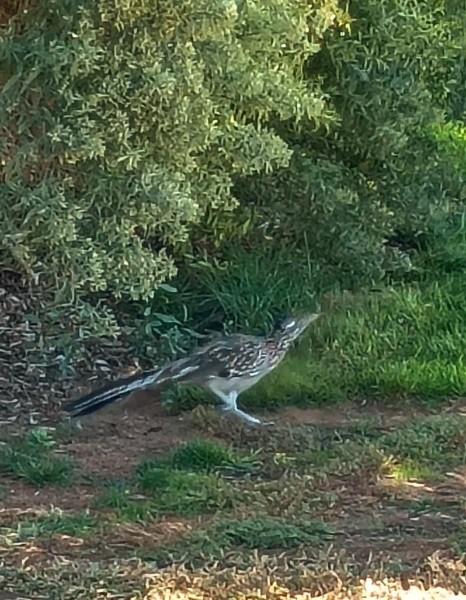
However, on Thursday while playing a round of golf at Lake Powell National Golf Course in Page, Arizona, we spotted a roadrunner between holes 12 and 13. This time, instead of keeping his distance, he posed for us.

For a few moments, this normally elusive desert bird seemed perfectly content to stand there while we admired him and took pictures.

And, of course, seeing a real roadrunner immediately took me back to childhood.

Beep, beep!

I loved the old Wile E. Coyote and Road Runner cartoons. The formula was simple: Wile E. Coyote was always scheming, plotting and ordering some elaborate Acme contraption in an attempt to catch the Road Runner. And the Road Runner was always one step ahead. Usually, the coyote’s plan ended badly.

I’m not sure the real roadrunners are quite as savvy when dealing with their adversaries as their cartoon counterpart. I doubt they spend much time contemplating elaborate strategies for outsmarting coyotes.

But one thing the cartoon got right: Roadrunners are fast!

The greater roadrunner is a real bird of the American Southwest. Its scientific name is Geococcyx californianus, and Arizona lists it among the state’s native bird species.

Unlike many birds, roadrunners spend much of their time on the ground. They have long legs, a long tail and a distinctive crest, and they are wonderfully adapted to life in the desert. They can run at impressive speeds when necessary, which makes the cartoon’s famous “beep, beep” escape scenes at least somewhat grounded in reality.

They also eat a remarkably varied diet, including insects, lizards, snakes, small mammals and other prey. In other words, the real roadrunner isn’t simply a cute desert bird. He is a pretty capable little predator himself.

A roadrunner in red-rock country

The Page area is an especially appropriate place to encounter one. Here in northern Arizona, the landscape seems almost inhospitable at first glance. There are miles of red sandstone, rugged mesas, deep canyons, sparse vegetation and seemingly endless sunshine. Yet the desert is anything but lifeless.

The National Park Service describes Glen Canyon National Recreation Area as home to a rich diversity of wildlife adapted to the arid conditions of the Colorado Plateau. More than 300 species of birds live in or migrate through the area, along with numerous mammals, reptiles, amphibians and fish.

That makes a roadrunner more than an interesting roadside sighting. He is one small part of a remarkable ecosystem.

More than roadrunners

During our time around Page and Lake Powell, we have been reminded repeatedly that wildlife is all around us, even when we don’t always see it.

The area is home to coyotes, bobcats, mountain lions, mule deer, kangaroo rats and desert bighorn sheep, among other mammals. The National Park Service notes that coyotes, bobcats and mountain lions inhabit Glen Canyon, although these predators generally avoid people.

And then there are the birds. In addition to roadrunners, the region provides habitat for eagles, hawks, falcons, owls, ravens, herons and many other species. Glen Canyon’s waters and shoreline also attract a variety of waterbirds and shorebirds.

Perhaps the most spectacular animal we could encounter would be the desert bighorn sheep. These remarkable animals are perfectly designed for the rocky desert. Their ability to negotiate steep, rugged terrain is extraordinary, and their coloring allows them to blend surprisingly well into the canyon walls and surrounding rocks.

Even the animals we don’t see leave evidence that they are here. Tracks, scat, bird calls, movement in the brush and an occasional flash of wings all remind us that the desert is alive.

Keeping eyes wide open

Perhaps that’s one of the lessons of traveling through the desert and to places like Page. You have to slow down enough to see the wildlife.

We can become so focused on the spectacular scenery—the towering cliffs, Lake Powell, Horseshoe Bend, Antelope Canyon and Glen Canyon Dam—that we sometimes overlook the smaller wonders.

A roadrunner standing beside a golf cart isn’t as dramatic as a red-rock canyon. But it is memorable.

On Thursday, between the 12th and 13th holes, we had our own little encounter with one of the Southwest’s most recognizable residents. He stood there long enough for us to appreciate him, photograph him and remember a cartoon character who entertained us when we were children.

Then, eventually, he went on his way. No Acme contraption. No Wile E. Coyote. No “Beep, beep!” Just a real roadrunner doing what real roadrunners do.

Sometimes you just have to keep your eyes open.

And when you see one, don’t blink.

He might be gone before you get the picture.

A Trio Southwestern Wonders: Glen Canyon Dam, Antelope Canyon, and Horseshoe Bend

Thursday September 24

Our third day in Page, Arizona, turned out to be one of those days when the scenery seems to get better every time you turn around.

After a simple breakfast of cereal, Amanda’s ice cold milk, and my Folger’s coffee, we headed into Page for our scheduled visit to Upper Antelope Canyon. But before arriving at the canyon, we made a brief stop to admire another remarkable feature of the desert landscape—Glen Canyon Dam and the Colorado River Gorge.

A Stop at Glen Canyon Dam

Glen Canyon Dam is an impressive sight. Completed in 1963, the massive dam spans the Colorado River and created Lake Powell, one of the largest reservoirs in the United States. The dam was built as part of the Colorado River Storage Project to provide water storage and generate hydroelectric power for the growing Southwest. Its construction dramatically changed the landscape, flooding much of Glen Canyon and creating new recreational opportunities while also altering the river ecosystem and inundating cultural and archaeological sites.

Standing above the dam and looking down into the river gorge, it is hard not to be impressed by both the scale of the engineering and the power of the river that carved this landscape over millions of years.

The Colorado River has been the great sculptor of this part of the country. And today, we saw some of its artwork up close.

Into Antelope Canyon

We arrived at the Upper Antelope Canyon tour area and discovered something rather amusing. For a place that attracts visitors from around the world, the entrance area is remarkably unassuming and simple. There was an unpaved parking area, a wooden pavilion where we checked in, and a bank of portable toilets serving as the rest area. Nothing about the entrance suggested the spectacular experience waiting just beyond the desert.

We checked in at 10:00 a.m. and waited until our group was called at 10:40. Then we climbed into the back of a pickup truck for the approximately three-mile, 15-minute ride across the desert to the entrance of the canyon.

The contrast was striking. We were traveling across a seemingly barren desert landscape toward a place renowned for some of the most beautiful rock formations in the Southwest.

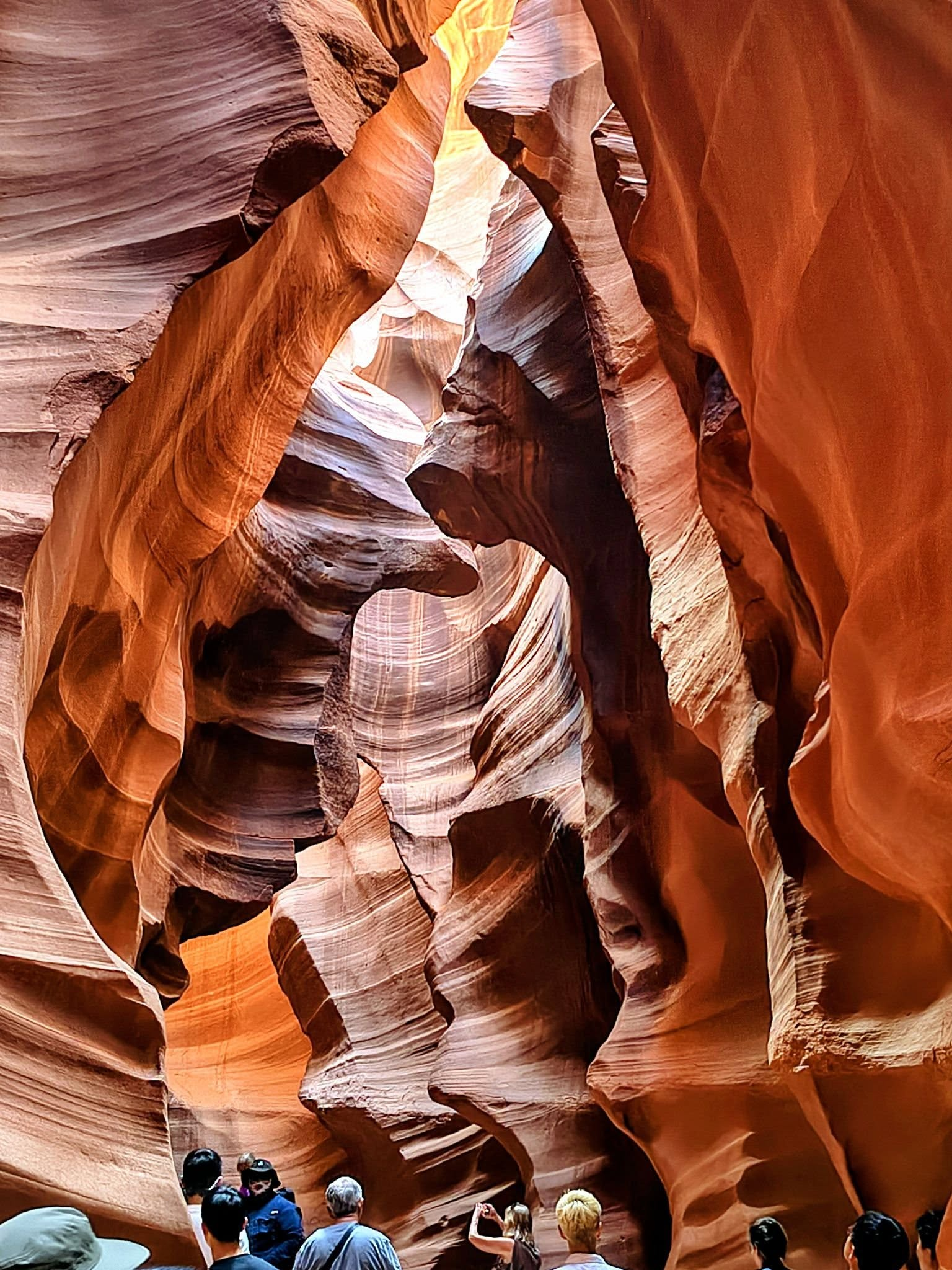
Antelope Canyon was formed primarily by water erosion over thousands of years. Flash floods and flowing water gradually carved and smoothed the Navajo sandstone, creating the narrow, flowing walls and graceful curves that make the canyon so distinctive.

The canyon is part of the Lake Powell Navajo Tribal Park and is located on Navajo Nation land. The Navajo Nation Parks & Recreation Department notes that local Navajo people have long had cultural connections to the canyon and surrounding LeChee area. The English name “Antelope Canyon” is associated with the pronghorn antelope that once roamed freely in the area. For generations, entering a place like Antelope Canyon was regarded by older Navajos as something akin to entering a cathedral—a place to pause, prepare, and experience the beauty of nature with respect.

That description seems especially appropriate once you enter the canyon.

Our Guide, Tyrone

Our guide was Tyrone, a member of the Navajo Nation. He was an exceptional guide.

Tyrone was highly knowledgeable about the canyon and its geological formations, but he was equally knowledgeable about Navajo history and culture. He was also well-versed in Navajo government and clearly passionate about the future of his people.

I got the impression that Tyrone would describe himself as progressive. He spoke openly about the need to consider reforms to some of the “old ways” and seemed deeply concerned about finding ways to improve life and opportunities for the Navajo people.

His perspective added another dimension to our tour. We weren’t simply looking at beautiful rocks. We were listening to someone who has a personal connection to this land, its history, its people, and its future.

Throughout the tour, Tyrone provided historical information about the canyon and was quick to point out nicknames given to various rock formations. He also knew exactly where to stand to capture the best photographs.

He would point out a formation and then tell us how to position our cameras to capture it.  And at times, he took photos of all of our group members with our own phone cameras.

Also, Amanda took some of the best photographs we’ve ever taken at a site like this.

The canyon walls seemed to change constantly as the sunlight filtered through the narrow opening above us. Curving sandstone walls flowed upward and around us, creating shapes and patterns that looked almost too artistic to be natural. But nature is often a better artist than we are.

After leaving the slot canyon, we climbed the outdoor stairs and made our way over the mountain and back to our vehicle.

It was quite a contrast—inside the canyon, we were surrounded by narrow sandstone walls; outside, we were back in the broad openness of the Arizona desert.

The Birdhouse for Lunch

After our tour, we headed to The Birdhouse for lunch.

The restaurant is located in a renovated Sonic drive-in and specializes in fresh-battered chicken tenders and homemade sauces.

The chicken was delicious. There’s something satisfying about a good meal after walking through a canyon and climbing a mountain!

After lunch, we decided to return to our townhouse for a brief rest.

We also took the opportunity to watch some of the President’s Cup before heading out again. Travel doesn’t have to mean being on the go every minute. (At least I keep telling Amanda that.)

Sometimes you need a little downtime to recharge before the next adventure.

Horseshoe Bend

Around 4:15 p.m., we headed out for our second major attraction of the day: Horseshoe Bend. And what a sight it is.

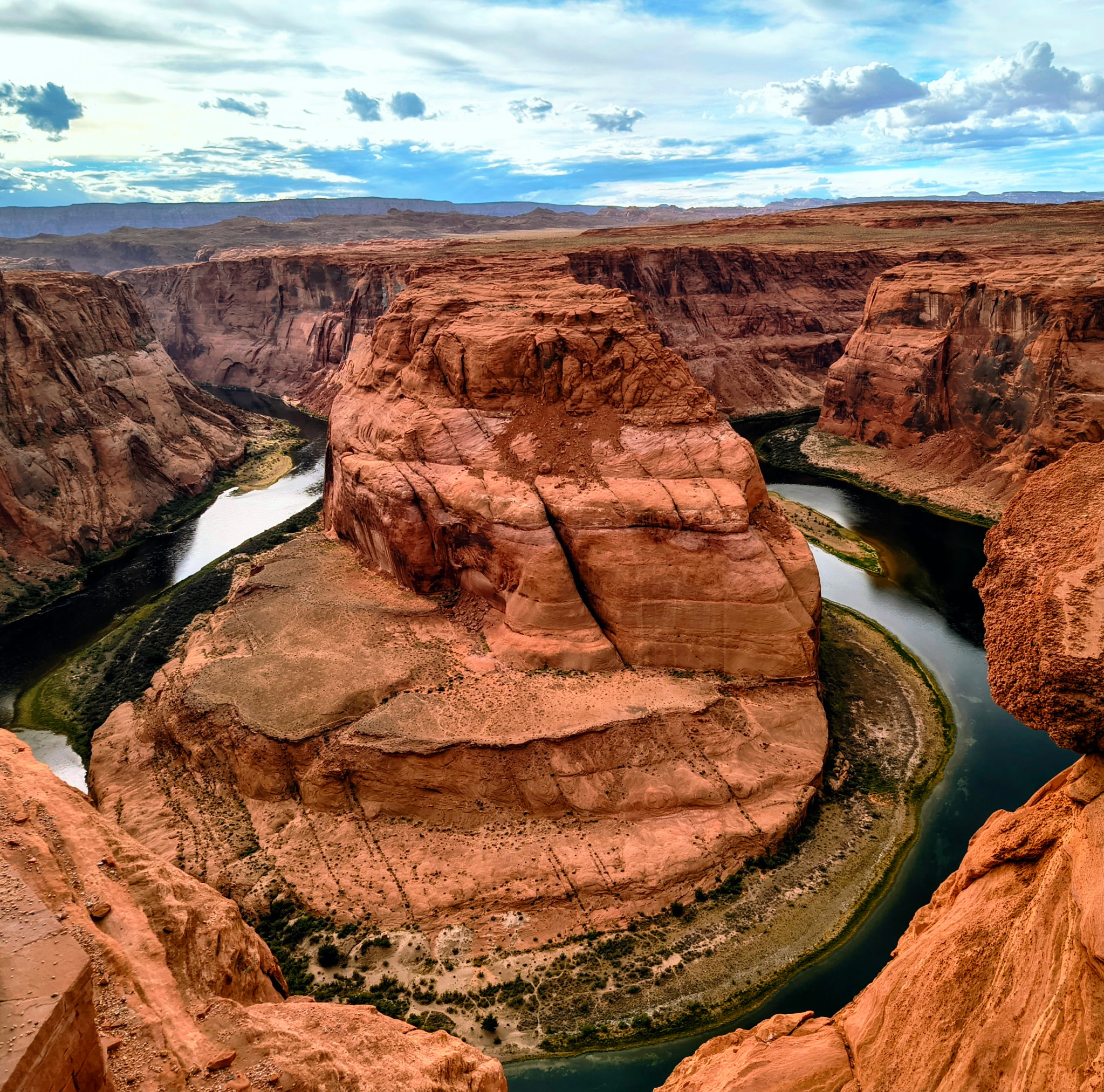
Horseshoe Bend is an enormous, horseshoe-shaped curve in the Colorado River just south of Page. The river makes a sweeping 270-degree turn around a sandstone escarpment, creating a canyon approximately 1,000 feet deep. The bend developed as the Colorado River continued cutting downward through the uplifted sandstone of the Colorado Plateau.

The overlook has become one of the most recognizable views in the American Southwest. Photographs simply don’t do it justice.

You stand on the rim and look down at the Colorado River making its enormous turn below. The river looks almost impossibly small from that height, yet you know that this seemingly modest ribbon of water helped carve the landscape surrounding you.

Most visitors were respectful of the “rim,” and they maintained a safe distance from the edge. Certainly, any slip and fall would prove fatal. But a few folks were pushing the limits, letting their feet hang over the side, or posing dangerously close to cliffs. This elevates my anxiety to the point I can’t hang around and watch for long.

We spent about 40 minutes walking and taking in the view.

Forty minutes doesn’t sound like a long time, but at Horseshoe Bend, you don’t really need an itinerary. You just stand there and enjoy the scenic view.

Sunset Over the Desert

We started back toward our townhouse, grabbed a frozen yogurt for our “light snack,”  but decided we weren’t quite ready for the day to end.

So we stopped at the Scenic Overlook near our unit to watch the sunset. It turned out to be an excellent decision.

As the sun began to sink toward the horizon, the desert landscape changed before our eyes. The various colors in the rock formations seemed to come alive as the setting sun cast its final rays of daylight across the cliffs, mesas, and desert floor.

The colors became warmer. The shadows grew longer. The landscape seemed to glow.

It was a fitting conclusion to a day where we had already enjoyed so much of the beauty of the desert.

One of the blessings of traveling is discovering that no two days are quite alike. Today we saw an enormous dam built by human hands, a canyon sculpted by water, and a bend in a river created through millions of years of geological change.

We listened to a Navajo guide share his knowledge and perspective. We ate good food. We rested. We watched golf. We stood at the edge of one of the most spectacular vistas in the Southwest. And we ended the day watching the sun paint the desert.

Tomorrow will be a little less adventurous. We plan to wash a few clothes, reorganize our suitcases, and prepare for the remaining days of our trip. We also have a tee time at Lake Powell Golf Club.

Then, on Saturday, we’ll head toward one of the great highlights of our western journey: the Grand Canyon.

We’ve discovered that the hardest part of a trip like this isn’t finding things to see. It’s finding enough time to see them.

Stay tuned. The journey continues.

Marching to Zion, Then Onward to Kanab and Page

Wednesday September 23

There are some places you visit once and check off your list. Then there are places that you want to visit again. Zion National Park is one of those places for us.

David Muench said, “Zion National Park is a symphony of stone, a cacophony of color, and a ballet of light.”

Today we traveled from Hurricane, Utah, to Springdale, the gateway to Zion National Park. We were returning to a place we first visited with family about 25 years ago. Some things had changed considerably. Other things—the towering sandstone cliffs, the Virgin River, and the breathtaking beauty of the canyon—looked remarkably familiar.

Springdale: Gateway to Zion

Springdale is a small community tucked into the Virgin River Valley immediately outside Zion National Park. Its history is closely connected to the Mormon pioneer settlement of southern Utah. During the 1860s, several communities sprang up along the upper Virgin River, including Springdale. Pioneer families established farms and homesteads in the area, although flooding, drought, and difficult agricultural conditions made life challenging.

Today, Springdale has become a bustling gateway for visitors from around the world who come to experience Zion. Hotels, restaurants, shops, galleries, and tour companies line the road leading toward the park.

And today, we became part of that traffic!

Marching Into Zion

Zion is Utah’s oldest national park, having been established by Congress on November 19, 1919. Before becoming a national park, the area was designated Mukuntuweap National Monument in 1909 and later Zion National Monument in 1918. The name “Zion” comes from an ancient Hebrew word meaning “sanctuary” or “refuge.” It certainly seems like an appropriate name for a place where the walls of the canyon rise dramatically toward the sky.

Long before it became a national park, however, people lived in and around Zion Canyon. Indigenous peoples—including Ancestral Puebloan and Southern Paiute peoples—have called this region home for thousands of years. Mormon pioneers later established settlements in the area during the nineteenth century.

Today, millions of people come to Zion each year to marvel at the landscape. We were among them.

Taking the Shuttle

One of the biggest changes since our last visit is the shuttle system.

During the shuttle season, private vehicles are not permitted on the Zion Canyon Scenic Drive. The National Park Service began operating the shuttle system in 2000 to reduce traffic and parking problems and help preserve the canyon experience.

Our original plan was to park at the Zion Visitor Center and catch the canyon shuttle there. There was only one problem. The parking lot was full.

So we did what the National Park Service recommends: we parked in Springdale and took the town shuttle to the visitor center. From there, we transferred to the Zion Canyon shuttle and headed into the park.

The shuttles were full, and the trails were fairly congested. The weather, however, was beautiful, so it was a great day to be enjoying one of our nation’s premier national parks.

A Milestone and Highlight

A highlight for me getting my Lifetime National Parks Pass now that I’ve reached the age of eligibility for the senior pass.

There is something special about receiving that little pass. It represents more than admission to America’s national parks. It feels like a passport to some of the most beautiful places in our country—and a reminder that retirement has its privileges!

This little card is going to get plenty of use on this trip and beyond.

Our Favorite Stop: The Narrows

Our favorite stop in Zion is Stop #9—the Temple of Sinawava, at the end of the canyon.

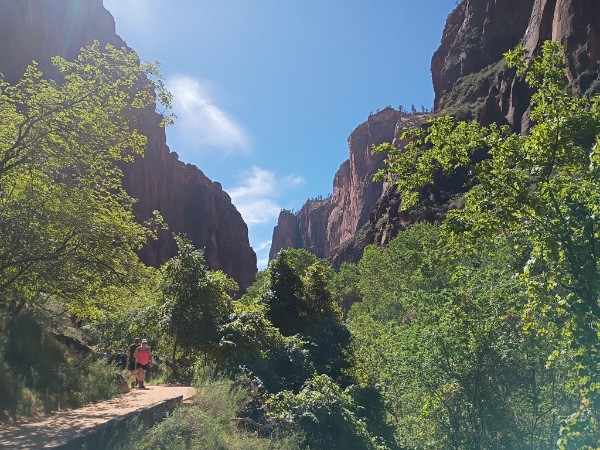
From there, we took the Riverside Walk, a paved trail that follows the Virgin River into the narrowing canyon. The National Park Service lists the round-trip distance at 2.2 miles.

This time we walked all the way to the end of the paved walkway. And that brought back some wonderful memories.

The last time we were here, about 25 years ago, we came with family and continued farther into The Narrows. By “into,” I mean we actually walked up the Virgin River.

Or, perhaps I should say, we walked in the Virgin River!

The Narrows is one of those places where the landscape seems almost impossible. Massive sandstone walls rise on either side while the river winds its way through the canyon floor. At the end of the Riverside Walk, the paved trail gives way to the famous river hike.

We didn’t wade into the river this time, but we enjoyed remembering the adventure from years ago.

Sometimes returning to a familiar place is almost as enjoyable as discovering it for the first time because the landscape brings memories along with it.

Over the Mountain and Through the Tunnel

After returning to our car, we continued through the eastern side of the park.

We climbed the mountain switchbacks and traveled through the historic Zion-Mount Carmel Tunnel, which was part of a major highway project completed in 1930 to connect Zion with Bryce Canyon and other destinations to the east. The highway was an engineering achievement for its time, climbing through the rugged sandstone landscape and passing through the mountain itself.

The drive itself is an adventure. One minute you’re surrounded by the towering cliffs of Zion Canyon, and before long you’re climbing through a dramatically different landscape on the eastern side of the park.

That’s one of the things we love about this part of the country. Sometimes the best view is through the car window.. Sometimes the road itself is the attraction.

Dinner in Kanab

We continued on to Kanab, where we stopped for dinner at Houston’s. The meal was great, and the homemade rolls were especially good. Our server even brought us a bottle of honey to go with the rolls. That’s the kind of thoughtful touch that turns a good meal into a memorable one.

After dinner, we climbed back into the car and continued toward Page, Arizona.

Home for the Next Three Days

We arrived in Page and checked into our Airbnb townhouse, where we’ll be staying for the next three days.

Our accommodations have a great view of the surrounding mountain range and desert, along with a distant glimpse of Lake Powell.

After several days of moving from one hotel to another, it will be nice to unpack for a few days and establish a temporary home base.

And there is plenty to explore from here. Tomorrow we’re planning to visit Antelope Canyon and Horseshoe Bend. Two more iconic places. Two more chapters in our western adventure

Today, we enjoyed our journey between Zion’s towering cliffs and Page’s desert landscape. Tomorrow, another adventure awaits.

From the Desert Oasis to the Valley of Fire

Tuesday September 22

Our second full day out West took us from the bright lights of the Desert Oasis of Las Vegas to the spectacular red-rock formations of Valley of Fire State Park. It was a day filled with good food, beautiful scenery, fascinating history, and another reminder of just how diverse the American West can be.

Breakfast in Overton

We left our hotel this morning before breakfast, so we decided to find something along the way. We stopped in Overton, Nevada, at Salt’s, a popular local restaurant.

We ordered the Captain’s breakfast platter and decided to split it. That turned out to be a very good decision. The platter included two enormous pancakes, two scrambled eggs, and two large sausage patties. The pancakes may have been the fluffiest we have ever tasted. We both ate until we were full and there was still food left!

Through the Nevada Desert

After breakfast, we continued north on I-15.

Along the way, we passed the Las Vegas Motor Speedway and then the three exits for Mesquite. One of the things that continues to fascinate us about traveling through the Southwest is the way unexpected pockets of green appear in the middle of an otherwise rugged desert landscape.

The golf courses around Mesquite were beautifully manicured and plush green—almost like oases in the desert.

Then we turned our attention toward one of Nevada’s great natural treasures.

The Valley of Fire

Our destination was Valley of Fire State Park, Nevada’s first state park and one of the state’s most spectacular landscapes. The park encompasses more than 40,000 acres of brilliant red Aztec sandstone surrounded by gray and tan limestone. The sandstone formations were created millions of years ago, and the landscape contains evidence of human habitation going back thousands of years.

The name “Valley of Fire” seems entirely appropriate.

The brilliant red, orange, and pink sandstone formations almost seem to glow when the sunlight strikes them.

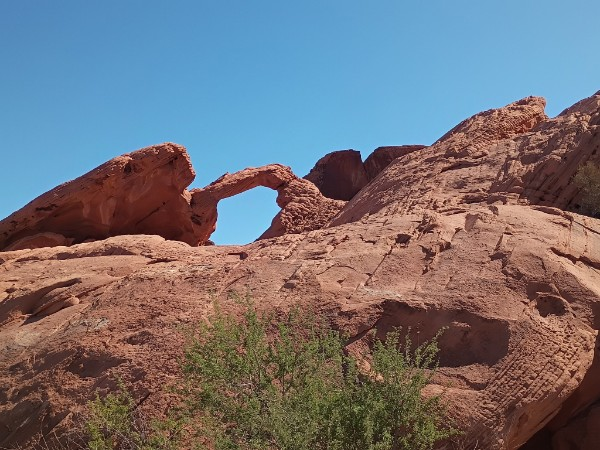
We enjoyed seeing several of the park’s most recognizable landmarks, including the Beehives, Arch Rock, Elephant Rock, and Atlatl Rock.

The Beehives are fascinating examples of geological cross-bedding. Arch Rock is exactly what its name suggests—a natural sandstone arch that can be viewed from the road. Elephant Rock looks remarkably like an elephant, and Atlatl Rock is especially interesting because of its ancient petroglyphs.

We also saw several other interesting features, including the Seven Sisters, Petrified Logs, and the Fire Canyon/Silica Dome area. The park also includes such attractions as Mouse’s Tank, Rainbow Vista, White Domes, Balancing Rock, and the Fire Wave/Seven Wonders area.

One of the highlights was the new Visitor Center, which opened in 2025. It is an impressive facility with exhibits focusing on the park’s geology, ecology, prehistory, history, and wildlife.

We could have spent much more time there.

The timing of our visit was also interesting. The park’s busiest season doesn’t really begin until October, and some of the trails were still subject to seasonal closures. Nevada State Parks closes many trails from May 15 through September 30 because of the extreme summer heat.

Even with some areas unavailable, there was plenty to see.

And one of the lessons of travel is, you don’t have to see everything to appreciate those things you do see.

On to Hurricane

After leaving Valley of Fire, we continued north into Utah and eventually arrived in Hurricane, where we checked into the Wingate Hotel.

Hurricane makes a great base for exploring this part of southern Utah. From here, Zion National Park and several other spectacular attractions are within easy reach.

And that’s where we’re headed tomorrow.

A Burger and a Few Motorcyclists

After checking into the hotel, we enjoyed a late lunch/early dinner at Red Rooster, just a couple of blocks from our room.

As graduates of Jacksonville State University, we couldn’t resist the name!

We both ordered burgers, and they were absolutely delicious.

While we were there, we met a group of 16 motorcyclists who were traveling together to visit several of the national parks. They were from France and were making their way through the American West. They already been to the Grand Canyon and Bryce Canyon, and they were headed toward Vegas.

One of the things we enjoy most about traveling is the people we meet along the way.

Sometimes the most memorable encounters aren’t on the itinerary. They happen at a restaurant, in a hotel lobby, at a gas station, or beside a scenic overlook.

A trip is measured not only in miles traveled but also in adventures experienced, people encountered and stories shared.

Tomorrow: Zion

We headed to bed early tonight because tomorrow promises another big day. We’re going back to Zion National Park.

This will be our second visit to Zion, and we’re looking forward to seeing those magnificent cliffs and canyons again. There is something special about returning to a place you’ve visited before. We hope to refresh a few memories and make a few new ones.

As we continue this journey, we’re reminded again how fortunate we are to have the health, time, and opportunity to travel during our retirement years.

Every day brings another road, another view, another meal, another story, and another memory. And that’s one of the great gifts of travel.

As writer J.R.R. Tolkien famously observed, “Not all those who wander are lost.”

We’re not lost. We’re simply wandering out West.

And tomorrow, we’re wandering into Zion.

Stay tuned. The adventure continues!

The Adventure Begins: Highlights from Our Journey West

Sunday September 20/Monday September 21

Travel is not about escaping life; it is about exploring the vastness of the world.

There is something wonderful about beginning a journey when you don’t quite know what adventures await around the next bend.

Our latest adventure out West got off to a somewhat unconventional start. In fact, if travel is supposed to be about the journey rather than the destination, we got an early reminder of that lesson!

We flew out of Huntsville through Atlanta to Las Vegas. Unfortunately, thunderstorms were creating havoc in several places, and our flight from Huntsville was delayed. Then our flight in Atlanta was delayed. Then we missed our connecting flight in Atlanta. Delta rebooked us on another flight, which was then delayed.

But eventually, we were airborne and headed west.

We finally arrived at our hotel in Las Vegas at 1:55 PDT on Monday morning. We were in bed by 2:30. For most people, that might not sound like much of a night’s sleep, but I managed to sleep in a little. For me, “sleeping in” means staying in bed until 6:45 a.m. I suppose retirement has not completely changed my internal alarm clock!

Despite the delays, we were grateful. Our flight was safe, and Delta kept us informed along the way. Sometimes you simply have to remind yourself that arriving late is considerably better than not arriving at all.

And once we arrived, our western adventure finally began.

Rather than trying to cram a lot into our first day, we enjoyed a leisurely day around the Las Vegas Hilton at Resorts World.

I began the morning with breakfast at Junior’s, right there at the resort. I also took a plate from Juniors back to the room for Amanda, who was still sleeping in. After our long travel day and short night, it was nice not to have an agenda.

One of the things we have learned about traveling is that you don’t have to turn every day into a race.

Sometimes the best travel memories are made when you slow down long enough to enjoy where you are.

As we often do when we travel, we enjoyed one substantial midafternoon meal and then settled for a light snack in the evening. We found a great diner near UNLV called Blueberry Hill Family Restaurant.

It was exactly our kind of place. Nothing pretentious. Just good food, friendly surroundings, and the kind of atmosphere that makes you feel comfortable the moment you walk through the door.

And there was an added bonus for seniors: a complimentary dessert!

So naturally, we did what any sensible senior travelers would do. We took our desserts to go and saved them for our evening snack.

For our “light” evening snack, Amanda chose Chocolate Oreo Cheesecake and I selected Carrot Cake.  Both were delicious…and huge. We could only eat a portion. Some travel traditions are worth preserving!

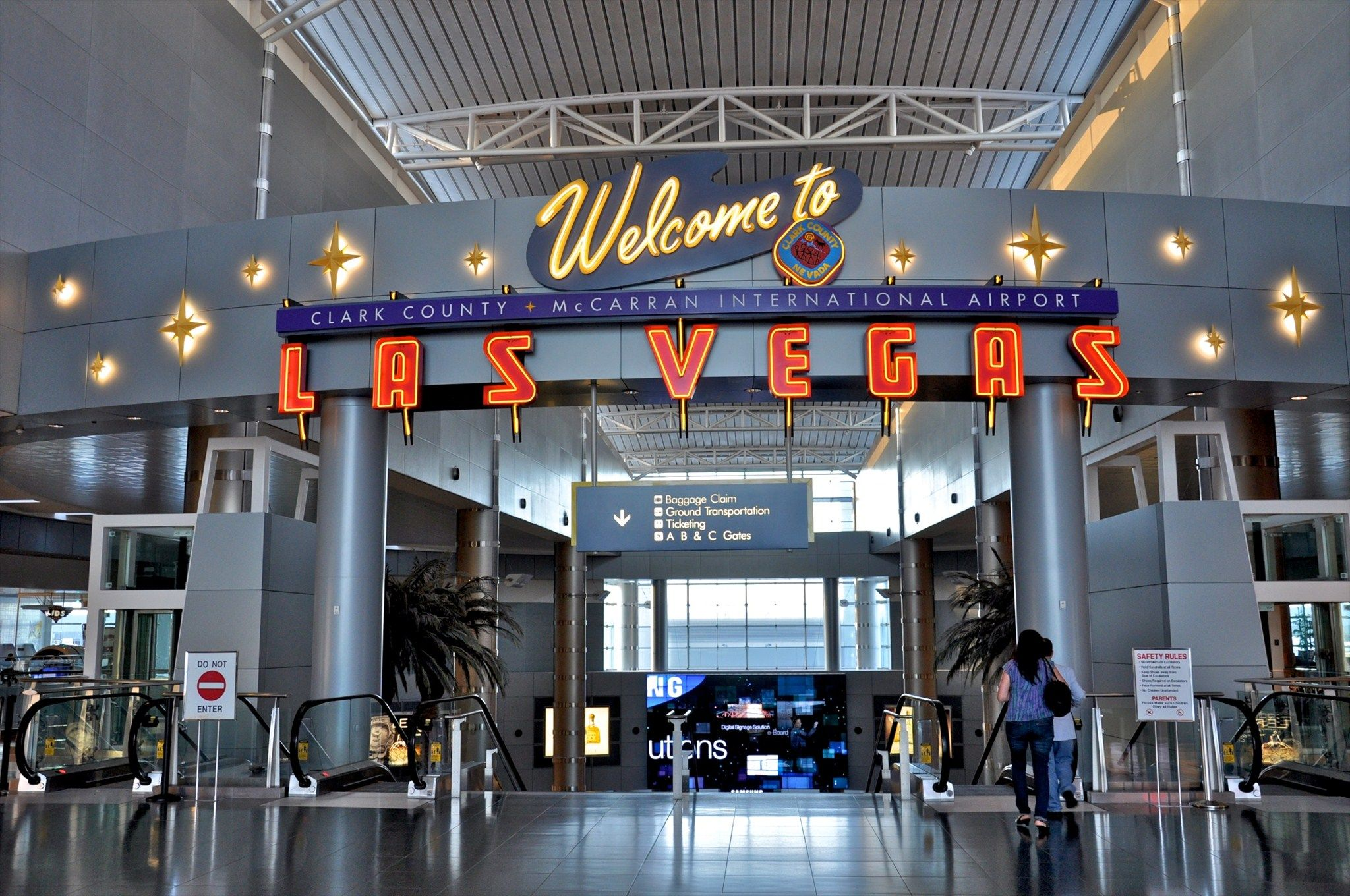
On the way back to our room, we drove by the Sphere, which has become one of the most recognizable landmarks in Las Vegas. We’re saving the inside experience for later in the trip. Next Sunday evening, when we return to Vegas for a couple of days before we head home, we plan to see The Wizard of Oz at the Sphere.

So our first day included a little preview of one of the experiences still waiting for us at the end of our journey.

Our rental car provided another unexpected twist.

We had reserved a Nissan Rogue, but when we arrived at the rental counter, the only SUV available was a Nissan Kicks. We had never driven one before.

As it turns out, the Kicks drives great, has plenty of room for the two of us, and has all the accessories we need for our journey. Sometimes the substitute turns out to be a pleasant surprise.

Perhaps that’s another lesson travel teaches us: Not everything has to go according to plan for things to turn out well.

Tomorrow we head toward Utah. Our plan is to stop at Valley of Fire State Park in the morning and then continue on to Hurricane, Utah. On Wednesday, we’ll return to Zion National Park for our second visit. We last visited there around 25 years ago.

From there, we’ll head to Page, Arizona, where we’ll explore Antelope Canyon and Horseshoe Bend.

Then it’s on to the Grand Canyon, followed by a return visit to Hoover Dam, which we have also visited before.

After that, we’ll head back to Las Vegas for a round of golf before catching our flight home.

And, of course, there is one more adventure waiting for us before we leave—the Wizard of Oz at the Sphere. It should be quite a journey.

One of the things we appreciate more and more about travel is that the destination is only part of the blessing. There is the anticipation before the trip. There are the unexpected moments along the way. There are new places to explore, old places to revisit, good meals to discover, beautiful scenery to enjoy, and memories to make together.

And there is something for which we are especially grateful: the health and opportunity to travel during our retirement years. We don’t take that blessing for granted.

Every journey reminds us that life is a gift, and every new destination gives us another opportunity to appreciate the beauty, diversity, and awesome wonder of God’s creation.

So, despite a delayed beginning, our adventure is officially underway.

The bags are packed. The car is ready. The road is calling.

And we’re grateful to have the opportunity to answer.

Welcome to the adventure. This week I’ll be sharing a few highlights from our journey here on my blog. We hope you’ll follow along as we make our way across the West—one scenic stop, memorable meal, unexpected detour, and scenic sunset at a time.

Ongoing Grief, Sustaining Grace: A Pastoral Prayer for the 25th Anniversary of September 11, 2001

O God of grace and peace,

On this twenty-fifth anniversary of the terrorist attacks of September 11, 2001, we come before you with hearts both grateful and heavy.

We remember an atrocious day, a day we wish we could forget. Yet even after twenty-five years, our grief still lingers, even as our faith still hopes.

We confess our ongoing need of your steadying and sustaining grace, for we are mindful that this date still grieves us, with emotions that are unsettling and memories that continue to elevate our anxiety.

Today, we lift up the families who lost husbands and wives, sons and daughters, mothers and fathers, friends and colleagues — in the collapse of the towers, in the field in Pennsylvania, and at the Pentagon. Comfort them still, O God, in the ongoing echo of that loss. May the years never erase the love they carry for those they lost.

We remember, too, the first responders and recovery workers who ran toward danger while others fled — firefighters, police officers, emergency medical workers, and ordinary citizens who became extraordinary in an instant. Bless them for their courage then, and be near to those among them who continue to serve.

And we pray especially today for those who are battling illness in their bodies now — illnesses set in motion by the toxic dust and hazards of that day and its aftermath, cancers and respiratory diseases and other conditions that continue to claim health and life a quarter-century later. Heal them, comfort them, and remind them that their sacrifice has not been forgotten.

We confess that our nation still struggles, twenty-five years later, with division, suspicion, and fear. Forgive us when disagreement hardens into contempt, and when our differences become excuses to separate rather than invitations to understand one another. Remind us that patriotism need not diminish compassion, and that strength need not silence mercy.

We pray for the leaders of our nation, and for leaders among the nations of the world — for wisdom and discernment, for the courage to seek peace rather than retaliation, and for a disposition that defuses conflict rather than inflaming it. Give them humility to lead with justice and grace to govern with integrity.

And we pray for peace in our world — not merely the absence of war, but the presence of justice, dignity, and understanding among all peoples and nations. Where there is conflict, bring reconciliation. Where there is fear, bring courage. Where there is hatred, let us, and all your people, be instruments of your love.

May the memory of September 11 never become simply a date on a calendar. May it call us to live with deeper gratitude, to serve with greater compassion, to forgive more freely, and to cherish the gift of each day we are given.

We offer this prayer in the strong name of the One who came to bring peace on earth and goodwill to all humankind.  Amen.

Etched in Granite, Towering with Hope: Remembering Our Visit to Ground Zero

Early that Sunday morning, we discovered the quietest spot in what must be our nation’s loudest city.

In 2017, just after I retired as pastor of the First Baptist Church of Pensacola, we visited New York City to attend the U.S. Open.

Since our visit was on the weekend of the anniversary of September 11, Amanda and I made our way to Ground Zero. It was my first visit to the memorial. It was her second. Typically, on a Sunday morning, we are in church. But on our final day in New York, we found ourselves in a different kind of sanctuary, one built not of stained glass and pews, but of granite, water, and names.

We read the names, like so many others there, looking for the name of the one from our hometown, and we thought about his mother and his family. And we remembered how life changed on that fateful day for families from large cities and small towns all around our country.

In the news footage of September 11, 2001, alongside the horrifying images of collapsing towers, I vividly remember the masses of people moving away from that site, desperate to escape. On this quiet Sunday morning, sixteen years later, I watched masses of people moving toward that same site — not to escape anything, but to remember and reflect.

Where the Twin Towers once stood, One World Trade Center now rises, crowned with an observatory that seems to keep watch over the city below. At its base rests a reflective pool, water descending endlessly into what feels like the basement of memory itself. Standing there, in the solemnness of that unexpectedly quiet corner of Manhattan, I found myself observing several things I haven’t been able to shake since.

A Congregation of Every Kind of American

The crowd that had gathered represented the vast diversity of our country. Multiple races and ethnicities filled that plaza. I’m sure some were international visitors, taking in the memorial as part of a holiday itinerary. But the vast majority, it seemed, were Americans — Americans of different backgrounds, different religious traditions, and undoubtedly different political convictions. And yet, on that morning, in that place, we were simply Americans. No hyphens. No labels. Just people standing shoulder to shoulder in shared grief and shared gratitude.

Dr. Martin Luther King Jr. preached, “Darkness cannot drive out darkness; only light can do that.”

Whatever darkness gathered over that site on September 11, what we witnessed on this Sunday morning was light — the light of ordinary people extending quiet dignity to one another as they remembered, reflected, prayed, and commemorated together.

Every Name, Equally Important

Every life lost that day was memorialized as equally important. From the firefighter, to the business executive, to the custodian, to the mother and child — the names inscribed around the reflective pools appear in the same font, the same size, with no suggested hierarchy of importance or privilege. No title before a name. No epitaph elevating one story above another.

There is something profoundly spiritual about that. It reminded me that in the eyes of God, every life bears equal worth — not measured by title, income, or accomplishment, but by the simple fact of being made in God’s image. Ground Zero, without necessarily intending to, underscores that truth in granite.

A Living Memorial

At the reflective pools, memories seemed to move in two directions at once — water descending into the depths, and grief, somehow, rising back up to meet the light. It’s an odd sensation to describe, but standing there, I felt as though the memorial itself understood something about grief that we often miss: that mourning is never a one-way street. What descends into sorrow can still rise again into hope.

I was struck, too, by how many families had brought young children with them — children born well after 2001, hearing this story perhaps for the very first time from a parent’s own lips. I watched mothers and fathers kneel beside sons and daughters, pointing to a name on the wall, offering a brief and tender history lesson right there on sacred ground. It gave new perspective to a phrase we often hear associated with 9/11: “Remember, and never, ever forget.”

But standing there, I realized that remembering is not meant to be a motif for vengeance. It is meant to be a motivating force for building a better world. Elie Wiesel, who knew more about memory and atrocity than perhaps anyone of his generation, put it this way: “To forget the dead would be akin to killing them a second time.”

Every parent kneeling beside a child at that wall was passing along not just a historical fact, but a sacred responsibility — to remember well, so that memory might do some good in the world.

Hope Rising Out of Rubble

Perhaps what moved me most was simply looking up. Where wreckage and ash once filled the skyline, a tower now stands — not identical to what was lost, but new, resilient, and unmistakably reaching toward the sky. The construction of that tower, and the entire redevelopment around it, testifies to something stubborn and beautiful in the human spirit: our capacity to hope for the future even in the shadow of unimaginable loss.

I couldn’t help but think of Fred Rogers, who famously recalled his mother’s advice for facing frightening news: look for the helpers. On this ground, I didn’t have to look far. I saw them in the volunteers guiding visitors. I saw them in the security personnel greeting people with quiet patience. I saw them in the parents becoming, for a moment, historians and pastors to their own children.

And I thought of President George W. Bush’s words spoken in the rubble of that very site, not long after the towers fell: “I can hear you. The rest of the world hears you. And the people who knocked these buildings down will hear all of us soon.”

Sixteen years later, what I heard on that plaza wasn’t defiance. It was something quieter and, in some ways, more powerful: resolve. The resolve to remember rightly. The resolve to grieve honestly. And the resolve to keep building — towers, yes, but also communities, families, and a nation still capable of standing shoulder to shoulder as one people.

Chimes in the Silence

Our time at Ground Zero passed far too quickly. As we made our way to catch the bus back to our hotel, the silence of the morning was broken by the resonating chimes of a nearby church. It felt like a benediction — as if that quietest spot in the loudest city was being gently released back into the noise and rhythm of ordinary life, but not without first leaving something behind in us.

I have preached in a lot of sanctuaries over the years. But that memorial plaza in lower Manhattan is uniquely inspiring — a sanctuary built out of tragedy, sustained by memory, and quietly insistent that even our deepest grief can become fertile soil for hope.

As the poet and civil rights icon Maya Angelou wrote: “History, despite its wrenching pain, cannot be unlived, but if faced with courage, need not be lived again.”

May we keep facing it with courage. May we keep remembering well. And may we keep building — towers, friendships, communities, and a world — worthy of the names etched in that granite.

(Barry Howard is a retired pastor who now serves as leadership coach and consultant with the Center for Healthy Churches. He and his wife, Amanda, live on Cove Lake in Northeast Alabama.)