Thursday September 24
Our third day in Page, Arizona, turned out to be one of those days when the scenery seems to get better every time you turn around.
After a simple breakfast of cereal, Amanda’s ice cold milk, and my Folger’s coffee, we headed into Page for our scheduled visit to Upper Antelope Canyon. But before arriving at the canyon, we made a brief stop to admire another remarkable feature of the desert landscape—Glen Canyon Dam and the Colorado River Gorge.
A Stop at Glen Canyon Dam
Glen Canyon Dam is an impressive sight. Completed in 1963, the massive dam spans the Colorado River and created Lake Powell, one of the largest reservoirs in the United States. The dam was built as part of the Colorado River Storage Project to provide water storage and generate hydroelectric power for the growing Southwest. Its construction dramatically changed the landscape, flooding much of Glen Canyon and creating new recreational opportunities while also altering the river ecosystem and inundating cultural and archaeological sites.
Standing above the dam and looking down into the river gorge, it is hard not to be impressed by both the scale of the engineering and the power of the river that carved this landscape over millions of years.
The Colorado River has been the great sculptor of this part of the country. And today, we saw some of its artwork up close.
Into Antelope Canyon
We arrived at the Upper Antelope Canyon tour area and discovered something rather amusing. For a place that attracts visitors from around the world, the entrance area is remarkably unassuming and simple. There was an unpaved parking area, a wooden pavilion where we checked in, and a bank of portable toilets serving as the rest area. Nothing about the entrance suggested the spectacular experience waiting just beyond the desert.
We checked in at 10:00 a.m. and waited until our group was called at 10:40. Then we climbed into the back of a pickup truck for the approximately three-mile, 15-minute ride across the desert to the entrance of the canyon.
The contrast was striking. We were traveling across a seemingly barren desert landscape toward a place renowned for some of the most beautiful rock formations in the Southwest.
Antelope Canyon was formed primarily by water erosion over thousands of years. Flash floods and flowing water gradually carved and smoothed the Navajo sandstone, creating the narrow, flowing walls and graceful curves that make the canyon so distinctive.
The canyon is part of the Lake Powell Navajo Tribal Park and is located on Navajo Nation land. The Navajo Nation Parks & Recreation Department notes that local Navajo people have long had cultural connections to the canyon and surrounding LeChee area. The English name “Antelope Canyon” is associated with the pronghorn antelope that once roamed freely in the area. For generations, entering a place like Antelope Canyon was regarded by older Navajos as something akin to entering a cathedral—a place to pause, prepare, and experience the beauty of nature with respect.
That description seems especially appropriate once you enter the canyon.
Our Guide, Tyrone
Our guide was Tyrone, a member of the Navajo Nation. He was an exceptional guide.
Tyrone was highly knowledgeable about the canyon and its geological formations, but he was equally knowledgeable about Navajo history and culture. He was also well-versed in Navajo government and clearly passionate about the future of his people.
I got the impression that Tyrone would describe himself as progressive. He spoke openly about the need to consider reforms to some of the “old ways” and seemed deeply concerned about finding ways to improve life and opportunities for the Navajo people.
His perspective added another dimension to our tour. We weren’t simply looking at beautiful rocks. We were listening to someone who has a personal connection to this land, its history, its people, and its future.
Throughout the tour, Tyrone provided historical information about the canyon and was quick to point out nicknames given to various rock formations. He also knew exactly where to stand to capture the best photographs.
He would point out a formation and then tell us how to position our cameras to capture it. And at times, he took photos of all of our group members with our own phone cameras.
Also, Amanda took some of the best photographs we’ve ever taken at a site like this.
The canyon walls seemed to change constantly as the sunlight filtered through the narrow opening above us. Curving sandstone walls flowed upward and around us, creating shapes and patterns that looked almost too artistic to be natural. But nature is often a better artist than we are.
After leaving the slot canyon, we climbed the outdoor stairs and made our way over the mountain and back to our vehicle.
It was quite a contrast—inside the canyon, we were surrounded by narrow sandstone walls; outside, we were back in the broad openness of the Arizona desert.
The Birdhouse for Lunch
After our tour, we headed to The Birdhouse for lunch.
The restaurant is located in a renovated Sonic drive-in and specializes in fresh-battered chicken tenders and homemade sauces.
The chicken was delicious. There’s something satisfying about a good meal after walking through a canyon and climbing a mountain!
After lunch, we decided to return to our townhouse for a brief rest.
We also took the opportunity to watch some of the President’s Cup before heading out again. Travel doesn’t have to mean being on the go every minute. (At least I keep telling Amanda that.)
Sometimes you need a little downtime to recharge before the next adventure.
Horseshoe Bend
Around 4:15 p.m., we headed out for our second major attraction of the day: Horseshoe Bend. And what a sight it is.
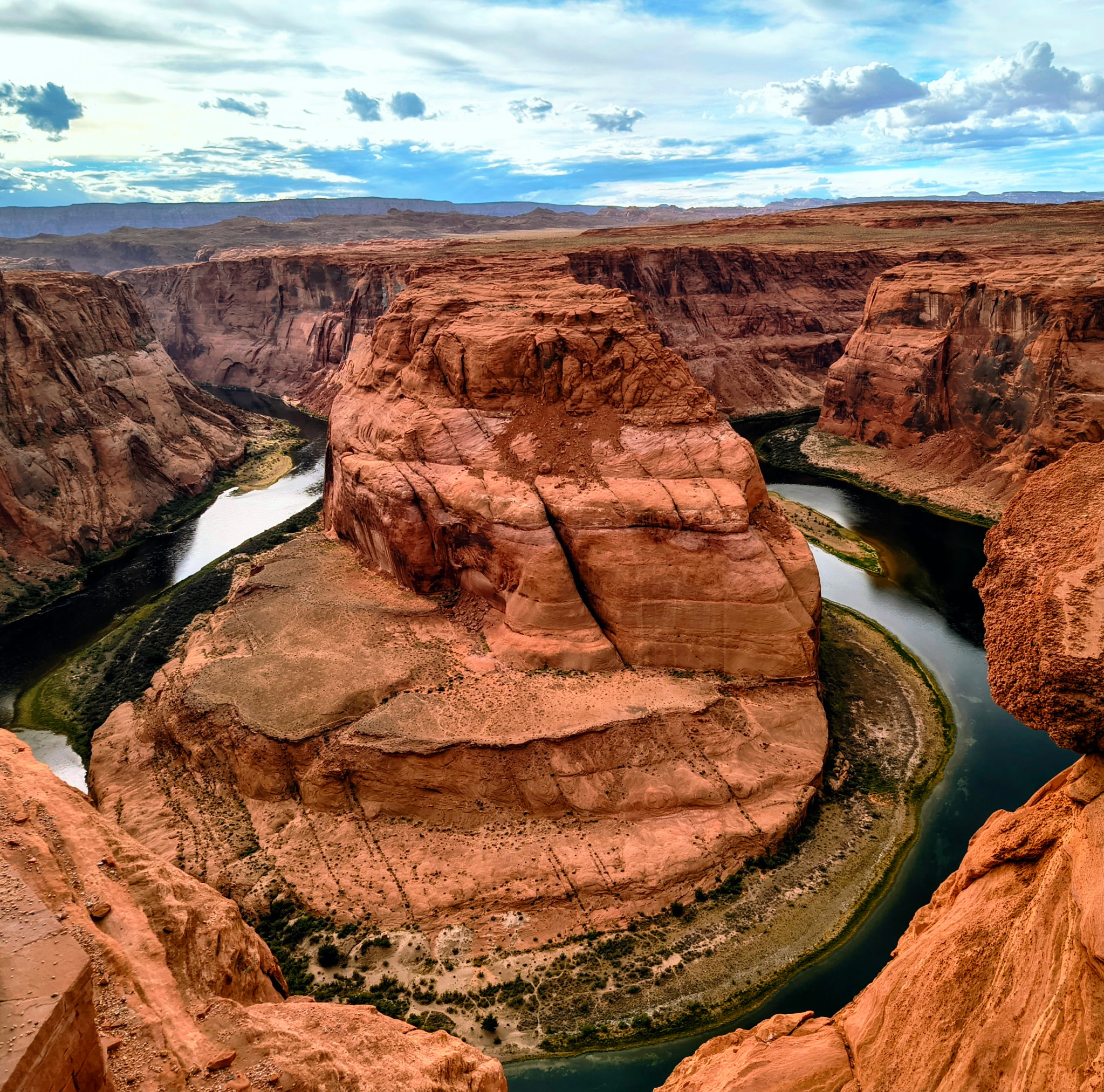
Horseshoe Bend is an enormous, horseshoe-shaped curve in the Colorado River just south of Page. The river makes a sweeping 270-degree turn around a sandstone escarpment, creating a canyon approximately 1,000 feet deep. The bend developed as the Colorado River continued cutting downward through the uplifted sandstone of the Colorado Plateau.
The overlook has become one of the most recognizable views in the American Southwest. Photographs simply don’t do it justice.
You stand on the rim and look down at the Colorado River making its enormous turn below. The river looks almost impossibly small from that height, yet you know that this seemingly modest ribbon of water helped carve the landscape surrounding you.
Most visitors were respectful of the “rim,” and they maintained a safe distance from the edge. Certainly, any slip and fall would prove fatal. But a few folks were pushing the limits, letting their feet hang over the side, or posing dangerously close to cliffs. This elevates my anxiety to the point I can’t hang around and watch for long.
We spent about 40 minutes walking and taking in the view.
Forty minutes doesn’t sound like a long time, but at Horseshoe Bend, you don’t really need an itinerary. You just stand there and enjoy the scenic view.
Sunset Over the Desert
We started back toward our townhouse, grabbed a frozen yogurt for our “light snack,” but decided we weren’t quite ready for the day to end.
So we stopped at the Scenic Overlook near our unit to watch the sunset. It turned out to be an excellent decision.
As the sun began to sink toward the horizon, the desert landscape changed before our eyes. The various colors in the rock formations seemed to come alive as the setting sun cast its final rays of daylight across the cliffs, mesas, and desert floor.
The colors became warmer. The shadows grew longer. The landscape seemed to glow.
It was a fitting conclusion to a day where we had already enjoyed so much of the beauty of the desert.
One of the blessings of traveling is discovering that no two days are quite alike. Today we saw an enormous dam built by human hands, a canyon sculpted by water, and a bend in a river created through millions of years of geological change.
We listened to a Navajo guide share his knowledge and perspective. We ate good food. We rested. We watched golf. We stood at the edge of one of the most spectacular vistas in the Southwest. And we ended the day watching the sun paint the desert.
Tomorrow will be a little less adventurous. We plan to wash a few clothes, reorganize our suitcases, and prepare for the remaining days of our trip. We also have a tee time at Lake Powell Golf Club.
Then, on Saturday, we’ll head toward one of the great highlights of our western journey: the Grand Canyon.
We’ve discovered that the hardest part of a trip like this isn’t finding things to see. It’s finding enough time to see them.
Stay tuned. The journey continues.

