The View from the South Rim: Highlights from Our Day at the Grand Canyon

Saturday September 26

David Brown observed, “Standing at the edge of the Grand Canyon is like standing at the edge of time, where nature’s artistry tells stories of eternity.” 

The Grand Canyon is one of those places where photographs, words, and memories seem inadequate to describe the experience of gazing across the gorge, admiring the colors, listening to the whistling wind, and inhaling the moment.

I have been to the Grand Canyon multiple times over the years, and one thing that continues to amaze me is that the view never gets old.

No matter how many times I stand at the rim, there is something about looking into that immense canyon that makes me pause, reflect, and simply take it in.

Our most recent visit was 25 years ago, when we visited the North Rim. It has been over 30 years since we visited the South Rim.. So today’s return to the Grand Canyon was not a new experience but it was a new adventure.

A Scenic Prelude to the Canyon

This morning we left Page, Arizona, and headed toward the Grand Canyon, entering the park through the East Entrance.

The drive itself was a wonderful primer on the formation of the canyon. For much of the way, we followed the Colorado River Gorge through a landscape of colorful cliffs, mesas and rugged desert terrain. The changing colors of the rocks seemed to provide a kind of primer for the Grand Canyon.

By the time we reached the park, we were already surrounded by the geological artistry that makes this part of Arizona so extraordinary. But the best was yet to come.

Desert View: Our Favorite Stop

Our first stop was Desert View, and it turned out to be our favorite of all the overlooks we visited.

The view was spectacular, but the setting was made even more memorable by the Desert View Watchtower, the distinctive stone tower built in the 1930s. The tower rises dramatically above the rim and looks as though it belongs there—as though someone simply found a way to make the architecture grow naturally out of the canyon landscape.

Standing there and looking across the canyon toward the distant horizon was breathtaking.

John Muir once described the Grand Canyon as “a vast wilderness of rocks in a sea of light, colored and glowing like oak and maple woods in autumn.” That description seemed particularly appropriate today.

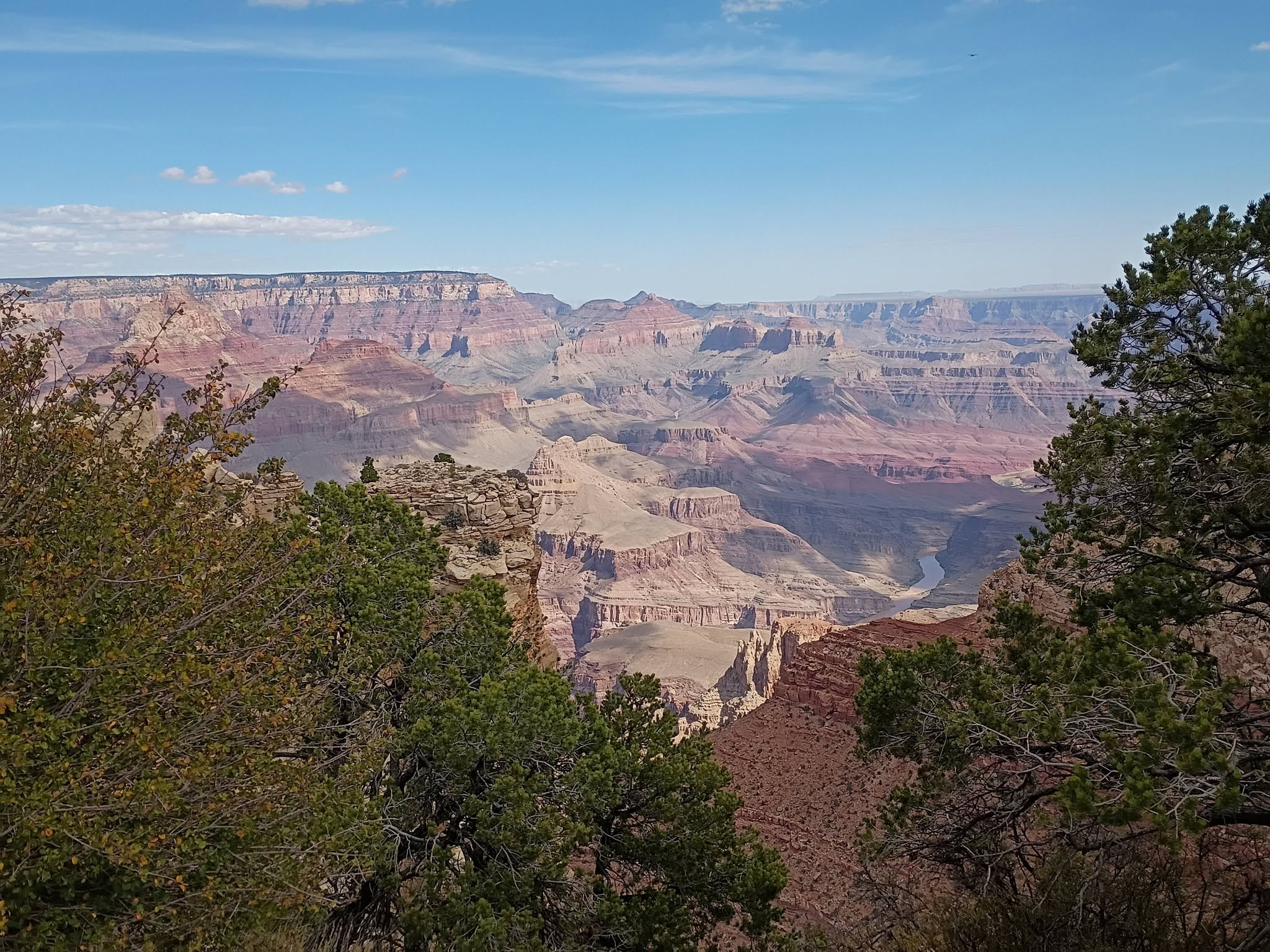
The canyon isn’t simply one big hole in the ground. It is a vast landscape of color, depth, shadows, light and seemingly endless layers of geological history. Even after multiple visits to the park, the sight still invokes awe and wonder.

We stopped briefly at several other overlooks as we made our way along the rim, but eventually we spent considerable time at Grandview Point. The name is certainly appropriate.

The View That Never Gets Old

One of the interesting things about returning to a place you’ve visited before is discovering that the place may not have changed nearly as much as you have.

Twenty-five years ago, we stood on the North Rim and looked across this same magnificent canyon. Today we stood on the South Rim and saw it from an entirely different perspective. The Colorado River was still winding its way through the depths. The layers of rock were still telling a story that began millions of years before any of us arrived. And yet the view still seemed fresh and inspiring.

There is something humbling about standing before a landscape that makes our own lifetimes seem so small.

Keeping the Canyon Clean

Eventually, we made our way to the Grand Canyon Visitor Center, parked the car and walked a portion of the South Rim Trail. We stopped at Mather Point, where the views were, once again, astonishing. But something else caught our attention.

We noticed a team of people wearing blue shirts who appeared to be preparing to rappel down the canyon. At first, we couldn’t figure out exactly what they were doing. It looked like some kind of adventurous expedition. Then we discovered they were a work crew whose job was to clean garbage and debris from the steep sides of the canyon.

Later, we saw another team doing similar work along the canyon wall behind Thunderbird Lodge. They are brave and appreciated souls indeed.

It was a good reminder that preserving places as magnificent as the Grand Canyon requires more than creating a national park and putting up a few signs.

Perhaps that’s part of the responsibility that comes with enjoying beautiful places: We should do what we can to preserve them for the generations who will come after us.

The Mystery of the Tonka Truck

As we were leaving Mather Point, we noticed something rather unusual. On the ground, over the fence and near the canyon’s edge, was a child’s Tonka truck. We wondered how it got there and imagined a child tossing it, not realizing it could not be safely retrieved.

Then, ironically, at the very next overlook, we encountered the answer. A young boy was crying because he had lost his truck. We overheard his dad explaining to him, rather matter-of-factly: “You threw it over the fence. There’s no getting it back. That’s just the way it is.”

We couldn’t help but smile at the irony. Of course, there may be a little life lesson in there for all of us. And sometimes, no matter how much we want something back, there’s no getting it back. Whether it’s a dilemma of our own making, or just the unfairness of life. That’s just the way it is.

Finding a Bite to Eat

After another restroom break and a brief stop in the Park Store, we drove on to the Village Market, where we purchased a turkey sandwich and Pringles to share.

It wasn’t exactly a leisurely Grand Canyon lunch, but it did the job.

And given the circumstances at the South Rim, we were fortunate to find something to eat. The lodges and restaurants at the South Rim are currently closed because of a flash flood in August that damaged the park’s water system. Officials are hoping to have things reopened sometime in November or December.

As a result, many of the regular restrooms are also closed, and portable toilets have been brought in for visitors.

It was an unusual sight at one of America’s most visited national parks. The Grand Canyon is still very much open to visitors, but the infrastructure that normally supports those visitors is undergoing repairs.

Bright Angel and the Crowds

After our stop at the market, we continued to Bright Angel, where we walked a little more of the South Rim Trail.

The crowds were noticeably larger here, which was interesting because the hotels are currently closed. There were several bus groups, and we suspect many of them were either getting ready to board the Grand Canyon Railway or had just arrived from the train.

Throughout our visit, we noticed that many of the visitors who appeared to be on day trips or overnight trips out of Las Vegas or Phoenix.  Others were staying in the area camp grounds which we still open. And others, like us, were driving the canyon loop as a part of a larger trip.

On to Williams

After our visit to Bright Angel, we departed the National Park and headed south. We drove on to Williams, where we stopped at the Pine Country Restaurant for a late lunch/early dinner. After a full day of driving, walking, and taking in one spectacular view after another, we were ready for a good meal.

Then we checked into the Ellsworth Hotel, arriving just in time to watch a little football. Both of our teams, Jax State and Alabama, pulled out big wins.

It was a fitting way to end an extraordinary day.

Another Day, Another Adventure

Tomorrow we will leave Williams and make our way back toward Las Vegas, with a brief stop at Hoover Dam along the way.

In the morning, we plan to participate in worship via livestream.

Tomorrow evening, we have tickets to see The Wizard of Oz at the Sphere.

After a good night’s sleep, we plan to make the most of our last couple of days out west.
A Trio Southwestern Wonders: Glen Canyon Dam, Antelope Canyon, and Horseshoe Bend

Thursday September 24

Our third day in Page, Arizona, turned out to be one of those days when the scenery seems to get better every time you turn around.

After a simple breakfast of cereal, Amanda’s ice cold milk, and my Folger’s coffee, we headed into Page for our scheduled visit to Upper Antelope Canyon. But before arriving at the canyon, we made a brief stop to admire another remarkable feature of the desert landscape—Glen Canyon Dam and the Colorado River Gorge.

A Stop at Glen Canyon Dam

Glen Canyon Dam is an impressive sight. Completed in 1963, the massive dam spans the Colorado River and created Lake Powell, one of the largest reservoirs in the United States. The dam was built as part of the Colorado River Storage Project to provide water storage and generate hydroelectric power for the growing Southwest. Its construction dramatically changed the landscape, flooding much of Glen Canyon and creating new recreational opportunities while also altering the river ecosystem and inundating cultural and archaeological sites.

Standing above the dam and looking down into the river gorge, it is hard not to be impressed by both the scale of the engineering and the power of the river that carved this landscape over millions of years.

The Colorado River has been the great sculptor of this part of the country. And today, we saw some of its artwork up close.

Into Antelope Canyon

We arrived at the Upper Antelope Canyon tour area and discovered something rather amusing. For a place that attracts visitors from around the world, the entrance area is remarkably unassuming and simple. There was an unpaved parking area, a wooden pavilion where we checked in, and a bank of portable toilets serving as the rest area. Nothing about the entrance suggested the spectacular experience waiting just beyond the desert.

We checked in at 10:00 a.m. and waited until our group was called at 10:40. Then we climbed into the back of a pickup truck for the approximately three-mile, 15-minute ride across the desert to the entrance of the canyon.

The contrast was striking. We were traveling across a seemingly barren desert landscape toward a place renowned for some of the most beautiful rock formations in the Southwest.

Antelope Canyon was formed primarily by water erosion over thousands of years. Flash floods and flowing water gradually carved and smoothed the Navajo sandstone, creating the narrow, flowing walls and graceful curves that make the canyon so distinctive.

The canyon is part of the Lake Powell Navajo Tribal Park and is located on Navajo Nation land. The Navajo Nation Parks & Recreation Department notes that local Navajo people have long had cultural connections to the canyon and surrounding LeChee area. The English name “Antelope Canyon” is associated with the pronghorn antelope that once roamed freely in the area. For generations, entering a place like Antelope Canyon was regarded by older Navajos as something akin to entering a cathedral—a place to pause, prepare, and experience the beauty of nature with respect.

That description seems especially appropriate once you enter the canyon.

Our Guide, Tyrone

Our guide was Tyrone, a member of the Navajo Nation. He was an exceptional guide.

Tyrone was highly knowledgeable about the canyon and its geological formations, but he was equally knowledgeable about Navajo history and culture. He was also well-versed in Navajo government and clearly passionate about the future of his people.

I got the impression that Tyrone would describe himself as progressive. He spoke openly about the need to consider reforms to some of the “old ways” and seemed deeply concerned about finding ways to improve life and opportunities for the Navajo people.

His perspective added another dimension to our tour. We weren’t simply looking at beautiful rocks. We were listening to someone who has a personal connection to this land, its history, its people, and its future.

Throughout the tour, Tyrone provided historical information about the canyon and was quick to point out nicknames given to various rock formations. He also knew exactly where to stand to capture the best photographs.

He would point out a formation and then tell us how to position our cameras to capture it.  And at times, he took photos of all of our group members with our own phone cameras.

Also, Amanda took some of the best photographs we’ve ever taken at a site like this.

The canyon walls seemed to change constantly as the sunlight filtered through the narrow opening above us. Curving sandstone walls flowed upward and around us, creating shapes and patterns that looked almost too artistic to be natural. But nature is often a better artist than we are.

After leaving the slot canyon, we climbed the outdoor stairs and made our way over the mountain and back to our vehicle.

It was quite a contrast—inside the canyon, we were surrounded by narrow sandstone walls; outside, we were back in the broad openness of the Arizona desert.

The Birdhouse for Lunch

After our tour, we headed to The Birdhouse for lunch.

The restaurant is located in a renovated Sonic drive-in and specializes in fresh-battered chicken tenders and homemade sauces.

The chicken was delicious. There’s something satisfying about a good meal after walking through a canyon and climbing a mountain!

After lunch, we decided to return to our townhouse for a brief rest.

We also took the opportunity to watch some of the President’s Cup before heading out again. Travel doesn’t have to mean being on the go every minute. (At least I keep telling Amanda that.)

Sometimes you need a little downtime to recharge before the next adventure.

Horseshoe Bend

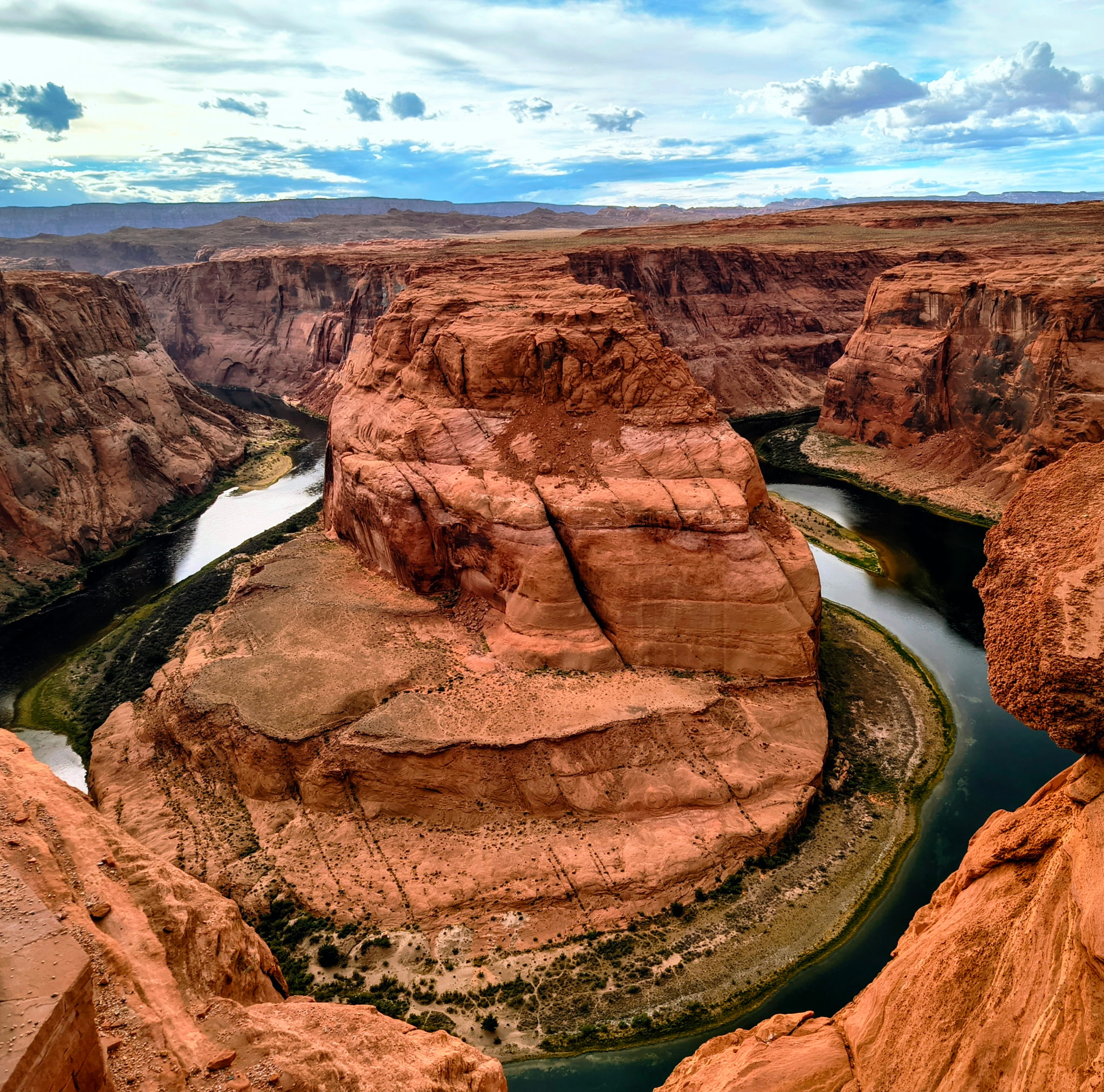
Around 4:15 p.m., we headed out for our second major attraction of the day: Horseshoe Bend. And what a sight it is.

Horseshoe Bend is an enormous, horseshoe-shaped curve in the Colorado River just south of Page. The river makes a sweeping 270-degree turn around a sandstone escarpment, creating a canyon approximately 1,000 feet deep. The bend developed as the Colorado River continued cutting downward through the uplifted sandstone of the Colorado Plateau.

The overlook has become one of the most recognizable views in the American Southwest. Photographs simply don’t do it justice.

You stand on the rim and look down at the Colorado River making its enormous turn below. The river looks almost impossibly small from that height, yet you know that this seemingly modest ribbon of water helped carve the landscape surrounding you.

Most visitors were respectful of the “rim,” and they maintained a safe distance from the edge. Certainly, any slip and fall would prove fatal. But a few folks were pushing the limits, letting their feet hang over the side, or posing dangerously close to cliffs. This elevates my anxiety to the point I can’t hang around and watch for long.

We spent about 40 minutes walking and taking in the view.

Forty minutes doesn’t sound like a long time, but at Horseshoe Bend, you don’t really need an itinerary. You just stand there and enjoy the scenic view.

Sunset Over the Desert

We started back toward our townhouse, grabbed a frozen yogurt for our “light snack,”  but decided we weren’t quite ready for the day to end.

So we stopped at the Scenic Overlook near our unit to watch the sunset. It turned out to be an excellent decision.

As the sun began to sink toward the horizon, the desert landscape changed before our eyes. The various colors in the rock formations seemed to come alive as the setting sun cast its final rays of daylight across the cliffs, mesas, and desert floor.

The colors became warmer. The shadows grew longer. The landscape seemed to glow.

It was a fitting conclusion to a day where we had already enjoyed so much of the beauty of the desert.

One of the blessings of traveling is discovering that no two days are quite alike. Today we saw an enormous dam built by human hands, a canyon sculpted by water, and a bend in a river created through millions of years of geological change.

We listened to a Navajo guide share his knowledge and perspective. We ate good food. We rested. We watched golf. We stood at the edge of one of the most spectacular vistas in the Southwest. And we ended the day watching the sun paint the desert.

Tomorrow will be a little less adventurous. We plan to wash a few clothes, reorganize our suitcases, and prepare for the remaining days of our trip. We also have a tee time at Lake Powell Golf Club.

Then, on Saturday, we’ll head toward one of the great highlights of our western journey: the Grand Canyon.

We’ve discovered that the hardest part of a trip like this isn’t finding things to see. It’s finding enough time to see them.

Stay tuned. The journey continues.

Marching to Zion, Then Onward to Kanab and Page

Wednesday September 23

There are some places you visit once and check off your list. Then there are places that you want to visit again. Zion National Park is one of those places for us.

David Muench said, “Zion National Park is a symphony of stone, a cacophony of color, and a ballet of light.”

Today we traveled from Hurricane, Utah, to Springdale, the gateway to Zion National Park. We were returning to a place we first visited with family about 25 years ago. Some things had changed considerably. Other things—the towering sandstone cliffs, the Virgin River, and the breathtaking beauty of the canyon—looked remarkably familiar.

Springdale: Gateway to Zion

Springdale is a small community tucked into the Virgin River Valley immediately outside Zion National Park. Its history is closely connected to the Mormon pioneer settlement of southern Utah. During the 1860s, several communities sprang up along the upper Virgin River, including Springdale. Pioneer families established farms and homesteads in the area, although flooding, drought, and difficult agricultural conditions made life challenging.

Today, Springdale has become a bustling gateway for visitors from around the world who come to experience Zion. Hotels, restaurants, shops, galleries, and tour companies line the road leading toward the park.

And today, we became part of that traffic!

Marching Into Zion

Zion is Utah’s oldest national park, having been established by Congress on November 19, 1919. Before becoming a national park, the area was designated Mukuntuweap National Monument in 1909 and later Zion National Monument in 1918. The name “Zion” comes from an ancient Hebrew word meaning “sanctuary” or “refuge.” It certainly seems like an appropriate name for a place where the walls of the canyon rise dramatically toward the sky.

Long before it became a national park, however, people lived in and around Zion Canyon. Indigenous peoples—including Ancestral Puebloan and Southern Paiute peoples—have called this region home for thousands of years. Mormon pioneers later established settlements in the area during the nineteenth century.

Today, millions of people come to Zion each year to marvel at the landscape. We were among them.

Taking the Shuttle

One of the biggest changes since our last visit is the shuttle system.

During the shuttle season, private vehicles are not permitted on the Zion Canyon Scenic Drive. The National Park Service began operating the shuttle system in 2000 to reduce traffic and parking problems and help preserve the canyon experience.

Our original plan was to park at the Zion Visitor Center and catch the canyon shuttle there. There was only one problem. The parking lot was full.

So we did what the National Park Service recommends: we parked in Springdale and took the town shuttle to the visitor center. From there, we transferred to the Zion Canyon shuttle and headed into the park.

The shuttles were full, and the trails were fairly congested. The weather, however, was beautiful, so it was a great day to be enjoying one of our nation’s premier national parks.

A Milestone and Highlight

A highlight for me getting my Lifetime National Parks Pass now that I’ve reached the age of eligibility for the senior pass.

There is something special about receiving that little pass. It represents more than admission to America’s national parks. It feels like a passport to some of the most beautiful places in our country—and a reminder that retirement has its privileges!

This little card is going to get plenty of use on this trip and beyond.

Our Favorite Stop: The Narrows

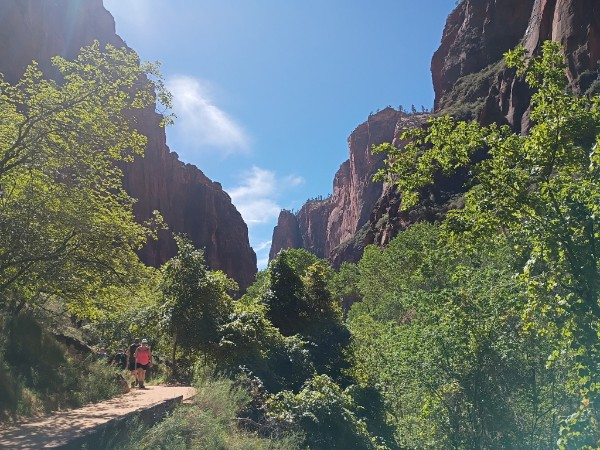
Our favorite stop in Zion is Stop #9—the Temple of Sinawava, at the end of the canyon.

From there, we took the Riverside Walk, a paved trail that follows the Virgin River into the narrowing canyon. The National Park Service lists the round-trip distance at 2.2 miles.

This time we walked all the way to the end of the paved walkway. And that brought back some wonderful memories.

The last time we were here, about 25 years ago, we came with family and continued farther into The Narrows. By “into,” I mean we actually walked up the Virgin River.

Or, perhaps I should say, we walked in the Virgin River!

The Narrows is one of those places where the landscape seems almost impossible. Massive sandstone walls rise on either side while the river winds its way through the canyon floor. At the end of the Riverside Walk, the paved trail gives way to the famous river hike.

We didn’t wade into the river this time, but we enjoyed remembering the adventure from years ago.

Sometimes returning to a familiar place is almost as enjoyable as discovering it for the first time because the landscape brings memories along with it.

Over the Mountain and Through the Tunnel

After returning to our car, we continued through the eastern side of the park.

We climbed the mountain switchbacks and traveled through the historic Zion-Mount Carmel Tunnel, which was part of a major highway project completed in 1930 to connect Zion with Bryce Canyon and other destinations to the east. The highway was an engineering achievement for its time, climbing through the rugged sandstone landscape and passing through the mountain itself.

The drive itself is an adventure. One minute you’re surrounded by the towering cliffs of Zion Canyon, and before long you’re climbing through a dramatically different landscape on the eastern side of the park.

That’s one of the things we love about this part of the country. Sometimes the best view is through the car window.. Sometimes the road itself is the attraction.

Dinner in Kanab

We continued on to Kanab, where we stopped for dinner at Houston’s. The meal was great, and the homemade rolls were especially good. Our server even brought us a bottle of honey to go with the rolls. That’s the kind of thoughtful touch that turns a good meal into a memorable one.

After dinner, we climbed back into the car and continued toward Page, Arizona.

Home for the Next Three Days

We arrived in Page and checked into our Airbnb townhouse, where we’ll be staying for the next three days.

Our accommodations have a great view of the surrounding mountain range and desert, along with a distant glimpse of Lake Powell.

After several days of moving from one hotel to another, it will be nice to unpack for a few days and establish a temporary home base.

And there is plenty to explore from here. Tomorrow we’re planning to visit Antelope Canyon and Horseshoe Bend. Two more iconic places. Two more chapters in our western adventure

Today, we enjoyed our journey between Zion’s towering cliffs and Page’s desert landscape. Tomorrow, another adventure awaits.

From the Desert Oasis to the Valley of Fire

Tuesday September 22

Our second full day out West took us from the bright lights of the Desert Oasis of Las Vegas to the spectacular red-rock formations of Valley of Fire State Park. It was a day filled with good food, beautiful scenery, fascinating history, and another reminder of just how diverse the American West can be.

Breakfast in Overton

We left our hotel this morning before breakfast, so we decided to find something along the way. We stopped in Overton, Nevada, at Salt’s, a popular local restaurant.

We ordered the Captain’s breakfast platter and decided to split it. That turned out to be a very good decision. The platter included two enormous pancakes, two scrambled eggs, and two large sausage patties. The pancakes may have been the fluffiest we have ever tasted. We both ate until we were full and there was still food left!

Through the Nevada Desert

After breakfast, we continued north on I-15.

Along the way, we passed the Las Vegas Motor Speedway and then the three exits for Mesquite. One of the things that continues to fascinate us about traveling through the Southwest is the way unexpected pockets of green appear in the middle of an otherwise rugged desert landscape.

The golf courses around Mesquite were beautifully manicured and plush green—almost like oases in the desert.

Then we turned our attention toward one of Nevada’s great natural treasures.

The Valley of Fire

Our destination was Valley of Fire State Park, Nevada’s first state park and one of the state’s most spectacular landscapes. The park encompasses more than 40,000 acres of brilliant red Aztec sandstone surrounded by gray and tan limestone. The sandstone formations were created millions of years ago, and the landscape contains evidence of human habitation going back thousands of years.

The name “Valley of Fire” seems entirely appropriate.

The brilliant red, orange, and pink sandstone formations almost seem to glow when the sunlight strikes them.

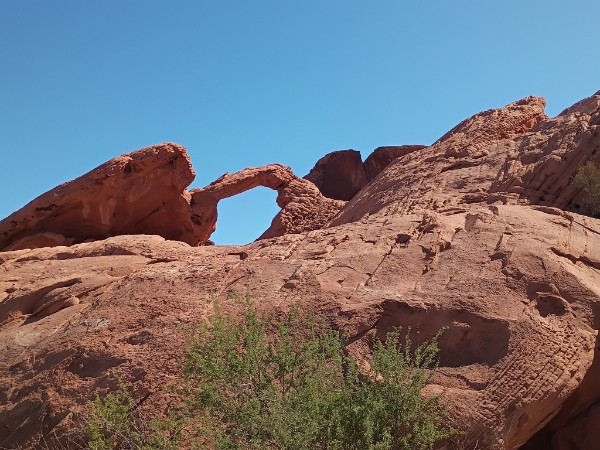
We enjoyed seeing several of the park’s most recognizable landmarks, including the Beehives, Arch Rock, Elephant Rock, and Atlatl Rock.

The Beehives are fascinating examples of geological cross-bedding. Arch Rock is exactly what its name suggests—a natural sandstone arch that can be viewed from the road. Elephant Rock looks remarkably like an elephant, and Atlatl Rock is especially interesting because of its ancient petroglyphs.

We also saw several other interesting features, including the Seven Sisters, Petrified Logs, and the Fire Canyon/Silica Dome area. The park also includes such attractions as Mouse’s Tank, Rainbow Vista, White Domes, Balancing Rock, and the Fire Wave/Seven Wonders area.

One of the highlights was the new Visitor Center, which opened in 2025. It is an impressive facility with exhibits focusing on the park’s geology, ecology, prehistory, history, and wildlife.

We could have spent much more time there.

The timing of our visit was also interesting. The park’s busiest season doesn’t really begin until October, and some of the trails were still subject to seasonal closures. Nevada State Parks closes many trails from May 15 through September 30 because of the extreme summer heat.

Even with some areas unavailable, there was plenty to see.

And one of the lessons of travel is, you don’t have to see everything to appreciate those things you do see.

On to Hurricane

After leaving Valley of Fire, we continued north into Utah and eventually arrived in Hurricane, where we checked into the Wingate Hotel.

Hurricane makes a great base for exploring this part of southern Utah. From here, Zion National Park and several other spectacular attractions are within easy reach.

And that’s where we’re headed tomorrow.

A Burger and a Few Motorcyclists

After checking into the hotel, we enjoyed a late lunch/early dinner at Red Rooster, just a couple of blocks from our room.

As graduates of Jacksonville State University, we couldn’t resist the name!

We both ordered burgers, and they were absolutely delicious.

While we were there, we met a group of 16 motorcyclists who were traveling together to visit several of the national parks. They were from France and were making their way through the American West. They already been to the Grand Canyon and Bryce Canyon, and they were headed toward Vegas.

One of the things we enjoy most about traveling is the people we meet along the way.

Sometimes the most memorable encounters aren’t on the itinerary. They happen at a restaurant, in a hotel lobby, at a gas station, or beside a scenic overlook.

A trip is measured not only in miles traveled but also in adventures experienced, people encountered and stories shared.

Tomorrow: Zion

We headed to bed early tonight because tomorrow promises another big day. We’re going back to Zion National Park.

This will be our second visit to Zion, and we’re looking forward to seeing those magnificent cliffs and canyons again. There is something special about returning to a place you’ve visited before. We hope to refresh a few memories and make a few new ones.

As we continue this journey, we’re reminded again how fortunate we are to have the health, time, and opportunity to travel during our retirement years.

Every day brings another road, another view, another meal, another story, and another memory. And that’s one of the great gifts of travel.

As writer J.R.R. Tolkien famously observed, “Not all those who wander are lost.”

We’re not lost. We’re simply wandering out West.

And tomorrow, we’re wandering into Zion.

Stay tuned. The adventure continues!